It is entirely possible that next year’s state election will be decided by a group too young to vote – juvenile offenders under the age of 18 who, under new laws, will face adult time for adult crimes.
This year has been dominated by youth crime, home invasions, carjackings, bail laws and hundreds of arrests. Voters are angry and frightened. Victoria Police Chief Commissioner Mike Bush has promised change, and as early as next week, he will announce a massive structural shake-up designed to get more cops out on patrol to deter crime.
The problem is not the fault of the police, who have had no trouble catching the offenders. The government has been battling to find solutions – some smart and some stupid.
There have been the machete amnesty and a dump bins program worth $13 million that may have been handy for people doing a shed clear-out but was not of much interest to those who use machetes to attack gang opponents.
Banning the sale of machetes but not other bladed implements is a little like banning .38 pistols but allowing the sale of .22 rifles.
Introducing laws that include a maximum life penalty for home invasions is nuts. No one is getting life for an aggravated burglary.

Dr Ashley Gordon was killed in Doncaster in a confrontation following an aggravated burglary.Credit: Nine News
Earlier this month, a teenager who stabbed Melbourne doctor Ash Gordon to death after burgling his house was sentenced to 17 years’ jail with a minimum of 12 years.
That is for an aggravated burglary and murder.
The government has tightened bail laws but court delays remain. If kids are to have their cases heard at the County Court, rather than in the Children’s Court, the delays will be greater.
Some who have been charged have been kept in the Custody Centre for weeks rather than days. No natural light and cramped conditions have turned the place into a medieval circus.
No one has the stomach for real reform in the justice system and no one talks about why an open-and-shut case has to take more than 12 months to resolve. Lawyers like change about as much as vegans like cheeseburgers.
We are, however, supporters of the government’s initiative to introduce methods developed in Scotland, which once had the worst youth violence problem in Europe.

Karyn McCluskey has spent years turning around attitudes in youth gang crime in Scotland.
Premier Jacinta Allan announced the introduction of a Violence Reduction Unit to work with schools, hospitals and employers on rehabilitation methods developed in Scotland.
Social workers will be employed in schools because the Scotland experience is if a kid is expelled, they are likely to end up in a gang.
The use of reformed gang members to talk to at-risk kids is again directly out of the Scotland playbook.
In Glasgow, when a kid was stabbed, a former gang member, called a navigator, turned up to talk, showing there were ways to get out of the violent cycle.
The government would do well to talk to Anne Hooker, a Churchill Fellow who ran a youth division in Port Phillip Prison with outstanding results.
She gave young offenders a chance to change, and the skills to survive in the outside world.
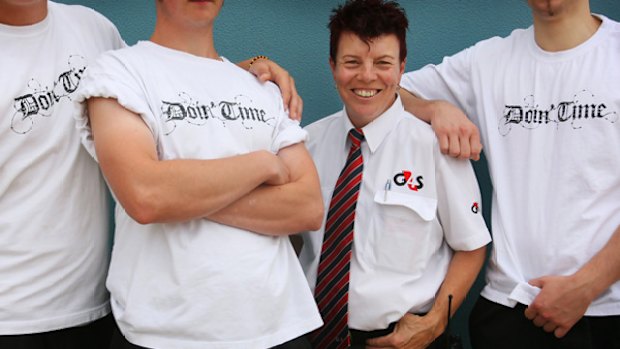
Anne Hooker, Youth Development Officer at Port Phillip Prison, with some of the inmates modelling T-shirts they print and sell.Credit: Rebecca Hallas
“We have to teach them the value of caring. If you don’t care, then you can do anything to anyone, and it doesn’t matter,” Hooker said. “These young men missed out on the basics. We had the conversations these kids never had.
“They have to learn there are consequences, both good and bad. Some of them have missed the very basic lessons of life.
“Inside jail, the consequences are immediate while outside they are not. It sounds basic but it works.”
And if there is an appetite to look at causes rather than just punish the outcome, those in authority should review an essay written by Jessie Clarey, Victoria’s fourth policewoman to graduate.
Recruited in 1928, she was restricted to office duties, but her mind was never desk-bound. What she saw over the next 10 years made her realise that just punishing juvenile offenders was a waste of time.
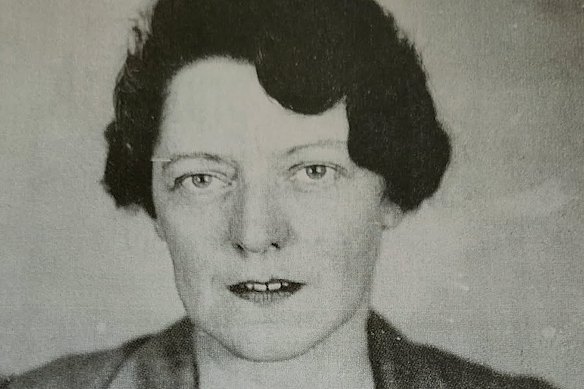
Jessie Clarey, Victoria’s fourth policewoman to graduate, promoted ideas on youth crime that were ahead of her time.
In 1939, she won the Empire-wide King’s Police Gold Medal essay competition for her paper on the causes and treatment of youth crime.
“For permanent results, it is not sufficient for us to ascertain, ‘Did the boy steal?’, but, ‘Why did he steal?’; not, ‘Is he a thief?’, but, ‘Why is he a thief?’
“Having answered that, the commonsense plan would be to remove the cause, not merely eliminate or suppress the outward act. Although this seems obvious, it is surprising how little it is understood or practised.
“Indeed, the more thought and investigation one gives to this subject, the more one is convinced that the causes behind juvenile crime can be likened unto a giant octopus, spreading its tentacles in all directions; and when the grip of one tentacle is released, the hapless victim is still enmeshed by the others.”
It is certain she would disapprove of the “adult crime, adult time” approach with young offenders and taking cases from the Children’s Court to the County Court.
Clarey wrote: “Until a little more than a century ago, it was not uncommon in England and America to hang a child for an offence.
“But with the acceptance of more enlightened ideas, there has come a greater realisation of the child’s inexperience and of his inability to exercise mature judgment. Legislation has been passed for the protection of the young, and separate tribunals have been constituted to study their needs.”
Hooker banned violent video games that she believes desensitised young offenders who committed violent crimes. Police say social media plays a part, with juvenile crooks posting and boasting, and gangs recruiting members after watching online videos of their street fights.
In Clarey’s time, there was no social media, but she raised movies as a trigger.
She wrote that the cinema (read today’s social media) could influence for good or evil, “by arousing desires for ‘easy money’; by fostering day-dreaming of criminal roles (the romantic activities of the criminal and his prestige as ringleader of a powerful ‘ring’ appeal to the boy); by displaying criminal technique”.
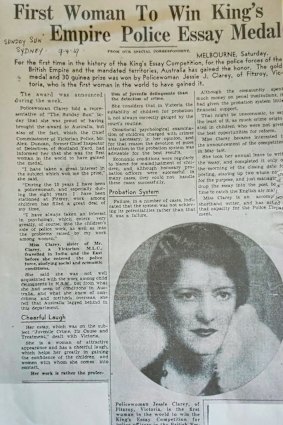
A 1939 newspaper report on Jessie Clarey’s King’s Empire award.
As in today’s social media, Clarey said cinema could prematurely sexualise the young.
“Passion pictures stir up sexual feelings which may be used as the preliminary of illicit relations later in the same evening. This aspect appeals to both sexes, whilst an added appeal to the girl lies in the fact that it teaches the technique of love-making, and at the same time, by arousing desires for clothes and appearance and a fast life, suggests methods of obtaining them by exploitation of her sex.”
It is telling how the views of Hooker, a Churchill Fellow, and Clarey, a King’s gold medallist, agree on matters of cause and treatment.
On gangs, Hooker says: “Many young offenders think, ‘I don’t care so why should I care about anyone else?’ They don’t belong and the only ones that matter are their peers, which is why they join a gang.”
Clarey writes: “Every investigator of juvenile misbehaviour knows that the most frequently tendered explanation of such conduct is ‘bad companionship’.
“In many cases, the boy’s contact with the group or gang marks the beginning of his career in delinquency. It is here he gains familiarity with delinquent practices and acquires the necessary technique.”
Both agree there is a powerful desire to belong, a sense that perhaps is not available in the family home.
“Comparatively little delinquency is engaged in without associates or gang connections. The language, the conduct, the ethical standards of these associates are quickly absorbed by the child. In many cases, the boy’s contact with the group or gang marks the beginning of his career in delinquency.”
Today, we see multiple reports of frustrated parents who want their children jailed before they kill or are killed. Police know early intervention is vital.
Clarey called for “the establishment of a fully staffed Psychological Clinic, working in conjunction with the Children’s Courts, and to which parents could voluntarily bring the behaviour problems of their children … It would examine and treat children who present serious behaviour problems; it could co-operate with teachers, social workers, and other community agencies”.
But what about the cases in which the parents have created an environment where their kids turn to crime?
“The Children’s Court should have greater jurisdiction over the responsible parents or guardians. In some instances, the Court may impose a fine, which must be met by the parents.”
Police and teachers say one of the problems is parents blame everyone but themselves. One senior cop says they deal with young adult males “who have never heard the word no”.
Again Clarey says: “A most important step conducive to the reduction of crime among juveniles lies in educating erring parents in parental responsibility of their children.
“The first step in the re-education of the parents is to make them realise that in some measure, they are responsible for the problem presented by the child.”
Clarey was ahead of her time but because of the wooden-headed attitudes of the time, policewomen were treated as second-tier cops.
Instead of dictating a program, she took dictation.
She died of a stroke in 1952, aged 51. Family member Frank Clarey says: “She loved her work and was dedicated to policing. The family believes overwork did her in.”
The best of Good Weekend delivered to your inbox every Saturday morning. Sign up here.
Most Viewed in National
Disclaimer : This story is auto aggregated by a computer programme and has not been created or edited by DOWNTHENEWS. Publisher: www.smh.com.au