
Toby Walsh
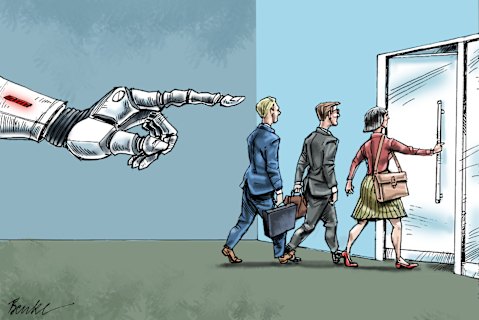
Ten years ago, when I told people what I did – artificial intelligence – they’d reply, “What?” Five years ago, they’d say, “Cool!” Now it’s simply: “Scary! Are we f—ed?” And then invariably they’d ask me what their kids should study to future-proof them from the arrival of the robots.
They have good reason to ask that question. This week, Atlassian, one of the darlings of Australia’s tech sector, announced it was laying off 10 per cent of its staff. That’s nearly 500 people here in Australia without a job, among the 1600 positions Atlassian is cutting globally. This follows on from another Australian unicorn, WiseTech, announcing job losses of 2000 employees, 30 per cent of its workforce.
For years, we’ve been offering young people terrible advice. If you want to be safe, go get a job in IT. It turns out that one of the first jobs that AI came after was computer programmer. Large language models like ChatGPT and Claude are terribly good at one particular type of language – programming language.
And I have more bad news. Software is the canary in the jobs coal mine. AI will, in the longer term, come after many other jobs. Customer support, human resources, legal work and consultancy are likely to be next in line. And the pain is going to fall disproportionately on those at the start of their careers. Experienced programmers who learn to use the AI tools will be kept to “vibe code” future software. They’ll tell AI tools in plain language what is required, and the AI will translate that into some complicated code in a jiffy. Veteran lawyers will proof AI-generated contracts. And HR managers will get AI agents and not junior staff to onboard new employees.
Of course, AI will also create many new jobs. But no economist, politician or futurist has any idea whether, as in the past, more jobs will be created than destroyed. This time might be different. What is certain is that we’re in for a rapid period of disruption, and that any new jobs will almost certainly require different skills to the jobs replaced.
In fact, this is the unique challenge that AI introduces. Other general purpose technologies have disrupted work before. The steam engine. Electricity. The internet. They all changed work dramatically. But none at such a speed as AI. We’ve never been able to put a general purpose technology in the hands of a billion people so quickly and so cheaply.
The good news is that, despite this rapid rate of change, we’re not f—ed. In the race against the machines, there are plenty of skills that humans have that machines lack. Machines don’t have our emotional and social intelligence. Nor our creativity and adaptability. And it’s not at all clear that they’ll ever match us in these areas. And even supposing they do, we’re likely to prefer humans in many roles needing these skills.
I want a human doctor to deliver (perhaps AI-generated) medical advice, a kind nurse to care for me in old age, and a friendly salesperson to sell me that tailored suit that was way more expensive than I intended.
But there’s a lot we need to do to minimise the pain of the AI transition. For example, we all need to be AI-literate. If the technology is magic, we’re not going to be active participants and we’re going to be taken advantage of by those who do understand it. And AI literacy needs to extend from kindergarten to retirement.
Shameless plug: I’m proud to have helped launch Day of AI here in Australia and for my university, UNSW, to be helping deliver AI literacy to thousands of schools across Australia. Day of AI is an initiative to give kids, especially under-represented groups such as girls and Indigenous students, a taste of AI. It’s free and is integrated into the national curriculum. This year’s program launched last week. If your kids’ school isn’t signed up, please get them to do so.
But it’s not just the young who need to ride the AI wave. In Finland, the government has run a national AI literacy program called “Elements of AI” that has given about 4 per cent of the working population a grounding in the basics of AI. Australia would profit from something similar.
Employers also need to step up. The Commonwealth Bank recently announced a $90 million initiative to help employees build skills, find new opportunities and prepare for the changing nature of work. AI learning has already been delivered to over 30,000 of its staff. Every other big employer needs to step up like this.
Finally, we need to build the AI future we want, not the one Silicon Valley wants to impose on us. This requires investment in people, data centres and data. Other nations have ambitious AI plans costing billions of dollars that they’re executing. It’s time that Australia put a few billion on the table.
Professor Toby Walsh is chief scientist at UNSW.ai, the university’s AI Institute. He is one of the world’s leading researchers in artificial intelligence, and a fellow of the Australian Academy of Science. He has advised governments, the UN and companies on the responsible development of AI. His latest book is The Shortest History of AI (2025).
From our partners
Disclaimer : This story is auto aggregated by a computer programme and has not been created or edited by DOWNTHENEWS. Publisher: www.smh.com.au






