Lee Freedman’s voice had a slight tremble when he spoke moments after Makybe Diva galloped into history at Flemington. Beneath baking sunshine and in front of 106,479 awestruck fans, his horse had done the impossible.
“Go out and find the smallest child here — because that child might be the only person who lives long enough to see something like this again. None of us ever will,” he declared on that first Tuesday in November 2005.
Three Melbourne Cups. Three years in a row. A feat so improbable few had dared to dream it.
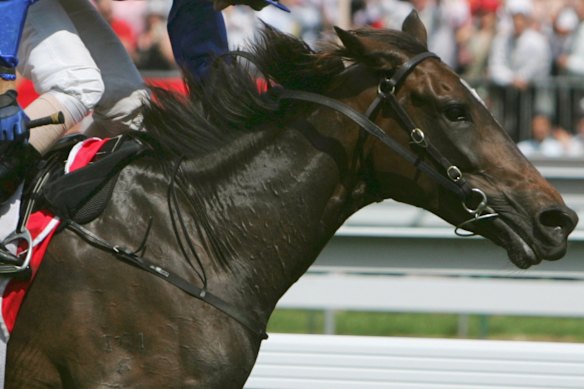
Makybe Diva wins the 2005 Melbourne CupCredit: Kristian Dowling
But Makybe Diva didn’t just win. She dominated. She toyed with the field, made a mockery of the topweight of 58 kilograms, and surged past her rivals like they were running in treacle. In doing so, she didn’t just etch her name into the record books – she left a hoofprint on the soul of a racing nation.
Now, two decades on, the great mare is gone. Makybe Diva died of a sudden colic attack at the age of 27 on Saturday, retired long ago from racing and from breeding, but never from the affection of those who watched her do what no horse had done before – nor likely will again.
Her trainer’s words that day now feel like prophecy. Because even as racing continues to produce great horses and stirring stories, few come close to Makybe Diva. She was more than a champion. She was a cultural force. A record 2.6 million tuned in on that Tuesday afternoon in 2005 to watch the race, then the biggest figure since the introduction of the people meter rating system.
She’d won with the ease of a Sunday stroll, 1¼ lengths clear of On A Jeune, with New Zealand’s Xcellent in third, and in doing so, lifted the weight of a nation while emptying bookmakers’ ledgers. Unusually, she’d win each of her Cup victories by exactly the same margin.
“This is Phar Lap the Second, I’m telling you that,” her jockey Glen Boss yelled on his victory lap. The mare, he said, was “bigger than the prime minister”.
But it didn’t feel like a comparison. It felt like a coronation. U2’s Bono, the frontman of what was at that time the world’s biggest band, listened in from abroad, and called Freedman to offer his congratulations.
Win a Melbourne Cup, and you’ll never forget it. Win two, and people will remember your horse’s name for years. Win three, and no one else will ever forget it.
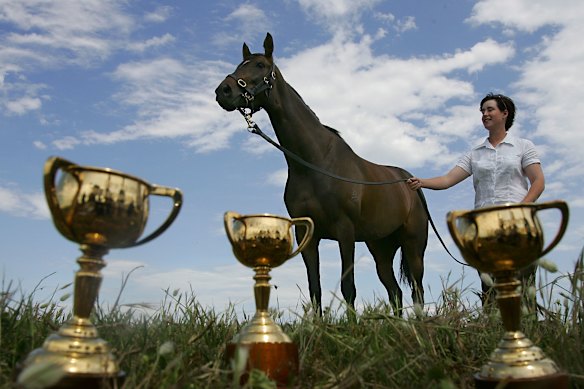
Makybe Diva with her Cups and strapper Christine Mitchell at trainer Lee Freedman’s Rye property in 2005.Credit: Sebastian Constanzo
One letter writer wrote to The Age that next day: “It is beautiful to think one mare has given Australians a licence to dream, to celebrate and to rejoice together in a time where terrorism, debt and uncertainty dominate the headlines.”
To appreciate what she became, it’s worth remembering where she began.
Bred in the United Kingdom, by Desert King out of Tugela, a foundation mare bought by tuna fisherman Tony Santic for his fledgling breeding operation, she was passed in at the Tattersalls sale as a nine-month-old. The reserve on the filly with the white star and white socks was 20,000 guineas and went through the sale ring virtually unnoticed.
“A couple of people bid for her, but she never reached her reserve,” John Foote, a bloodstock agent for Santic once recalled, adding he told Santic he could either leave her in the UK or put her on a plane to Australia.
“Tony decided to fly her out and race her himself. Wise decision,” he said.
The filly was loaded in the back of a cargo plane with crates of bananas and sent to Arrowfield Stud near Scone, NSW.
“It was a fairly arduous experience for a young horse. Maybe it was character building,” Foote said.
Santic was a mullet-topped, chain-smoking fisherman. A rags-to-riches son of Croatian migrants who dragged himself out of financial ruin by pioneering tuna farming. Thirty years earlier he’d ridden the wild seas of Tasmania in a leaky boat called Vigorous, fishing for orange roughy.
He gave his filly an odd-sounding name – an acronym of five of his Port Lincoln employees: Maureen, Kylie, Belinda, Diane and Vanessa. It was the first hint of a horse who would turn expectations upside down.
She made her race debut on July 5, 2002, in a modest fillies sprint at Benalla. She finished fourth. It was a muddy, forgettable winter’s day in the Victorian countryside, far removed from Flemington’s grandstands and cameras. But those who were watching closely saw something. A strong-finishing stayer in the making.
Her first trainer, David Hall, brought her along patiently. She would win for the first time at Wangaratta (over 1600m), then at Sandown. Then the Queen Elizabeth Stakes and the Werribee Cup.
Her first Melbourne Cup, the following year in 2003, was met with admiration, if not yet awe. Santic, ever confident, had placed $500,000 on her at the traditional call of the card.
She came from 13th at the 400-metre mark to win, proving herself as a serious stayer. Hall soon left for Hong Kong, and Lee Freedman took over.
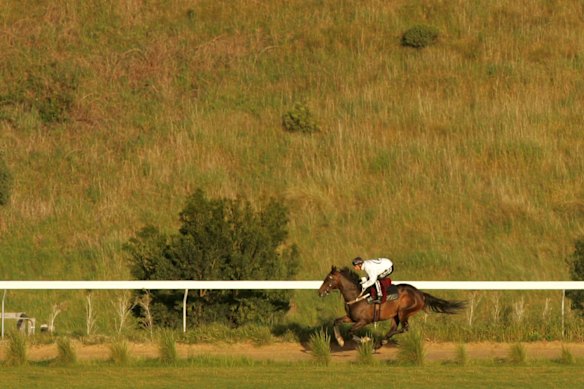
Makybe Diva and jockey Glen Boss at Lee Freedman’s Rye training property.Credit: Pat Scala
“Nobody can predict a horse is going to win three Melbourne Cups and, if I had stayed there, she may not have done that with me,” Hall would say 20 years later. “That’s just the way things went, but on the other side of the coin, if I didn’t take the job in Hong Kong when I did, the opportunity wouldn’t have come around again. I think, at the end of the day, I made the right decision.”
Under Freedman’s guidance, she moved from Flemington to his Mornington Peninsula complex. She didn’t just improve – she transformed.
The 2004 Cup was harder. She carried more weight and faced a deeper field, including champion Irish raider Vinnie Roe, but she still found a way up inside on a heavy track.
By the time 2005 arrived, her legend was building – but not yet settled.
It was the Cox Plate that finally silenced any doubters. Racing snobs sometimes dismissed stayers as one-dimensional, too slow for the sprint tactics of Moonee Valley. But on that day in October 2005, Makybe Diva shattered the narrative.
She sat midfield in the run, unhurried and calculating. On the turn, she swung wide, found clean air, and exploded. The amphitheatre erupted. Fans held aloft masks in her racing colours – red, blue and white with stars – and chanted “Diva!” like it was the name of an ancient warrior. She crossed the line with composure, almost casual in her domination.
And then she stood there, in the shadows of the grandstand, head raised, as if she knew. She always seemed to know.
Ten days later, she won her third Cup. And then, just minutes after returning to scale, came the moment that closed the book. “It’s over,” Santic said quietly to Freedman in the mounting yard. The horse who had given them everything would be asked for no more.
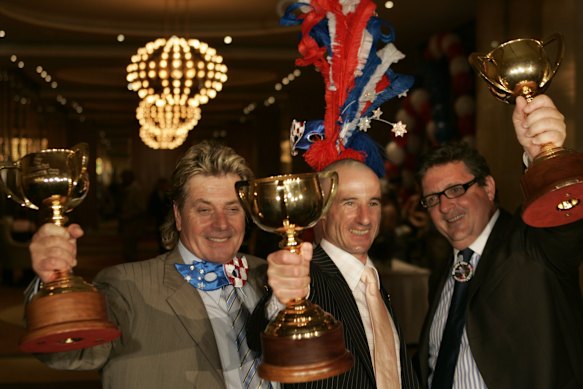
Makybe Diva’s owner Tony Santic (left), jockey Glenn Boss and trainer Lee Freedman celebrate a third Melbourne cup win.Credit: Michael Clayton-Jones
“To ask anything more of this wonderful mare would not be fair,” Santic told the crowd before calling for three cheers.
The farewell felt more like a state ceremony than a sporting goodbye. Les Carlyon, the track’s greatest scribe, would write that she had “brought more glory to the Cup than any winner since Carbine in 1860”.
Not every part of her story gleamed. Her overseas campaign in Japan ended in disappointment, including the only time she was beaten over 3200m, in the Emperor’s Cup at Kyoto. The travel, the surface, the unfamiliar rhythm of international racing all seemed to work against her. She laboured and finished well back. But her place in the Australian story would later be assured.
She retired with 15 wins from 36 starts – from 1400m to 3200m, more than $14 million in prize money, and a clutch of Group 1 titles: three Melbourne Cups, a Cox Plate, a Sydney Cup, a Tancred Stakes (with a famous last-to-first burst), an Australian Cup and a Turnbull Stakes among them.
Freedman would say that famous day: “I don’t want to run Phar Lap down, but I never saw Phar Lap win three Cups.” And that quote – initially offered with a grin – has aged into something more meaningful.
Because while Phar Lap remains enshrined in legend, Makybe Diva was ours in real time.
She galloped into lounge rooms, classrooms, and betting shops. She drew tears from punters who never backed her, and belief from children who didn’t know what she had overcome.
She lived out her post-racing years at Makybe Stud at Gnarwarre, just west of Geelong in Victoria’s south-west.
She was aloof, dignified, unmistakably proud. Those who cared for her said she never lost her presence – that same quiet awareness of who she was and what she had done.
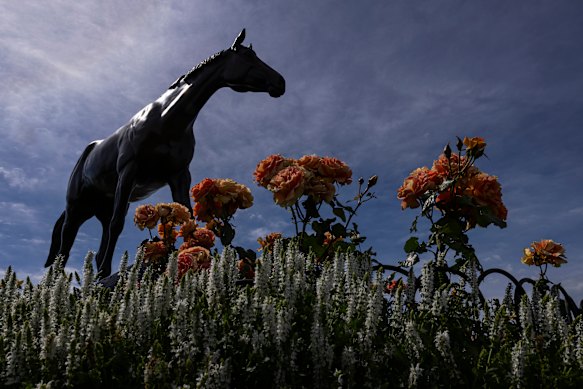
The Makybe Diva statue at Flemington Racecourse.Credit: Daniel Pockett
Her progeny never reached her heights. How could they? Greatness can’t be bred to order. It emerges, unexpectedly, from muddy maidens at Benalla and unfolds, improbably, into national legend.
Today, at Flemington, two warrior horses stand in bronze. One is Phar Lap, chest puffed, forever frozen in that pose which made him a Depression-era icon. The other is Makybe Diva. Mane flowing, gaze unbroken.
Two statues. Two giants. One remembered through history. The other remembered by a generation who watched and wept as she galloped past.
She didn’t just run – she soared. And those who saw her will never forget how it felt to watch her fly.
News, results and expert analysis from the weekend of sport sent every Monday. Sign up for our Sport newsletter.
Most Viewed in Sport
Disclaimer : This story is auto aggregated by a computer programme and has not been created or edited by DOWNTHENEWS. Publisher: www.smh.com.au