German government plans crack down on digital violence, finance minister calls Trump policies ‘misguided’ as inflation fears grow, rock icon gets his own ‘Panik‑Express’ at Hamburg Wunderland and more news on Thursday, March 26th.
Thursday’s top story: German government wants to crack down on digital violence and deepfakes
Triggered by the current debate on sexualised digital violence, new demands and proposals can be heard almost daily.
German leaders debated the issue in parliament on Wednesday. While any draft law could probably not be expected until the coming fall there are growing calls for a law targeting people who make and distribute nude images and AI-manipulated material, or deepfakes.
Additionally anyone who violates the privacy of another person by taking pictures could expect a fine or up to two years in prison if the proposals heard in the Bundestag on Wednesday were to be passed.
This all comes in the wake of a story, first reported by Der Spiegel, about actress Collien Fernandes who has brought charges against her ex-partner, actor Christian Ulmen, for distributing deepfake sexualised images of her online.
READ ALSO: Germany to crack down on sexualised deepfakes
Meanwhile, Chancellor Friedrich Merz didn’t miss his chance to make the issue somehow about immigration.
Asked about the government’s plans to combat digital violence, Merz said, “We have exploding violence in our society, both in the analogue and digital space… And then we also have to address the fact that a considerable part of this violence comes from the groups of immigrants to the Federal Republic of Germany.”
The comment, which reads as wildly off topic considering the issue at hand, was met by “indignant heckling from the plenary” according to a report by Der Spiegel, and feels reminiscent of the Chancellor’s previous ‘cityscape’ comments which were met with widespread condemnation.
OPINION: Merz’s divisive comments are a distraction from real problems in Germany
Germany’s largest union takes Tesla to court
Germany’s largest trade union said Wednesday it would take Tesla to court as it accused Elon Musk’s electric car maker of intimidating staff in elections for workforce representatives.
The works council, an elected body of employees that negotiates pay deals and working hours with management, has long been an unshakeable component of German corporate life, especially in the automobile sector.
The IG Metall union, Germany’s largest, earlier this month came second in works council elections at Tesla’s “Gigafactory” outside Berlin, behind the management-aligned “Giga United” list.
Speaking on Wednesday, IG Metall head Christiane Brenner said the union was going to court to have the results declared invalid.
Brenner alleged that management had restricted IG Metall’s ability to campaign and also told employees that voting for the union threatened both the future of the plant and their jobs.
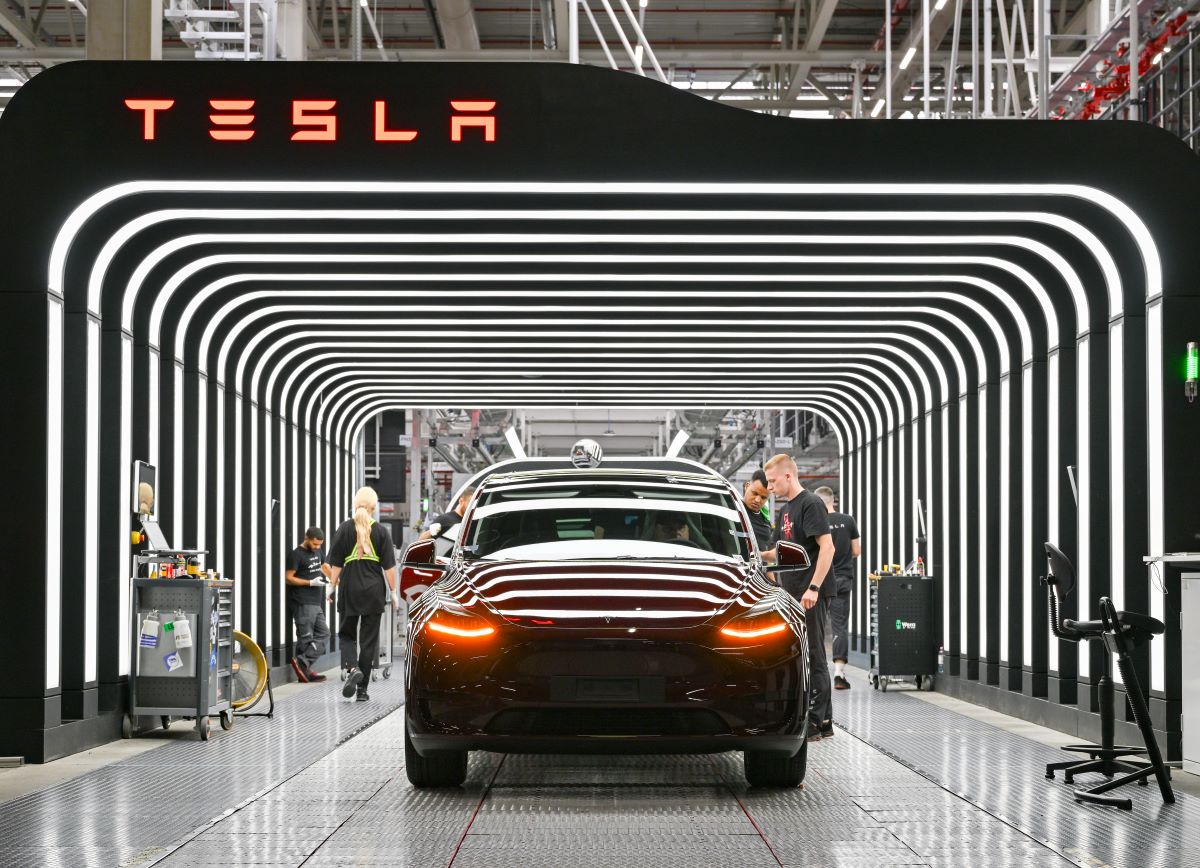
Workers perform the final inspection on a Tesla Model Y electric vehicle at the Tesla Gigafactory Berlin-Brandenburg. Photo: picture alliance/dpa | Patrick Pleul
READ ALSO: ‘Unacceptable’ – How Tesla is battling against German workers’ sick pay claims
“The impression that the election at Tesla was influenced by threats is too serious not to be clarified in court,” she said. “Democratic principles must apply to these important democratic elections in this country.”
Labour law expert and activist Ernesto Klengel told AFP this month that, while it was normal for parties to seek to influence works council elections, Tesla had taken an unusual and “highly confrontational approach”.
Tesla has previously been accused of union busting tactics by workers and labour union groups in the US and in Sweden. Whereas labour union organisers suggest that giving blue-collar workers more say over their working conditions is key to building a more just and sustainable green transition.
Finance minister calls Trump policies ‘misguided’ as inflation fears grow
Germany has warned that the economic fallout from the war in Iran, combined with what it calls “misguided” policies by US President Donald Trump, is placing fresh strain on Europe’s largest economy.
Speaking in Berlin on Wednesday, Finance Minister and Vice Chancellor Lars Klingbeil (SPD) said Germany was facing a serious “geo‑economic shock”, driven above all by surging energy prices. He argued that US policy decisions were directly affecting household budgets in Germany, adding to uncertainty caused by the Middle East conflict.
Klingbeil also criticised companies he accused of exploiting the crisis, particularly in the energy sector, calling such behaviour “despicable” and “unpatriotic”.
The government suspects some firms of unfairly hiking fuel prices and has pledged tougher oversight. Measures under discussion include a windfall tax on crisis‑related profits and expanded tax relief for commuters.
Meanwhile, Carsten Brzeski, chief economist at ING Bank, is one of many analysts warning that a wave of inflation is already building.
“We’re already seeing it at the gas stations, and this will continue: transportation costs will rise, food prices will rise, and very likely heating and electricity costs as well next winter,” he said.
Merz says Ukraine no longer needs German Taurus missiles
German Chancellor Friedrich Merz said Wednesday there was no longer any need to send long-range Taurus missiles to help defend Ukraine against Russia’s invasion, a move long debated in Berlin.
Kyiv has long wanted the missiles but Berlin has resisted openly committing to this for fear it would worsen tensions with nuclear-armed Russia.
When in opposition, Merz himself had committed to sending the missiles, but he has backed away from this since taking office last May.
Answering questions from lawmakers on Wednesday, Merz said that his original remarks had been made “in a different context”, at a time when he “assumed that the Bundeswehr had a sufficient number of operational Taurus cruise missiles in its stocks that we could supply to Ukraine”.
Furthermore he said that Ukraine’s progress in domestic weapons development had rendered the debate over Taurus missiles moot.
“Today, Ukraine itself has long-range weapons in its depots, which it has built itself — partly with our help — and which are significantly more effective than the relatively small number of Taurus cruise missiles we could have delivered,” Merz said.
Udo Lindenberg gets his own ‘Panik‑Express’ at Hamburg model railway attraction
German rock icon Udo Lindenberg has been immortalised in miniature form with the launch of the “Panik‑Express” at Hamburg’s Miniatur Wunderland, one of the city’s most popular attractions.
The specially commissioned model train traces key moments from eight decades of the musician’s life across eight meticulously crafted carriages.
Each carriage captures a different chapter of Lindenberg’s career, from his childhood in Gronau in the 1950s to his early years as a drummer, his formative nights at Hamburg’s legendary Onkel Pö club, and his performances in the former East Germany.
More recent successes, including his chart‑topping hit Komet, are also represented.
One of the centrepieces is a striking depiction of German division and reunification. The train is split between East German Reichsbahn and West German Bundesbahn designs, with Lindenberg performing against a backdrop of the fallen Berlin Wall.
In a playful nod to his political symbolism, a miniature Erich Honecker appears strumming a guitar beneath the slogan “Guitars instead of guns”.
Wunderland founder Frederik Braun called the Panik‑Express the most elaborate train the team has ever built, praising Lindenberg’s lifelong role in bringing people together across borders, generations and cultures.
With reporting by AFP and Paul Krantz.
Disclaimer : This story is auto aggregated by a computer programme and has not been created or edited by DOWNTHENEWS. Publisher: thelocal.de