Updated ,first published
THEATRE
月を見る夜 Moongazing ★★★
La Mama Theatre, until February 22
La Mama springs back to life with the opener of its 2026 season, 月を見る夜 Moongazing –
a bilingual play written by Maki Morita modelled after the aesthetics of Noh theatre. A series of vignettes centred on Tsukiko (a suitably disaffected Anna Fujihara) chronicle the
alienation wrought by being hyperconnected yet lonely, oversaturated with information yet
suspended in a state of unknowing.
In the Japanese folktale, Ubasute-yama, a traveller ascends a mountain to see the full moon
and encounters the spirit of an old woman who was abandoned by her son. In Morita’s tale,
Tsukiko does the very same before she is visited by the spectral vision of Chie (a bewitching
Yumi Umiumare), an older ethereal figure who transcends time and space.
Tsukiko and Chie converse easily in an exchange of Japanese and English, the former
illuminated for audiences through surtitles. Tsukiko is halting in a mother tongue she
understands but isn’t fluent in, Chie incredibly expressive and emotive with the full range of
vocabulary afforded to her.
Between their meets, we see Tsukiko searching for kinship in all the wrong places. By
chatting daily to the artificially intelligent, cosmic sidekick that governs her life but can’t offer
her companionship. Through rote conversations with an absent father who only makes
contact once a year. By hooking up with a fling who waxes lyrical about his ex.
It’s in serendipitous encounters where Tsukiko is more successful, whether it’s with the
budding astronomer she meets in the park (a role performed by Sean Yuen Halley in the
exaggerated affect of Moss from The IT Crowd to many laughs) or the depressed customer
she solicits for market research (yet another turn from Halley), whose deep sorrow can’t help
but leak into their call.
In movements informed by Umiumare herself under the direction of Ari Angkasa, the
characters orbit one another in impeccably choreographed formations – languid and
dreamlike, deliberate and precise. Jack Whu’s elevated sound design, melding the elegance
of guzheng – a traditional Chinese plucked string instrument – with 1980s synth beats is an
extrapolation of the play’s central conceit, a through line between tradition and modernity.
Umiumare is a wonder to watch as she oscillates between jerky, horror-reminiscent spasms
and hypnotic dancing, and Fujihara is beautifully pliable and porous as the boundaries
between Tsukiko’s dreams and waking moments blur.
At times, the play gestures towards its well-trodden themes in heavy-handed ways, and
its formlessness is mirrored by a script that can occasionally sound stilted. But by parsing
the collective responsibility we have for one another, 月を見る夜 Moongazing imagines a
generative mode of meaning-making that transcends the silos we’ve unwittingly built
around ourselves.
Reviewed by Sonia Nair
MUSIC
Sophie Ellis-Bextor ★★★★
Forum Melbourne, February 6
Tonight, the Forum is sold out and completely crammed. The floor staff frantically try to clear people from the thoroughfares.
This is Sophie Ellis-Bextor’s first Australian headline show, and she seems genuinely excited that it’s in Melbourne. She loves our cafes, she tells us. We cheer proudly. “You were the first to successfully protest for an eight-hour day!” Cheers. “The Hoddle Grid is approximately eight degrees off magnetic north!” Less certain cheers.
She’s amusing herself, and me. Sophie Ellis-Bextor is best known for two or three hits 25 years ago, which was more than sufficient to make her name as a disco queen. Then, a couple of years ago, the film, Saltburn, used her 2001 song, Murder on the Dancefloor, in a key scene, and she got an “unexpected twirl around the globe”, as she puts it.
She’s put out eight albums and had a varied career, but it’s no surprise that many people are waiting to hear the obvious. “Murder on the Dancefloor!” someone behind me screams (more than once) between songs. Her set, then, is about delayed gratification.
Songs from her latest album, the cleverly titled Perimenopop, are sprinkled with collaborations and well-chosen covers, including Cher (Take Me Home) and Donna Summer (I Feel Love). Groovejet, her breakout single with Italian DJ Spiller, segues beautifully into her and Junior Caldera’s Can’t Fight This Feeling and then ABBA’s Gimme! Gimme! Gimme!
The new material is pretty good (Layers, Glamorous), but to the crowd, it’s immaterial. Between songs, when the lights go up, the crowd cheers and stomps in anticipation until finally, it comes. And it’s worth it.
Even after Murder on the Dancefloor, there’s an encore of the elegant disco track, Bittersweet, and a surprising a cappella, Don’t Know What You’ve Got ’Til It’s Gone, performed un-mic’d from somewhere in the middle of the crowd. It’s a strange gambit to hush the Friday night crowd to silence after riling them up like that, but it’s an effective power move.
Reviewed by Will Cox
MUSIC
Rachmaninoff’s Rhapsody ★★★★
Australian Chamber Orchestra, Melbourne Recital Centre, until February 9
Now that the Australian Chamber Orchestra’s 50th anniversary celebrations are over, it continues to forge ahead with bold programming that challenges, comforts and intrigues. Witness this year’s season opener.
Challenge came in John Luther Adams’ Horizon, receiving its world premiere performances on this tour. Adams now calls Australia home and the work partly composed here explores the notion of horizons, real or perceived.
Beginning with the double bass’s low rumblings the work constructs layers of sound; long notes, reiterated pitches and oscillating patterns contributing to a soundscape that builds and recedes. The audience was not enlightened as to why the orchestra was arranged in an unusual formation, with a lead quartet in front. Furthermore, its lukewarm reception would suggest the work requires further listening and elucidation.
Intrigue was provided by two masterly yet rarely heard morsels for chamber orchestra: Stravinsky’s Concerto in D “Basle” and Lithuanian composer Raminta Šerkšnytė’s De Profundis. These are exactly the sort of works in which the ACO shines.
The 1946 “concerto” is really a concerto for orchestra, requiring razor-sharp reflexes and considerable artistic flair to make sense of its somewhat edgy neoclassicism echoing Britten and Tchaikovsky. Brimming over with contrasting ideas, the De Profundis (receiving its Australian premieres) mines the vast possibilities of string writing, eliciting from the ACO finely calibrated timbres and taut ensemble.
Comfort finally arrived with Rachmaninoff’s crowd-pleasing Rhapsody on a Theme of Paganini, Op. 43 arranged for piano, percussion and strings by Bernard Rofe with soloist, Croatian pianist Dejan Lazić. Without the heft of a full orchestra, pianistic sparkle came to the fore; Lazić thoroughly enjoying every moment in the limelight, balancing pyrotechnics with poetry, while the orchestra soared and swooned in the famous 18th variation.
Such fine playing and intrepid repertoire provided a stellar start to the ACO’s second half-century.
Reviewed by Tony Way
MUSIC
MIDSUMMA | Homophonic! ★★★★
Theatre Works, February 6
Promising “classical music … but gayer”, Midsumma’s annual tribute to art music was both a colourful celebration of diversity and difference, and a thoughtful exploration of our common human condition.
Recollection in the face of loss provided a sombre yet tender point of departure.
American composer Eve Beglarian’s memorial piece, Inundated by Night, effectively merges a string quartet, double bass and percussion into taped sounds of Utah’s wilderness where they gain prominence before receding into nocturnal shadows.
Sydney composer and former recording executive Lyle Chan became an HIV/AIDS activist at the height of that pandemic and was involved in the clandestine importation of lifesaving medication. Using a carrier’s code name, Dextran Man 1, 2, & 3, from the larger AIDS Memoir Quartet reveals Chan as an assured and evocative chronicler in the string quartet medium.
Humour shines through I aint reading all that, Connor D’Netto’s orderly response for voices and instruments to a long, messy but at times hilarious poem by Alex Creece.
Winner of The Homophonic! Pride Prize, Shakey by Samuel Carrick for double bass and tape, summons up a gay bar in Brisbane, glittering disco ball included.
After some specific affirmations of sexuality, came To the Hands by Pulitzer Award winner Caroline Shaw, a broader appeal for human compassion. A reinterpretation of baroque composer Dieterich Buxtehude’s cantata on Jesus’ hands, Shaw pleads for the displaced people of the world, in music movingly realised by the singers of the Consort of Melbourne under Steven Hodgson and instrumentalists including Homophonic! artistic director Miranda Hill.
These clouds soon lifted and the rainbow returned with a feel-good arrangement by Kym Dillon of Freddie Mercury’s Somebody to Love including a comic episode in Viennese waltz style. Underlining the search for love was the perfect way to wrap up this eclectic but well-performed program.
Reviewed by Tony Way
THEATRE
MIDSUMMA | Afterglow ★★★★
Chapel Off Chapel, until February 21
Gay sex has a pop-cultural currency that would have been unimaginable a decade ago. Think of all those comments about Heated Rivalry clogging up your feed. It can’t be only gay and bisexual men who were aroused by raunchy encounters between closeted hockey players in the show, or it wouldn’t have been such a huge phenomenon. In fact, women consume almost half of all gay male porn on Porn Hub, and as we enter an age of increasing heteropessimism, it seems homoeroticism has become flavour of the month.
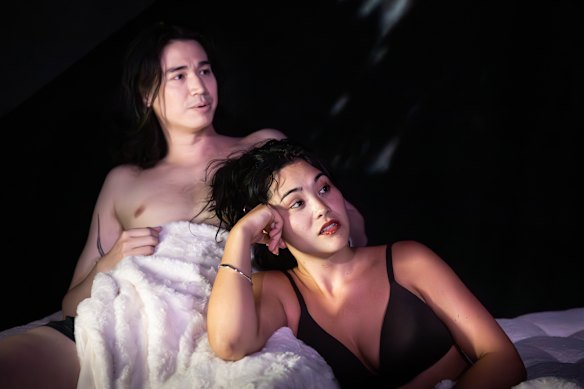
That’s good news for S. Asher Gelman’s Afterglow. The play bears the tagline “the climax is just the beginning”, and true to its word, starts in flagrante, with a gay male threesome nuzzling and pashing each other, post-coitally entwined.
If you’re jonesing for a Heated Rivalry fix in the flesh, look no further. The show comes fully stocked in the eye candy department, with liberal displays of full-frontal male nudity (the most I have seen on stage since Puppetry of the Penis).
All three actors are intimidatingly hot and ripped. Gym-toned physiques. Washboard abs. Bubble butts. And the characters are unabashedly sexual, with tastefully choreographed erotica underpinning Gelman’s relationship drama.
Scientist Alex (Julian Curtis) and his theatre director husband, Josh (Matthew Mitcham – yes, the Olympic gold medallist), are a Manhattan gay couple in an open marriage.
They seem to have it all. They’re handsome, successful and loaded – and they have a commitment to starting a family together, expecting their first child via surrogacy in a few months.
Their equilibrium is fractured when Josh desires something more than a casual fling with their latest playmate, Darius (Matthew Predny), a younger massage therapist.
Alex consents to his partner’s new “friend with benefits” arrangement, with a veto if it starts to make him feel threatened or uncomfortable. Josh fails to inform his husband of a crucial detail, while seeking to avoid confronting marital difficulties or disappointments in his newfound passion for Darius. Darius genuinely falls for Josh and is torn between desire for what he cannot have and appal that the love triangle he’s entered is causing unintended distress.
The set is modular genius that’d put IKEA designers to shame (and allows for steamy shower scenes). And the performances are strong and likeable, lending a charismatic gloss to the unfolding melodrama, even if the underlying emotional dynamics aren’t always fully and precisely articulated.
As an examination of modern polyamory, the play is a touch predictable and superficial for my taste. Yet, it does have the advantage of being broadly relatable – whether you’re gay or straight or something in between – and remains non-judgmental about the various forms contemporary relationships may take.
If there’s a message, it’s that you can get hurt no matter what kind of romance your heart leads you to pursue. You’ll be forgiven if you get distracted from it, though, by the sensuality of the sex scenes and the way Afterglow plugs so directly into the homoerotic zeitgeist.
Reviewed by Cameron Woodhead
DANCE
Songs of the Bulbul ★★★
Playhouse, Arts Centre Melbourne, until February 7
The UK-based Aakash Odedra is a superb dancer. His emotional intensity and poetical abundance feel almost radical in the world of contemporary concert dance. He’s a proper phenomenon and still very much in the prime of his career.
For Songs of the Bulbul, he has teamed up with choreographer Rani Khanam to make an hour-long solo from the Sufi myth of the caged nightingale or bulbul. The more the bird suffers, goes the story, the more beautiful its song.
The result is a tour de force: a moody, mettled drama that slips between plain statement and lyric suggestion. It is yearning and inward but with plenty of athletic excitement in the combination of rapid Kathak footwork and the loosened spinning of the Sufi dervishes.
In the beginning, Odedra ranges freely across the stage, buoyant and smiling, skirts flaring into blurred halos, bare feet snapping lightly at the floor. Birdlike figurations, with quicksilver movements of head and hand, connect cleanly with happy leaps and turns.
The pathways of movement become narrower as the cage descends. The bird strains against captivity, projecting anguish: arms reach upward, palms open, sometimes pleading, sometimes offering. The light begins to dwindle and flicker as Odedra collapses, clutching at the red confetti that swirls around him.
The soundtrack, by composer Rushil Ranjan, is epic: thunderous percussion, tinkling music-box phrases, blanketing strings and soaring arias. Select UK performances reportedly featured a full live arrangement. One can only imagine the immersive force of such an event.
Here, pre-recorded, the intensity is still formidable. Indeed, sometimes, with the strings building and building and building, it all becomes too much, too busy, too alarming.
At the show’s climax the bird has its eyes removed. This moment is staged with clarity and admirable restraint. It’s the quietest passage, wisely, and therefore the most concentrated. The tragedy lands with the barest ornament, its awful resonance unimpeded.
Coming down from that is hard. The closing scenes, for me, fall into something a little too gimmicky: standing before a bank of electric candles, Odedra gestures here and there, lighting the lights and dousing them as if by the magic of the suffering he has just passed through.
Still, in Melbourne right now there are few chances to see an international touring dance artist at all, let alone one of this calibre, moving across traditions with such total imaginative surrender and generosity of feeling.
Reviewed by Andrew Fuhrmann
The Booklist is a weekly newsletter for book lovers from Jason Steger. Get it delivered every Friday.
 Sonia Nair is a contributor to The Age and Good Food.
 Will Cox writes fiction and arts criticism. He’s based in Merri-bek.
From our partners
Disclaimer : This story is auto aggregated by a computer programme and has not been created or edited by DOWNTHENEWS. Publisher: www.smh.com.au