

Avalanches from heavy snowfall in the European Alps claimed more lives over the weekend, as a train was derailed by a snow slide in Switzerland on Monday and roads and villages around Mont Blanc were closed or placed under evacuation orders.
As large areas of the western Alps remained under a high risk of avalanche – following a week in which alerts reached category 5, the highest level – Swiss police said a train derailment caused by an avalanche injured five people near the town of Goppenstein.
The incident in Switzerland followed a series of deadly avalanches in the Alps in recent days involving skiers.
On Friday two Britons were among three skiers killed in an avalanche while being accompanied by an instructor in Val d’Isère, in south-east France.
A French national, who was skiing alone, was also killed. The Albertville prosecutor, Benoît Bachelet, said the ski instructor, who avoided injury, tested negative after taking blood and drug tests. He added that another British person had sustained minor injuries.
In another incident on Sunday, an avalanche claimed the lives of two skiers on the Italian side of Mont Blanc.
The incident occurred about 11.00am in the Couloir Vesses, a popular off-piste route in Courmayeur, located in the upper Val Veny, near the border with France and Switzerland.
The incidents come on top of the record 13 off-piste skiers, climbers and hikers who died in the Italian mountains over a week ending 8 February, Alpine Rescue said last Monday, including 10 in avalanches triggered by an exceptionally unstable snowpack.
Fresh snowfall during recent storms and windswept snowcaps on weak internal layers have created especially risky conditions along the entire Alpine crescent bordering France, Switzerland and Austria, Alpine Rescue said.
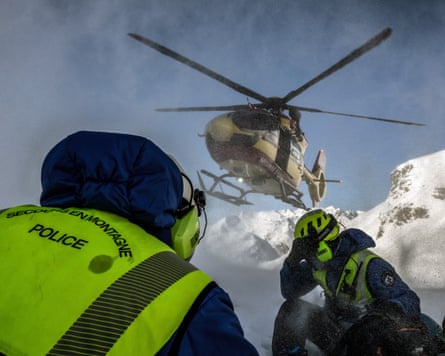
“Under such conditions, the passage of a single skier, or natural overloading from the weight of snow, can be sufficient to trigger an avalanche,’’ said Federico Catania, Italy’s Alpine Rescue Corps spokesman.
Under the European avalanche warning system, grade 5 risk conditions are categorised as “extraordinary” and rare, being issued for conditions where the possibility of “numerous very large and extremely large natural avalanches (ie not victim triggered) can be expected” and posing danger to valley roads and settlements.
In grade 5 conditions. skiers and mountaineers are cautioned to avoid all but open and unthreatened slopes.
The very high current risk levels in the mountains have been produced by a combination of factors including recent heavy falls of snow, combined with high winds which have deposited heavy and unconsolidated accumulations on an already unstable snowpack produced by lean snow conditions earlier in the season.
“We have had some very complicated, very unstable snow since the beginning of the season,” Luc Nicolino, slopes manager at the resort of La Plagne, told Agence France-Presse last week. “It’s a kind of mille-feuille with many hidden, fragile layers.”
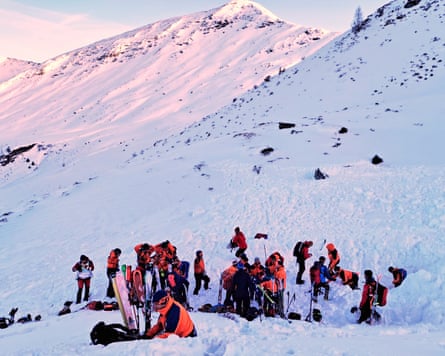
Conditions were already dangerous in the wake of Storm Nils, which passed through the Alps last week depositing between 60cm and 100cm of snow with a further 40-50cm predicted in some areas of the Alps during Monday.
Among those caught up in the avalanches in the French Alps on Friday was Daniel Matthews, whose profile describes him as an adventure skier, who was buried for eight minutes after a couloir he was skiing collapsed and buried him before being dug out by his companions.
“I don’t really know what I’m doing here but I have been getting asked so many questions about the avalanche on Friday and to be honest I don’t know how to answer them and maybe could help people not to make the mistake I made,” Matthews wrote on Instagram.
“I made a very bad decision and uneducated decision to ski Skimans [sic] Couloir just off the Palafour lift in Tignes.
“I dropped in and did one turn the whole couloir collapsed underneath me and I immediately tried to pull my [avalanche] airbag but as I was fell I fell forward making it impossible to reach my toggle, I was then quickly thrown into what felt like a washing machine and I just remember falling for about 35 seconds (about 400m) and then coming to a very quick stop.
“I hope I and other[s] may be able to learn some things. I didn’t follow the signs that day that were clearly there! and I paid for it. The only person to blame is myself,” he added.
Disclaimer : This story is auto aggregated by a computer programme and has not been created or edited by DOWNTHENEWS. Publisher: theguardian.com



