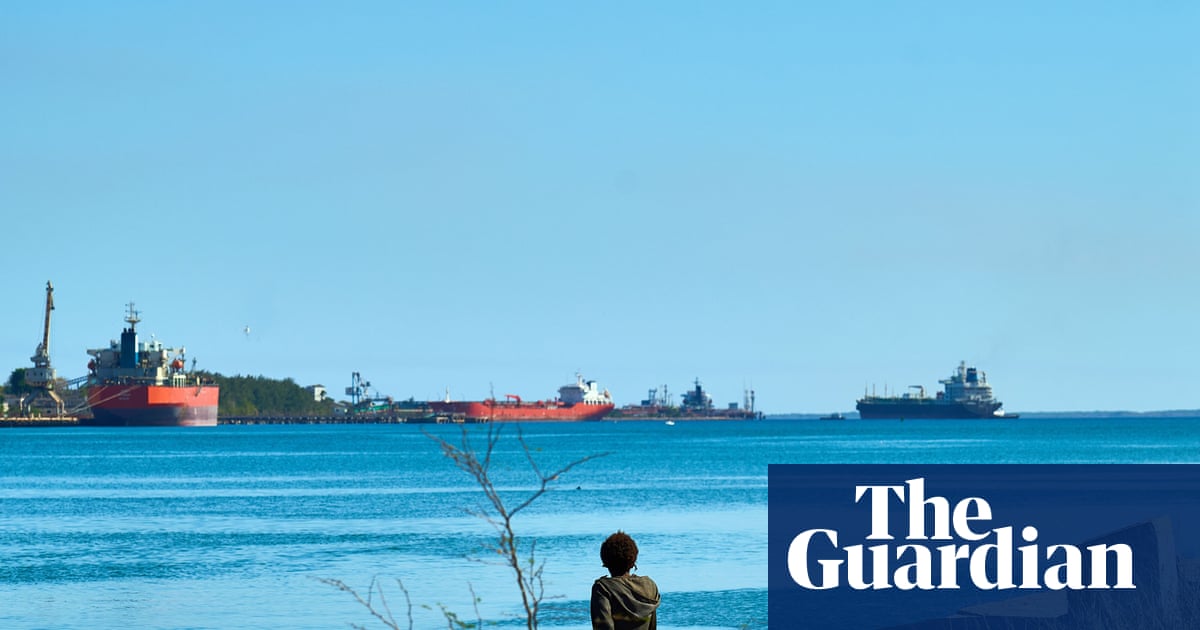
Donald Trump appears to have relaxed his blockade on fuel-starved Cuba after a Russian tanker reached the Caribbean island carrying 100,000 tonnes of crude.
Russia’s transport ministry said the Anatoly Kolodkin tanker arrived at the port of Matanzas on Cuba’s northern coast on Monday to deliver the crisis-hit country’s first such cargo in more than three months.
“Russia considers it its duty not to stand aside, but to provide the necessary assistance to our Cuban friends,” the Kremlin spokesperson, Dmitry Peskov, told reporters on Monday.
Peskov said “the issue” had been raised “with our American partners” in advance.
Speaking on Sunday, Trump, who has been trying to pressure Cuba’s communist regime by denying it access to fuel, indicated he had opted against blocking the arrival of the tanker, which left the Baltic port of Primorsk in early March. “If a country wants to send some oil into Cuba right now, I have no problem, whether it’s Russia or not,” the US president told reporters on Air Force One.
Cuba’s 10 million citizens have been repeatedly plunged into darkness in recent months as Trump has intensified his campaign against its leaders – first by blocking Venezuelan oil deliveries to the island after the abduction of its president Nicolás Maduro, then by discouraging others such as Mexico and Brazil from filling the gap.
Critics say the result has been a deepening humanitarian crisis on the already economically troubled island, which has forced schools and universities to shut, thrown the health care system into chaos and ravaged the tourism industry. Petrol shortages have left streets eerily quiet, with one ingenious mechanic reportedly modifying his Fiat engine so it can run on charcoal.
“We haven’t received a drop of fuel for nearly four months,” Cuba’s president, Miguel Díaz-Canel, complained in an interview last week with the Mexican newspaper La Jornada. He blamed Trump’s actions on US “anger” at the failure of decades-long “yearning … to seize control of Cuba” since the 1959 revolution.
Behind the scenes, negotiations between high-ranking US and Cuban officials have been taking place, with the Trump administration seemingly keen to identify a malleable successor to Díaz-Canel similar to Venezuela’s acting president, Delcy Rodríguez.
Rodríguez, who was vice-president under Maduro and took power after his rendition to the US, has overseen a major thaw in Washington-Caracas relations and ordered a series of major economic concessions. On Monday, the state department announced the US embassy was reopening in Caracas, seven years after it closed, and hailed the start of “a new chapter in our diplomatic presence in Venezuela”.
One of the people touted as a possible “Delcy-esque” figure in Cuba is Raúl Guillermo Rodríguez Castro, the millennial grandson of the 94-year-old former Communist party chief Raúl Castro. Another is Cuba’s deputy prime minister and foreign trade and investment minister, Oscar Pérez-Oliva Fraga, who recently announced that Cubans living abroad would be allowed to invest back home in an effort to create “a dynamic business environment”.
On Sunday, Trump denied Russia’s oil delivery would provide salvation for Cuba’s embattled leaders. “Cuba’s finished. They have a bad regime. They have very bad and corrupt leadership and whether or not they get a boat of oil, it’s not going to matter,” the US president said, adding that he favoured allowing the delivery “because the people need heat and cooling and all of the other things”.
Disclaimer : This story is auto aggregated by a computer programme and has not been created or edited by DOWNTHENEWS. Publisher: theguardian.com