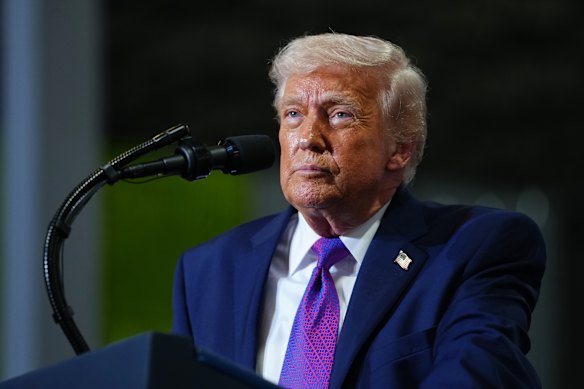
US President Donald Trump says the American military has bombed critical Iranian military sites on Kharg Island and will target energy infrastructure next if the Iranian regime continues to menace oil tankers passing through the Strait of Hormuz.
The island is Iran’s primary oil export hub and its economic lifeline. Variously described as Iran’s “crown jewel” and “Achilles heel”, oil terminals on the island handle around 90 per cent of Iran’s crude oil exports.
It had so far not been subject to US and Israeli assault, but Trump said in a social post that US Central Command had executed “one of the most powerful bombing raids in the History of the Middle East, and totally obliterated every MILITARY target” on Kharg.
“For reasons of decency, I have chosen NOT to wipe out the Oil infrastructure on the island,” he wrote on Truth Social.
“However, should Iran, or anyone else, do anything to interfere with the Free and Safe passage of Ships through the Strait of Hormuz, I will immediately reconsider this decision.”
It was not immediately clear which military targets were hit and Trump later told reporters the war would last for “as long as it’s necessary”.
“I mean, I have my own idea. But what good does it do [speculating]? It’ll be as long as it’s necessary,” he said before boarding Air Force One.
Iranian Parliament Speaker Mohammad Bagher Qalibaf warned on Thursday in a social media post that attacks on the islands on Iran’s southern maritime frontier would cause Iran to “abandon all restraint,” underscoring how central they are to the country’s economy and security.
On Saturday, Iran’s joint military command reiterated its threat that it will attack the US-linked oil and energy facilities in the region if the oil infrastructure of the Islamic Republic was hit.
The warning from Trump of further strikes on Kharg comes with more US military resources headed towards the region. An American official told The Associated Press that 2500 more Marines and an amphibious assault ship are being sent to the Middle East nearly two weeks into the war with the Islamic Republic.
Elements from the 31st Marine Expeditionary Unit and the amphibious assault ship USS Tripoli have been ordered to the Middle East, according to the US official, who spoke to The Associated Press on condition of anonymity to discuss sensitive military plans.
Marine Expeditionary Units can conduct amphibious landings, but they also specialise in bolstering security at embassies, evacuating civilians, and disaster relief. The deployment does not necessarily indicate that a ground operation is imminent or will take place. The new Marine deployment was first reported by The Wall Street Journal.
The 31st Marine Expeditionary Unit, as well as the Tripoli and other amphibious assault ships carrying the Marines, are based in Japan and have been in the Pacific Ocean for several days, according to images released by the military.
Earlier in the week, the US navy had 12 ships, including the aircraft carrier USS Abraham Lincoln and eight destroyers, operating in the Arabian Sea. Should the Tripoli join this flotilla, it would be the second-largest ship behind the Lincoln in the region.
Meanwhile, Iran has continued to launch widespread missile and drone attacks on Israel and neighbouring Gulf states, and has effectively closed the Strait of Hormuz, through which a fifth of the world’s traded oil passes.
A missile struck a helipad inside the US embassy compound in Baghdad, two Iraqi security officials said.
The sprawling embassy complex, one of the largest US diplomatic facilities in the world, has been repeatedly targeted by rockets and drones fired by Iran-aligned militias.
There was no immediate comment from the US embassy in Baghdad. On Friday (Iraq time), the embassy renewed its Level 4 security alert for Iraq, warning that Iran and Iran-aligned militia groups have previously carried out attacks against US citizens, interests and infrastructure, and “may continue to target them.”
Earlier in the Iranian capital, a large explosion rocked a central square where thousands of people gathered for an annual state-organised rally to support the Palestinians and call for Israel’s demise. There were no reports of casualties.
The explosion in Tehran rocked the Ferdowsi Square area midday, where thousands had gathered for an annual Quds Day rally, chanting “death to Israel” and “death to America.”
Israel had issued a warning on a Farsi-language X account for people to clear the area shortly before the blast. But few Iranians would have seen it, as authorities have almost completely shut down the internet. Footage showed people chanting “God is greatest,” as smoke rose in the area.
Israel earlier announced another wave of strikes in Iran targeting infrastructure, and said its air force had hit more than 200 targets in the last 24 hours, including missile launchers, defence systems and weapons production sites.
Israeli aircraft are also continuing their air offensive in Lebanon and have dropped leaflets onto the streets of Beirut in an attempt to shift public opinion against Hezbollah fighters who are firing rockets into Israel, but there is no sign of a peace deal that could halt the airstrikes that have forced more than 800,000 people out of their homes across Lebanon.
Israeli Prime Minister Benjamin Netanyahu is urging the government of Lebanon to disarm Hezbollah, and the leaflets spread this message to Lebanese citizens. “Lebanon is your decision, not someone else’s,” the leaflets said.
“Stability is not just a word – it is a right for every Lebanese.” The leaflets called Hezbollah “Iran’s shield” and said it should be disarmed.
In Washington, US Defense Secretary Pete Hegseth said that over 15,000 enemy targets have been struck — more than 1000 a day since the war began.
He also sought to address concerns about the bottling of the Strait of Hormuz, telling reporters: “We have been dealing with it and don’t need to worry about it.”
With David Crowe, AP and Reuters
Get a note directly from our foreign correspondents on what’s making headlines around the world. Sign up for our weekly What in the World newsletter.
From our partners
Disclaimer : This story is auto aggregated by a computer programme and has not been created or edited by DOWNTHENEWS. Publisher: www.smh.com.au