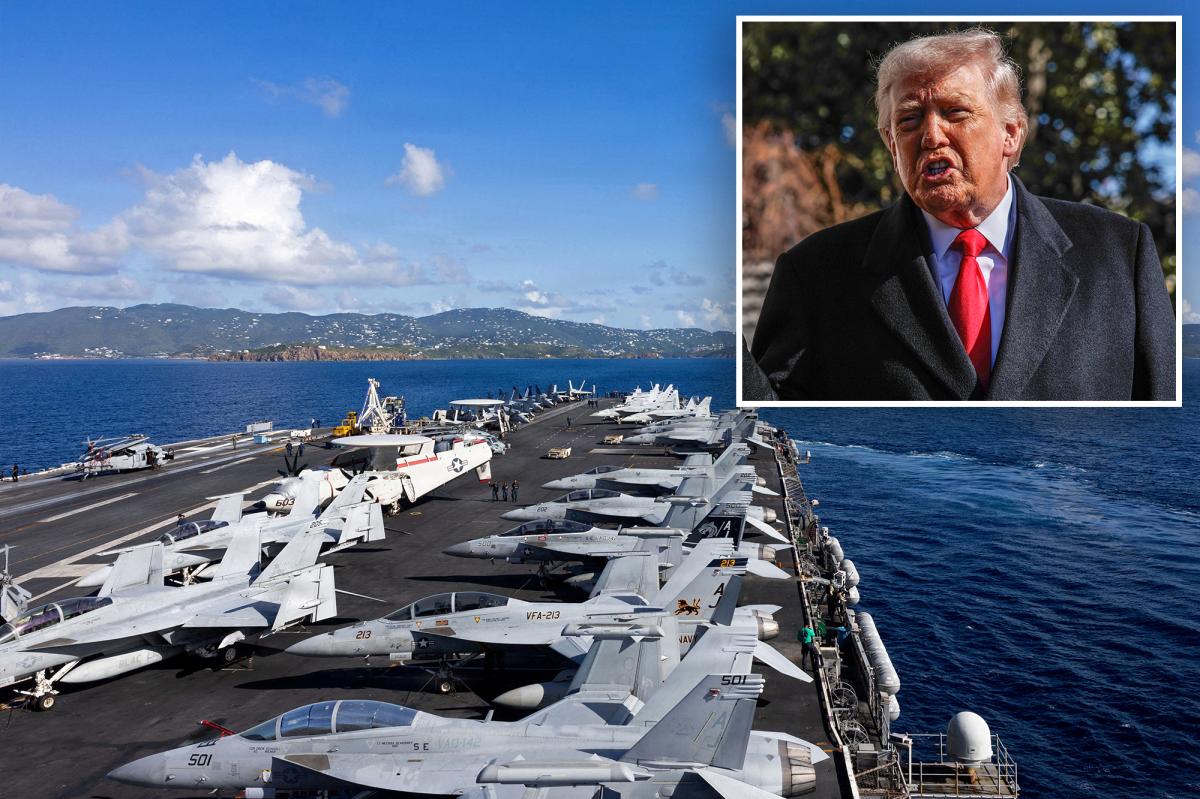
A massive US military buildup in the Middle East suggests the US could be ready to launch a “sustained” bombing campaign on Iran in weeks — or even days — should Tehran continue refusing President Donald Trump’s demands in ongoing negotiations.
With a second aircraft carrier en route to the region and a flood of hundreds of strike, support and other aircraft already nearby, the sheer scale of forces now positioned in the region alone is highly unusual — and unprecedented in recent decades, former Pentagon official and Atlantic Council fellow Alex Plitsas told The Post.
“What we have amassed is an unprecedented size combination of land-based attack aircraft, command and control and sea-based platforms,” he said. “We haven’t seen a buildup like this in this region in decades.”
While last year’s Operation Midnight Hammer took just 25 minutes to strike Iran’s nuclear facilities, a new campaign could last days to weeks, US officials told The Post.
The deployment — including carrier strike groups, land-based aircraft, refueling tankers and command-and-control assets — gives Trump the option to launch what Plitsas described as a sustained air and naval campaign without committing US ground troops.
“The military footprint tells us that that option is quite large,” he said. “This is sufficient firepower for a sustained and very large air and naval strike campaign.”
That much firepower would allow the US to launch a massive military campaign if Trump so chooses — with options ranging from targeted strikes on weapons facilities and mid-level officials to full-blown decapitation strikes that would eliminate the current radical Islamist Khamenei regime.
“The only thing that any of this tells us for sure is the range of options on the table and what’s in and what’s out,” Plitsas said.
The president could decide against military action entirely, but the time remaining for that may soon run out.
“Diplomacy is always his first option, and Iran would be very wise to make a deal with President Trump and with this administration,” White House Press Secretary Karoline Leavitt said Wednesday.
Timelines and targets
The buildup comes after Vice President JD Vance on Tuesday said Iran had failed to meet several of Trump’s negotiating “red lines” despite some progress in talks in Geneva that day.
“It was very clear that the president has set some red lines that the Iranians are not yet willing to actually acknowledge and work through,” Vance told Fox News host Martha MacCallum.
The bold statement in addition to the massive military buildup indicates Trump is dead-serious about getting what he demands, a source familiar with the White House’s discussions told The Post.
“The message to the Iranians is crystal clear: Come to the table, meet the red lines and get a deal done — or else,” the person said.
But Leavitt said the US and Iran are “still very far apart on some issues.”
“I believe the Iranians are expected to come back to us with some more detail in the next couple of weeks, and so the President will continue to watch us,” she said.
Two weeks is also the approximate timeline it will take for the aircraft carrier USS Gerald R. Ford to arrive in region, military experts have predicted.
The president previously gave Tehran a two-week notice to come to the table on nuclear talks in June 2025 — only to turn around and order the US to destroy Iranian nuclear sites before that timeline ran out.
“If you look at the timeline for them to respond the Vice President’s comments and the military buildup, what it tells us is that we are already at the potential for a massive campaign at any point if the president choose to order it,” a source familiar with White House discussions told The Post.
Leavitt said Trump is consulting “many people” to determine how to proceed — “his national security team first and foremost.”
“This is something obviously the President takes seriously,” she said. “He’s always thinking about what’s in the best interest of the United States of America, of our military, of the American people, and that’s how he makes decisions with respect to military action.”
If a decision is made to move forward with strikes, military planning experts say strikes must first prioritize Iran’s abilities to retaliate.
“What you need to do initially is take out the missiles, the launchers and the drones and drone factors, if you can, right away to prevent retaliatory strikes against US forces and the Israelis in the region,” Plitsas said.
After that, the US would have a range of options at its disposal, from targeting Iranian officials instrumental in January’s brutal crackdown on protesters despite Trump’s repeated warnings — all the way to potential decapitation strikes to take out Supreme Leader Ali Khamenei and his leadership.
With so many options on the table, there are more questions than answers.
“If it happens, it’s going to be weeks of sustained campaigns,” the source familiar with discussions told The Post. “Questions are who survives the opening strikes? If that happens, who’s in charge? You know, when do we stop?”
“Is just a [Venezuelan dictator Nicolas] Maduro-type thing where we do a quick, fast decapitation, take out the missiles, everything else, and negotiate with what’s left?” the person added.
US vs. Israel’s priorities
A key complication is that different players in the region have different priorities, Plitsas said.
For Washington, the main concern remains Iran’s nuclear program, including stockpiles of highly enriched uranium. For Israel, the urgent threat is Tehran’s growing ballistic missile arsenal, which Plitsas said is expanding by roughly 300 missiles per month and could soon exceed defensive interception capacity.
“At some point, you go from having sufficient missiles to serve as a deterrent to building a stockpile that’s sufficient for war,” he said. “When they cross that threshold … it’s going to invite an Israeli strike.”
Regional partners are also focused on Iranian-backed proxy groups, creating a three-front problem that a nuclear-only agreement would not solve.
“Even if the US strikes a great nuclear deal, if that does not extend into a deal over the ballistic missiles as well, that doesn’t mean the Israelis are going to be satisfied,” the US source familiar told The Post. “If it doesn’t include the proxy groups, other regional partners may not be satisfied either.”
The person further warned that limiting negotiations solely to nuclear issues could actually increase the likelihood of conflict — particularly if Iran continues expanding its missile arsenal.
“Their continued production of ballistic missiles is effectively serving as a countdown clock toward a potential strike,” the person said. “The smartest thing that they could do at this point is freeze ballistic missile production.”
What’s more, Plitsas warned Tehran may be misreading Trump’s willingness to use force.
“If there’s a question about his intentionality and somebody doesn’t think he’s going to do it, they are very sadly mistaken,” he said. “It will come down to whether the president believes that there is still room to negotiate. Or if at this point they’re wasting their time.”
Disclaimer : This story is auto aggregated by a computer programme and has not been created or edited by DOWNTHENEWS. Publisher: nypost.com