Donald Trump has urged Iranian leaders to negotiate an end to the near-month-long war or face further assassinations of senior officials amid intensified military action by the US and Israel.
The latest threat on Thursday came as Israel said it had had “blown up and eliminated” the Revolutionary Guards’ naval commander, Alireza Tangsiri, and several senior officers in a strike on the Iranian port of Bandar Abbas.
Heavy strikes by Israeli or US warplanes were also reported around Isfahan, home to a major Iranian airbase and other military sites, as well as one of the nuclear sites bombed by the US during the 12-day war in June.
Iran has strenuously denied it is “begging to make a deal”, as Trump claimed, and continued its retaliatory strikes across a swathe of the Middle East on Thursday.
Loud booms were reported in Tel Aviv, the central Israeli city of Modi’in and Jerusalem throughout the day as Israel’s air defences worked to bring down incoming missiles. In the Gulf, Iranian attacks were also intercepted.
Trump’s new threat was among a series of statements made by the US president in Washington and on social media on Thursday in which he again criticised Nato allies, described Iran as producing “great negotiators” but “lousy fighters”, and repeated his claim that the war he launched last month had already been won.
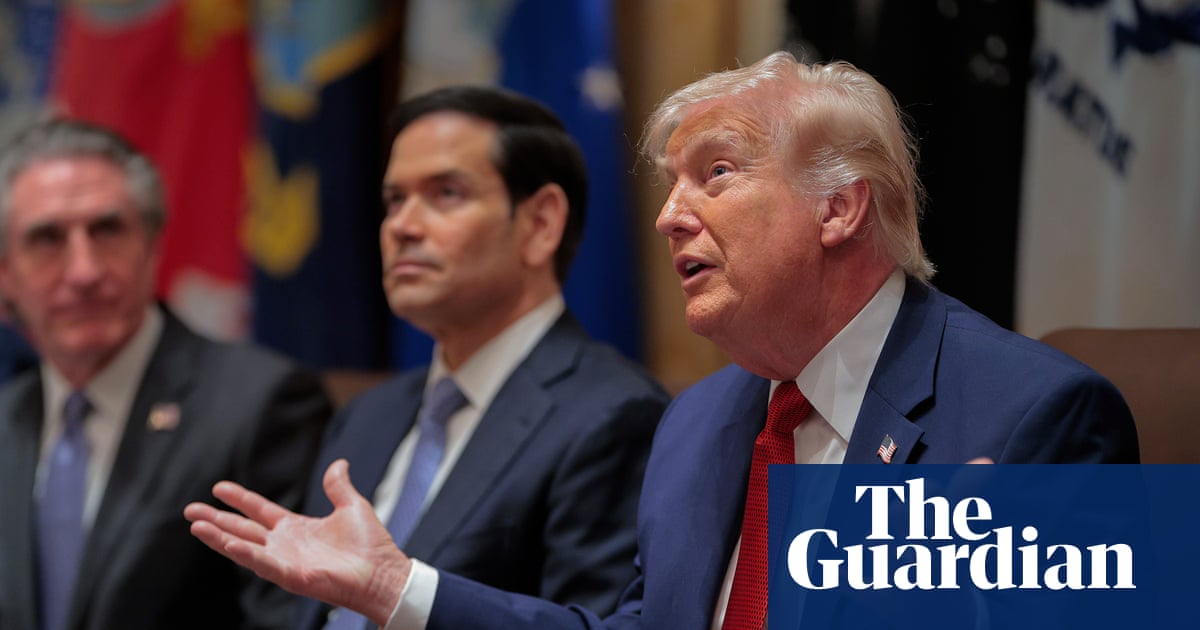
“They now have the chance, that is, to permanently abandon their nuclear ambitions and to join a new path forward,” Trump said during a cabinet meeting at the White House. “We’ll see if they want to do it. If they don’t, we’re their worst nightmare. In the meantime, we’ll just keep blowing them away.”
Later Trump added: “They want to make a deal. The reason they want to make a deal is they have just been beat to shit.”
He claimed Tehran had let 10 oil tankers transit the strait of Hormuz as a goodwill gesture in negotiations, including some Pakistan-flagged vessels.
Since the war began with an Israeli airstrike that killed Ayatollah Ali Khamenei, dozens of senior Iranian security and military officials have been killed by the US and Israel, as well as political leaders such as Ali Larijani, the veteran head of the national security council. The new supreme leader, Mojtaba Khamenei, is thought to have been injured, possibly severely, in the attack that killed his father.
Adm Brad Cooper, head of US Central Command, said Thursday’s killing of Tangsiri put Iran’s navy on a path toward “irreversible decline” and said the US would keep striking naval targets. Israel’s defence minister, Israel Katz, said Tangsiri had been “directly responsible for the terror operation of mining and blocking the strait of Hormuz to maritime traffic”.
Iran in effect closed the strait, a critical waterway through which a fifth of the world’s oil and gas passes, to almost all shipping in the first days of the conflict. The blockade sent oil prices soaring, hit global stock markets and threatens a global economic crisis.
Though the US claims to have destroyed most of Iran’s naval capabilities, Tehran has both smaller boats capable of laying mines and anti-ship cruise missiles that can be launched from ashore. Either weapon could render the strait impassable to shipping.
On Sunday, Trump threated Iran with a massive escalation of the US-Israeli offensive if it did not reopen the strait within 48 hours. Iran retaliated with a threat to launch broad attacks on energy infrastructure in the Gulf and Israel. Trump then extended his ultimatum until Friday or Saturday.
Iran’s foreign minister, Abbas Araghchi, accused the US of “double standards” and said international law was “not a tool of convenience”.
He wrote on X: “The US backed Israel’s Gaza blockade … yet condemns Iran for defending itself in the strait of Hormuz. Double standard: Israel’s crimes are OK while Iran’s defence against aggressors is condemned.”
Israel reportedly removed Araghchi and Mohammad Bagher Ghalibaf, a regime veteran who is the speaker of Iran’s parliament, from its hitlist after Pakistan, which is emerging as a key mediator in the conflict, asked Washington to ensure they were not harmed, a Pakistani official said. Ghalibaf is reportedly the “top man” with whom Trump said on Monday he has been indirectly negotiating on terms for ending the conflict.
Trump said on Thursday he was seeking an agreement that opened the strait of Hormuz and shut down Tehran’s military and nuclear ambitions but suggested that a deal might not ultimately come together. “I don’t know if we’ll be able to do that,” he said of the prospects for a deal. “I don’t know if we’re willing to do that.”
On Thursday, Steve Witkoff, Trump’s envoy to the Middle East, said the US had presented a 15-point “action list” to Iran via Pakistan as a framework for a possible peace deal.
Speaking at a cabinet meeting in Washington, Witkoff said there were “strong signs” that Tehran was ready to negotiate an end to the fighting He said: “If a deal happens, it will be great for the country of Iran, the entire region and the world at large.”
A senior Iranian official told Reuters on Thursday that Washington’s proposal for ending nearly four weeks of fighting was “one-sided and unfair” but that diplomacy continued.
Iran’s Tasnim news agency, citing an unnamed official, said Iran’s demands included an end to US and Israeli attacks on Iran but also on Tehran-backed groups elsewhere in the region – an implicit reference to Lebanon’s Hezbollah, among others. War reparations should be paid, it said, and Iran’s “sovereignty” over the strait of Hormuz be respected.
Analysts said it was very difficult to see any immediate pathway to an agreement given the gap between the two sides and the continuing widening of the conflict, which has directly involved more than a dozen countries from Azerbaijan to Oman.
Thousands of US marines and airborne troops have been sent to the region and could be used to seize Kharg Island, Iran’s principal hub for oil exports, or other strategic points in the Gulf. Such a move would mark a significant escalation in the conflict.
Ali Bahreini, Iran’s top envoy to UN institutions in Geneva warned Thursday that any US and Israeli attempt to mount a ground invasion of Iran would be a “big” mistake.
The death toll from the war has risen to more than 1,900 people in Iran, according to authorities, and nearly 1,100 people in Lebanon, where more than a million have been displaced. Israeli strikes in Lebanon have killed another 22 people and wounded 110 in the past 24 hours, Lebanese officials said.
Israel says its invasion of southern Lebanon is aimed at protecting its northern border towns from attacks by Hezbollah, the Iran-backed militant Islamist movement, and establishing a defensive buffer zone. Eighteen people have been killed in Israel in the new conflict.
There are fears that if Trump follows through on threats to deploy troops to seize Kharg Island or elsewhere, Tehran may ask the Yemen-based Houthis, who have close ties with Iran, to strike shipping in the Red Sea, through which about $1tn (£750bn) worth of goods passed each year before the war.
Abdul-Malik al-Houthi, the Houthis’ leader, reiterated the group’s condemnation of the US-Israel war with Iran on Friday, describing it as “unjustifiable”. He called for solidarity protests in Sana’a, Yemen’s capital.
Al-Houthi did not say whether the armed rebel group would fight alongside Iran if asked to join the conflict.
Disclaimer : This story is auto aggregated by a computer programme and has not been created or edited by DOWNTHENEWS. Publisher: theguardian.com