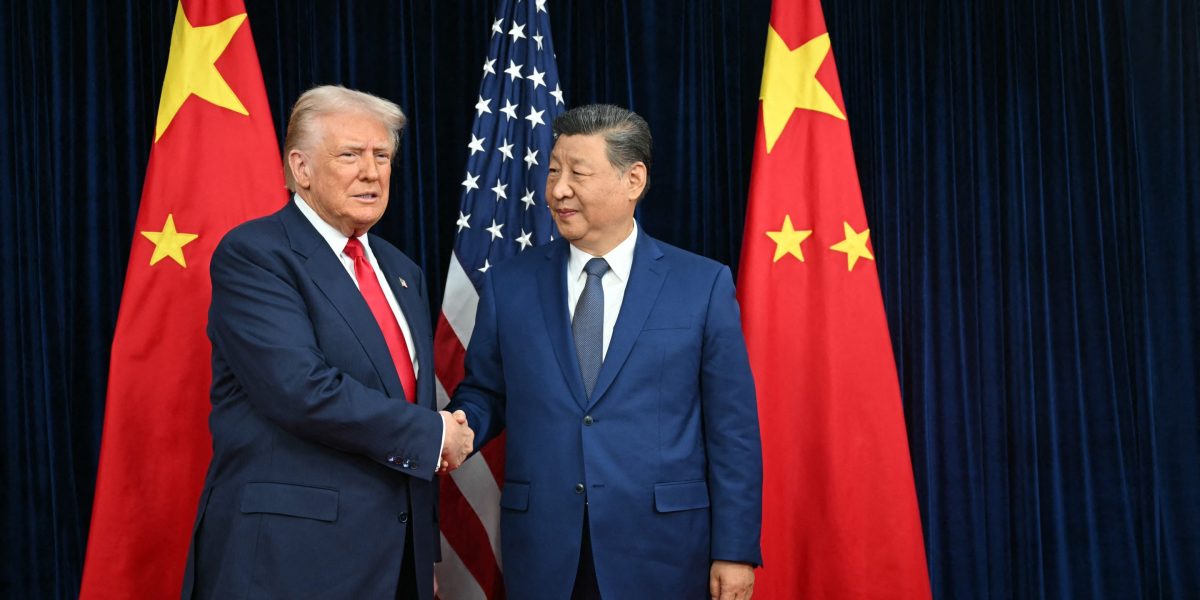
President Trump hates the United States’ trade deficit. Indeed, he is so concerned about the “economic and national security risks” the deficit creates that he imposed a tariff regime that raised geopolitical tensions across the globe.
The only problem is that his tariffs don’t appear to be rebalancing the huge volume of goods and services the U.S. imports, versus its declining exports.
The goods and services deficit for the U.S. was $70.3 billion in December, up $17.3 billion from $53 billion in November, according to the latest data from the Bureau of Economic Analysis (BEA), released yesterday.
This imbalance came on account of a 3.6% increase in imports, up to $357.6 billion—$12.3 billion more than November imports.
The gap was widened because exports also fell: In December, they sat at $287.3 billion, $5 billion less than November exports. The U.S. is also losing traction in the areas it previously held a surplus over its trading partners, with the services sector reducing its trade surplus in the month of December by $1.6 billion, to $29 billion.
In terms of the specific industries where the U.S. is seeing the greatest shift in its trading balances, it saw an $8.7 billion decrease in industrial supplies and materials. Meanwhile, its imports in the same category rose by $7 billion.
However, while the U.S. is still operating a monthly trade deficit of some $70 billion, the deficit on a year-to-year scale is improving, albeit slowly. For 2025, the goods and services deficit decreased $2.1 billion, or 0.2% compared to 2024.
The data begs the question of how successful Trump 2.0 will ultimately be in addressing the nation’s trade deficit with partners. Between July and October 2025, the U.S. trade deficit had been trending downwards on a monthly basis, bringing down the three-month average as well.
However, toward the end of 2025 that figure began to rise again, up from a monthly deficit of circa $30 billion to more than $70 billion in December. The December trade shortfall is roughly on par with the monthly deficit reported in December 2024, before President Trump won the election.
The bigger picture
Trump set his agenda on trade deficits early, in an executive order on Liberation Day in April 2025: “Large and persistent annual U.S. goods trade deficits have led to the hollowing out of our manufacturing base; inhibited our ability to scale advanced domestic manufacturing capacity; undermined critical supply chains; and rendered our defense-industrial base dependent on foreign adversaries.”
Here, the president is echoing the concerns of many: that America is drifting from self-sufficiency, particularly in its own defense. J.P. Morgan CEO Jamie Dimon advocated for greater U.S. independence from China in his 2023 letter to shareholders, writing: “The United States cannot rely on any potential adversaries for materials essential to our national security … We also cannot be sharing vital technologies that can enhance an adversary’s military capabilities. The United States should properly and narrowly define these issues and then act unilaterally, if necessary, to fix them.”
This is where the BEA report indicates some positive news for Trump 2.0. Perhaps unsurprisingly, given the escalating tensions between Washington and Beijing, in 2025 the deficit with China decreased by $93.4 billion to $202.1 billion. Exports decreased $36.9 billion to $106.3 billion, and imports decreased $130.4 billion to $308.4 billion.
As Deutsche Bank’s Jim Reid told clients this morning: “While the aggregate trade position of the U.S. has not changed much, we’ve seen some big redirection of trade. Notably, the latest data highlights the extent that US-China decoupling, with China now accounting for only 7% of U.S. imports, down from 13% in 2024 and above 20% prior to President Trump’s first China tariffs in 2018.”
Disclaimer : This story is auto aggregated by a computer programme and has not been created or edited by DOWNTHENEWS. Publisher: fortune.com