
For Donald Trump, tariffs are a “magic pudding”, an endlessly expanding source of revenue for whatever comes to his mind.
Last month they were going to fund a $US2000 ($3000) “tariff dividend” for US households, while also paying down America’s “enormous” debt.
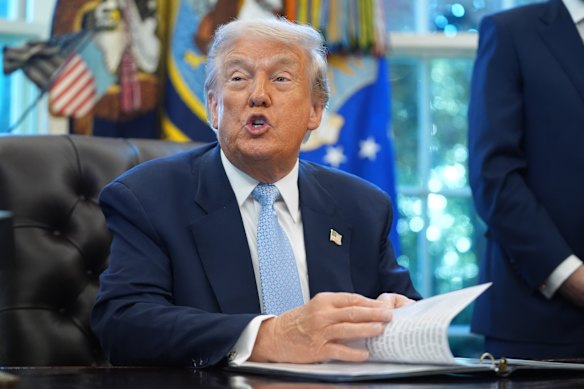
US President Donald Trump latest plan doesn’t add up.Credit: AP
Then, late last Thursday, he decided they could also fund the abolition of personal income taxes in the US.
“Over the next couple of years, I think we’ll substantially be cutting and maybe cutting out completely, but we’ll be cutting income tax,” he told members of the US military in a video call.
“Could be almost completely cutting it because the money we’re taking in is going to be so large.”
Trump has floated the idea of using tariff revenue to eliminate income taxes before, during last year’s election campaign and, again, after his “Liberation Day” tariffs on the rest of the world were unveiled in early April.
He has referred longingly to the period in the late 19th century when there were no income taxes in the US and government was funded by tariff revenue, although he overlooks the fact that, then, government spending was less than 2 per cent of US GDP and today it is more than 22 per cent.
He may, of course, not have any new tariff revenues of substance if the US Supreme Court rules the April 2 tariffs illegal and emphasising their revenue raising potential might not be the best strategy ahead of their decision, given that the administration’s lawyers argued that they weren’t primarily intended to raise revenue measures and would be most effective if there were absolutely no revenue from them.
His Thanksgiving Day comments to the military were, however, greeted deliriously, and taken very seriously, by his MAGA followers on social media and weren’t contradicted by the senior economic officials in his cabinet, despite the reality that the numbers make both his tariff dividends and the replacement of income taxes with tariffs nonsensical.
Depending on the cut-off points for the dividend cheques, for instance, they would cost between about $US300 billion and $US600 billion a year.

Trump’s MAGA supporters shouldn’t hold its breath waiting for his tariff dividends or removal of income taxes.Credit: Bloomberg
Again depending on how they were targeted (Trump has previously said taxes for those earning less than $US200,000, or about 90 per cent of US taxpayers, would initially benefit), abolishing income taxes for that group could cost something approaching $US700 billion, while completing removing individual income taxes (if it included the payroll taxes deducted from employees’ wages) would cost about $2.6 trillion a year.
Whatever the number might be, it would be a big one.
Unhappily for Trump, and US taxpayers, the tariff numbers aren’t as big.
So far this year, US Customs and Border Protection has collected about $US195 billion of tariff revenue, of which about $US118 billion relates to Trump’s new tariffs. The Yale Budget Lab has estimated that, between 2026 and 2035, revenue from those tariffs will be a net $US2.3 trillion, or about $US230 billion a year.
That wouldn’t cover Trump’s tariff dividends, let alone replace the lost revenue from taxes.
The tariff revenue also wouldn’t, as Trump has boasted they would, help reduce US deficits and government debt that has blown out from $US36.2 trillion to $US38.1 trillion in the 11 months since Trump regained the White House – and will blow out even further once all the measures in his One Big Beautiful Bill Act, including $US4.5 trillion of tax cuts over a decade, primarily for the wealthy, are in place from next year.
Whether it’s his tariff dividend, or income tax cuts, they would add, and add substantially, to US deficits and debt, not subtract from them.
The rate of the tariffs could, of course, be raised to raise more revenue. The average effective rate of the tariffs to date is already around 17 per cent, or nearly 7 times their level when Joe Biden was in the White House.
The problem with that is that the higher the tariff rate, the more it is likely to discourage imports – and the tariff revenue they generate.
To replace all income taxes paid by those earnings less than $US250,000 the average effective tariff rate on all imports would be to be around 25 per cent. To replace all individual taxes (about half all government revenue) the rate would be above 70 per cent. There’d be few, if any, imports – or tariff revenue – at that point.
The other challenge to the maths is that the headline amounts of revenue being collected from tariffs overstates their net benefit to the government’s income.
Contrary to Trump’s assertion (his economic spokespeople tend to prevaricate when questioned on this subject), tariffs are paid for by US companies and ultimately by US consumers.
They are a tax on businesses and consumption and, by reducing the incomes available to businesses, their shareholders or households, the tariffs also shrink the tax base. The US Tax Foundation says that tariff revenue should be discounted by between 23 per cent and 25 per cent.
Because they flow through to US companies and ultimately households via higher prices for goods (most estimates are that exporters, once the regime settles, will absorb only between about 5 per cent and 15 per cent of their cost) they are also highly regressive.

Contrary to Trump’s assertion (his economic spokespeople tend to prevaricate when questioned on this subject), tariffs are paid for by US companies and ultimately by US consumers.Credit: Bloomberg
Lower income households spend more of their income on necessities than wealthy households.
The US income tax system is progressive, albeit that its tax rates are far lower than in most developed economies, so its tax system would be switching from one that is progressive to one where the lower income households shouldered most of the burden of funding the government.
Higher income households, already set to benefit massively from the One Big Beautiful Bill, would be even better off if tariff revenues were substituted for at least some of their income tax.
Trump’s promises disappear as their impossibility becomes clear to him and a cabinet which, while generally unwilling to challenge anything Trump says or does, has at least one or two who can probably add up.
Trump’s proposed abolition of income taxes (while handing out tariff dividends and slashing government debt) is, of course, a fantasy.
Either he doesn’t know that (just as he doesn’t seem to know that tariffs on China’s exports aren’t paid by China) or he is deliberately and cynically misleading his MAGA base for political gain, with his cabinet and congressional Republicans happy to go along with him.
MAGA shouldn’t hold its breath waiting for Trump’s tariff dividends or removal of income taxes.
Like the promised $US5000 per household cheques the Trump and Elon Musk once promised (before Musk’s $US2 trillion of spending cuts shrunk to $US1 trillion and then to a claimed ( but almost certainly overstated) $US214 billion, Trump’s promises disappear as their impossibility becomes clear to him and a cabinet which, while generally unwilling to challenge anything Trump says or does, has at least one or two who can probably add up.
The Business Briefing newsletter delivers major stories, exclusive coverage and expert opinion. Sign up to get it every weekday morning.
Most Viewed in Business
Disclaimer : This story is auto aggregated by a computer programme and has not been created or edited by DOWNTHENEWS. Publisher: www.smh.com.au







