
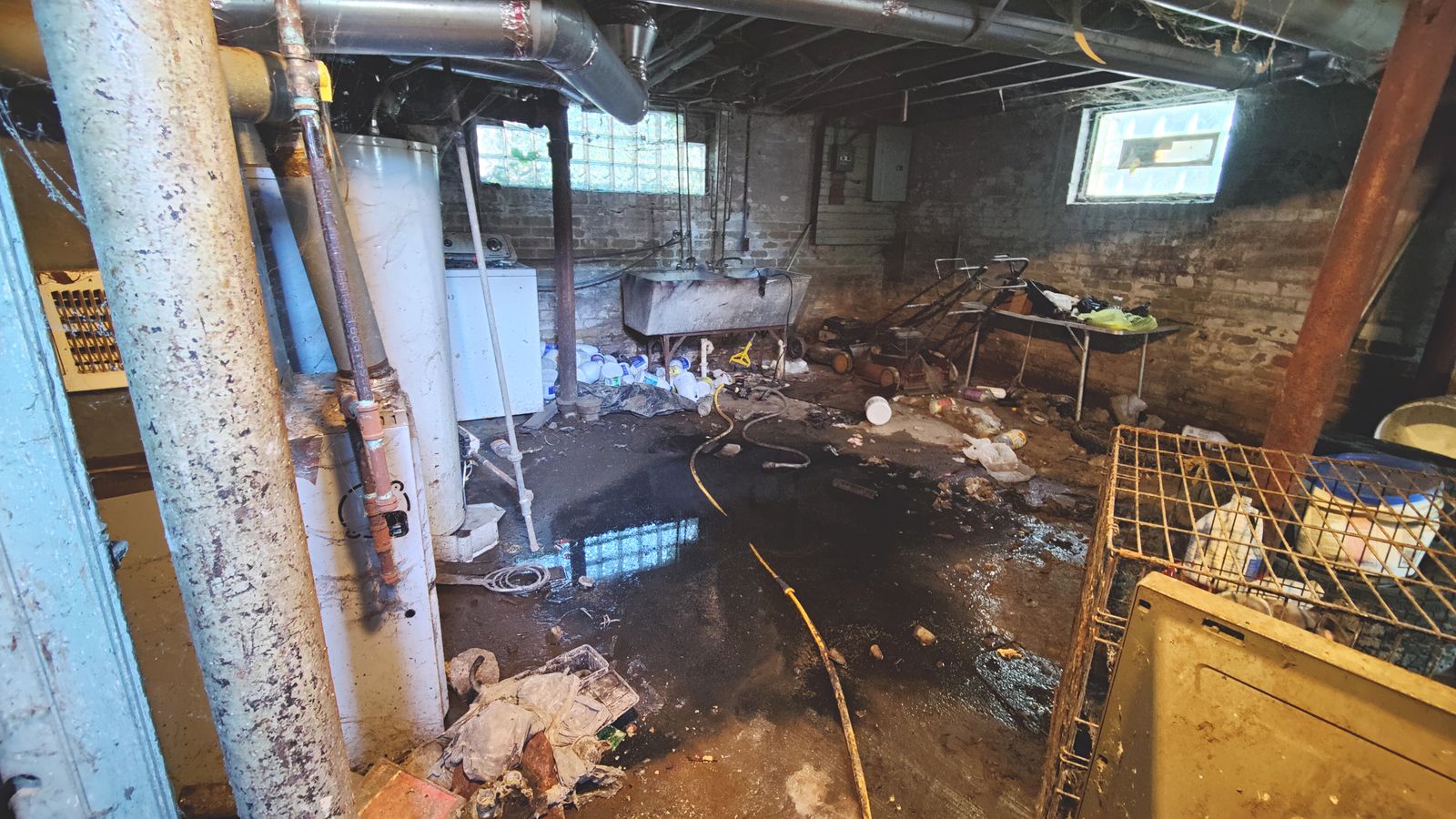
The smell hit me first: damp brick, stagnant water, mold, and bleach. I was partway down a flight of wooden stairs that led to the basement of a 1920s duplex in east Detroit, Michigan. Leading the way was Cornell Dorris, a tenant in the building for nearly a decade. Dorris is in his early forties, has two daughters who visit on weekends, and makes a living smoking meat and cooking for events.
As my eyes adjusted, I made out rodent droppings and a black puddle that spread across the basement floor. “Anytime it rains, the water comes down,” Dorris said. The air was unnaturally heavy, and I felt a nagging urge to leave.
Dorris doesn’t have a typical landlord. Almost four years ago, his building was acquired by a startup called RealToken, or RealT. The company had a plan to “democratize access to real estate investment” using cryptocurrency technology. The idea was that a property could be represented by thousands of crypto tokens sold for around $50 each. Token owners would collect a portion of a property’s rent, possibly making an annual return as high as 12 percent. They also could profit from any growth in the property’s value.
Investors lapped up the idea, and RealT went big on Detroit, snapping up approximately 500 buildings. It also bought around 200 properties in more than 40 other cities across the Americas, bumping the combined value of its portfolio to roughly $150 million. US residents are not allowed to invest, for regulatory reasons, but at least 16,000 people from 150 countries have purchased RealT tokens. Though reliable figures are difficult to come by, RealT once called itself the “largest real estate tokenization platform in the world, by all metrics.”
For all its triumphs in the cryptosphere, though, RealT has run into plenty of real-world trouble. Last summer, the City of Detroit sued RealT and its founders, alleging “hundreds of blight violations.” Dorris’ property was one of many that city inspectors declared unfit for habitation. He told me that while his previous landlord wasn’t perfect, sometimes leaving Dorris to organize repairs, his building has deteriorated markedly since RealT entered the picture. The smoke detectors are missing, and the bathtub has no hot water, inspectors found. “The only way of washing is me standing over my sink,” says Dorris. “There are rats in the downstairs, there are squirrels in the upstairs.”
As a proportion of the US housing market, estimated by Zillow to be worth $55 trillion, tokenized real estate is a rounding error. But the concept of using crypto to buy fractions of an asset—whether art, gold, oil, or stocks—has grown in just a few years into a $30 billion industry, per Deutsche Bank. Yet in Detroit, the promise of spending a few bucks to become a landlord, often from the other side of the globe, has collided with the inconvenient physicality of homes and the humans who live in them.
A pair of Canadian brothers, Rémy and Jean-Marc Jacobson, founded RealT. They aren’t twins but look like they could be—both have glasses, slicked-back hair, salt-and-pepper mustaches. Both identify as staunchly libertarian, favoring free markets and minimizing the reach of government. When we met over Zoom, Jean-Marc was impassioned and occasionally prickly. I got a little wordy trying to frame a question in a tactful way, and he told me, “Just ask it.”
The Jacobsons grew up in Canada and Europe, part of a colorful family that has been embroiled in court proceedings that span the globe. A sister’s bitter divorce culminated in a fight over a multimillion-dollar fortune that had been sequestered in the Bahamas, which she won. Their brother-in-law received a suspended prison sentence after he was linked to a group that had been involved in the illegal sale of arms to Angola. When their father, a financier, was asked about the family’s fortune in a 2003 article, the reporter was told, “Don’t ask and I won’t not tell you.”
Rémy and Jean-Marc have said that they carved out their real estate careers by turning over properties in Quebec and parts of the US. Then, in the early 2010s, they discovered bitcoin. Almost immediately, they launched their own bitcoin mining operation, followed by various other companies and a nonprofit. The brothers got entangled in bitcoin-related troubles too—they fell for a Ponzi scheme, and settled with a client that accused their firm of withholding a crypto payment now worth millions.
As early as 2013, as Jean-Marc tells it, the Jacobsons began to consider how to blend their expertise in real estate and crypto. In traditional finance, people could buy into real estate investment trusts (REITs), which let them earn a slice of rental income on a bundle of properties. But that generally meant investing at least a few thousand dollars. The brothers cast about for a way to use crypto to structure a roughly similar product but invest significantly smaller amounts. They didn’t crack it until five years later, when Rémy received a phone call from his lawyer.
Normally, it’s not possible to sell one house to a thousand people. But if the Jacobsons transferred a property’s title to a limited liability company (LLC), they could create and sell crypto tokens that represented shares in the LLC.
The Jacobsons went hunting for a location in which to test their tokenization concept. Detroit, known for its cheap housing stock and ambitions of urban renewal, was an obvious place to look. “Detroit was a city that had just come back from bankruptcy. It was already on the way back up,” says Jean-Marc. “It was a natural choice for potential increase in value. And, mostly, for beautifying and improving neighborhoods.”
They bought their first property—9943 Marlowe, a modest single-family home in West Detroit. In April 2019, they tokenized it, pricing 1,000 tokens at a markup to cover various fees and repairs and a 10 percent cut for the Jacobsons. They also planned to take a 2 percent cut of any future rental income. The rest of the rent would cover maintenance, taxes, and fees, and whatever remained would be distributed among token holders.
On the first day of trading, Jean-Marc tells me, RealT sold fewer than five tokens. The brothers asked their friends and family to buy in and tried to get the word out on X, Medium, and in press interviews. “People were at first suspicious,” says Jean-Marc. “We sold very, very, very little.” After about five months, the Jacobsons considered selling the house, refunding the people who had bought tokens, and walking away.
Slowly, however, the tokens for 9943 Marlowe began to sell. By December 13, they had sold out completely. At the time, the property belonged to 107 investors from 33 countries, who on average each owned a 0.93 percent stake and split among them $25.22 in daily rental income.
The Jacobsons started a chat group for French-language investors on Telegram, and demand for RealT’s tokens began to take off. In 2020, RealT went on a spree in Detroit: It tokenized an apartment building on Appoline, a quadruplex on Schaefer, then a single-family on Mansfield. That year, the Jacobsons tokenized nearly 50 properties.
As they eyed further expansion in Detroit, the brothers worked with real estate professional Shawn Reed, who, according to court documents, started to identify and sometimes help renovate properties for RealT to tokenize. Unbeknownst to the Jacobsons, Reed had a checkered past; he had previously served prison time for conspiracy to commit bank fraud and once agreed that he could be described as a “slumlord.” He teed up deals that helped RealT to keep pace with the now-soaring demand for its tokens.
I spoke with one investor, who posts on Telegram as TokNist, who said that when they first heard about RealT, they understood the proposition immediately. A French national living in Asia, TokNist (who asked to not be named out of fear of retaliation by other RealT investors) had wanted to buy real estate but couldn’t secure a loan. RealT offered a way to invest small sums without any bank involvement. “A lot of people are like me,” says TokNist. “They are not wealthy speculators. They are simple people who want a piece of real estate, and they want fixed income.”
In 2022, TokNist began to snap up RealT tokens. It wasn’t always straightforward. Whenever RealT was due to list a new property, they waited at their computer and watched as a timer ticked down. The website frequently failed, and their screen would go blank, or tokens would vanish from their cart. “The houses were sold instantly. You could have six or seven for sale the same day and, after a few minutes, every token was gone,” TokNist tells me. “It shows you, there is really a demand.”
Behind the scenes, the Jacobsons were beginning to run into problems with administering their swelling property portfolio. In 2023, a bank foreclosed on a commercial property the brothers owned as part of a separate business venture in Miami, Florida, after they defaulted on a loan and were ordered to pay $10.4 million. The City of Miami also happened to have classified the property as unsafe. (The Jacobsons describe this episode as a strategic decision in light of the Covid pandemic and an outlier in their track record in Florida.) That same year, the City of Chicago brought multiple fines against RealT LLCs over alleged blight violations, failures to adhere to building code, and debt delinquency. It was an early indicator of the troubles brewing in Detroit.
In the summer of 2024, Aaron Mondry was casting about for a fresh lead. A reporter at nonprofit local news organization Outlier Media, Mondry had been writing a series of articles, “The Speculators of Detroit,” about the city’s housing market. Then a contact pointed him to a curious pattern in the deed register for Wayne County, Michigan.
Scanning the register, Mondry saw that a large number of Detroit properties were owned by LLCs whose names were variations of “RealToken.” By that time, through these many LLC subsidiaries, RealT had bought and tokenized hundreds of properties across Detroit and become one of the city’s largest landlords. Many of the properties were single-family homes that RealT acquired in batches by striking deals with other landlords, sometimes without visiting the units in person. The RealT properties are concentrated in low-income, predominantly Black neighborhoods in the east and west of Detroit.
Mondry pulled together a list of RealT properties and set about knocking on doors. Soon, he noticed an alarming pattern: Many of the homes he visited were in terrible condition, a large number appeared to be vacant, and looking at various databases, in numerous cases the property taxes hadn’t been paid.
In February 2025, Mondry published the first of several stories about RealT, drawing from public records and conversations with the tenants. The stories alleged widespread mismanagement, corner-cutting, and neglect of tenants, some of whom told Mondry they were living in squalor. Around that time, city building inspectors warned RealT that an apartment complex on Cadieux Road had inoperable smoke detectors, emergency lighting, and fire doors. In March, a fire tore through the building.

I heard similar accounts when I went door-to-door in early September 2025. I drove my rental car past basketball hoops weighed down with cinderblocks and caught the scent of barbeque and strains of music wafting over fences—cheerful fragments of everyday life that cut against the otherwise wretched condition of the RealT properties I saw scattered across the neighborhoods.
I pulled up at the apartment building on Cadieux to find its scorched remains now boarded up. In the neighborhood of Grand River-St. Marys, in the northwest, a purported gang said they had seized control of 14881 Greenfield, a two-story brick apartment building with a distinctive red awning. In a YouTube video, the group claims to be acting as the landlord, renting the dilapidated units. “For a drug addict, this is like five stars,” says one of the people interviewed. Two other RealT houses I visited were peppered with bullet holes. Multiple tenants told me they are withholding rent in the hope of forcing repairs.
At a Tim Hortons in Redford, West Detroit, I met Maya, a RealT tenant who lives nearby in a boxy redbrick house. When Maya—who asked to be identified only by her first name—gets home, she parks her car in the driveway and sits there, sometimes for up to an hour, before she goes inside. In one bedroom, a leak has created a yawning hole in the ceiling, exposing the wooden roof supports. The paint is peeling, and shreds of fiber insulation, sodden and brown, dangle into the bedroom. Maya sticks to the bathroom, kitchen, and living room, where she sleeps. “I probably shouldn’t be living in it, to be honest with you, but I’m trying to find somewhere I can go,” says Maya. “It’s a slumlord city.”
A few blocks away from Maya’s place, I knocked on the door of Monica, who has lived in a house south of the famous Eight Mile Road for six years, lately with her two grandchildren. The home’s tokens are owned by 331 people, who have made a 9.3 percent average annual return on their investment, funded by Monica’s rent. Monica tells me that her heating is broken and the water supply is temperamental—and I can see that some of the windows are smashed and the roof is damaged. A long-dead tree hulks over the front yard. At night, Monica can’t sleep for fear an intruder might enter through one of the broken windows. She says she has repeatedly applied to move into an emergency shelter, but they’re always full. “Go home, honey. Go home,” Monica told me. “It’s terrible here.”
Disclaimer : This story is auto aggregated by a computer programme and has not been created or edited by DOWNTHENEWS. Publisher: wired.com



