BEIRUT — Lebanon’s ongoing financial collapse has reopened fundamental questions about sovereignty, foreign intervention, and the country’s strategic choices.
Recent controversy surrounding the U.S. ambassador’s meeting with the head of the International Monetary Fund (IMF) mission to Lebanon has intensified public debate. At the same time, remarks delivered by Hezbollah Secretary-General Sheikh Naim Qassem during the commemoration of the party’s martyred leaders have framed the crisis within a broader political and security context.
Together, these developments highlight a central tension: who determines Lebanon’s future, and under what conditions?
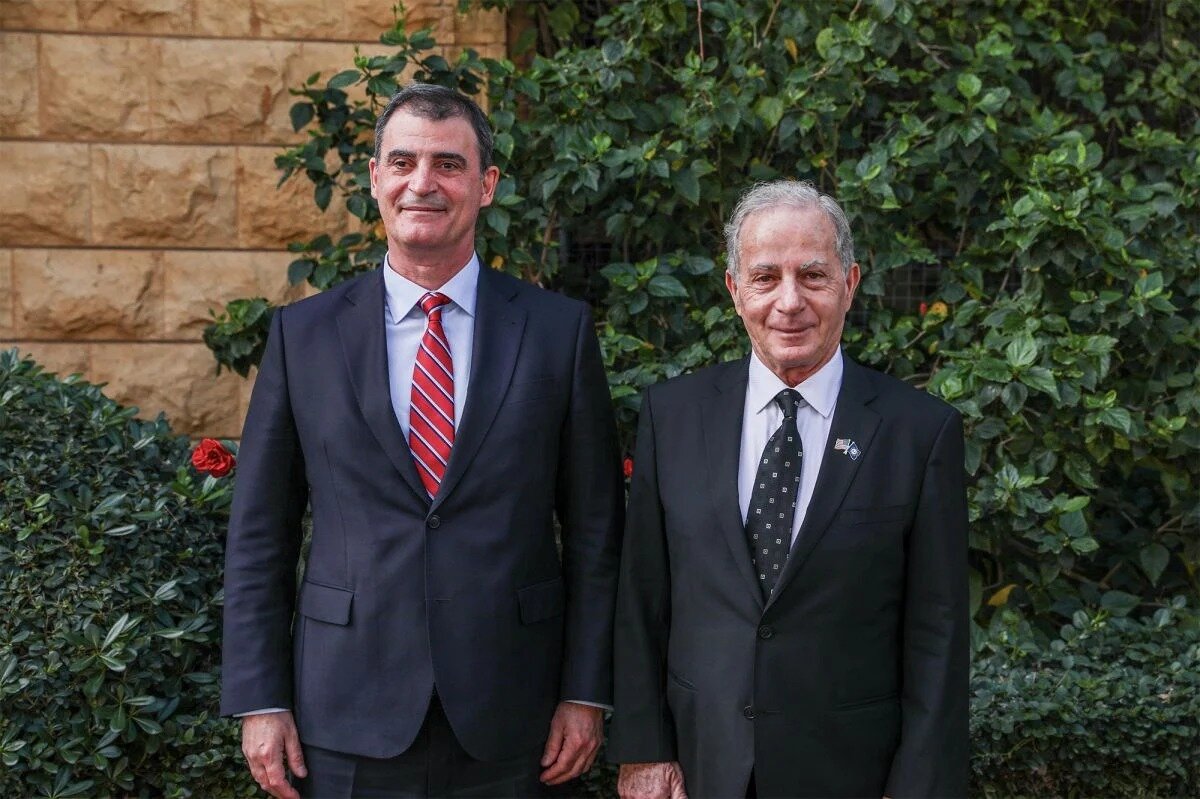
On February 13, 2026, the U.S. Embassy in Beirut announced that Ambassador Michel Issa had met with Ernesto Ramírez Rigo, who leads the IMF delegation engaged in discussions with Lebanon.
The embassy stated that achieving a “stable and prosperous future” requires comprehensive financial restructuring.
Besides, the meeting allegedly addressed ways to restore Lebanon’s international credibility, attract global investment, and advance reforms deemed necessary to encourage further American business engagement.
While diplomatic exchanges of this kind are not unusual, the optics of the announcement sparked criticism. Financial restructuring, public debt management, and structural reforms are decisions that fall within the authority of Lebanon’s constitutional institutions.
When a foreign ambassador appears prominently involved in conversations about shaping such policies, it raises concerns about whether the boundaries between cooperation and influence have become blurred. For many, sovereignty is not merely symbolic; it requires that core economic decisions be debated and approved domestically, free from external direction.
These concerns intersect directly with the political arguments articulated by Sheikh Qassem in his recent speech.
In that address, he said he would discuss “three problematic narratives” raised in confrontation with the Israeli enemy. The first, he argued, is the claim that Lebanon will not receive international assistance unless it disarms and submits.
Sheikh Qassem rejected this outright. Lebanon, he maintained, does not need conditional aid that compromises its independence. Assistance tied to political or military concessions—especially those aimed at weakening the resistance—was described as unacceptable.
He questioned the logic of aid packages that would allegedly strengthen the Lebanese Army only to redirect it against the resistance rather than toward defending the country against the Israeli enemy.
In his framing, genuine support would reinforce internal security, combat crime and narcotics, and uphold sovereignty in the face of external threats.
Anything else, Sheikh Qassem suggested, risks turning Lebanon into a platform for foreign interests. Conditional assistance, in this view, amounts to a form of guardianship that erodes national decision-making.
Sheikh Qassem’s second point addressed the argument that concessions through negotiation can prevent harsh military strikes. He dismissed the idea that compliance shields Lebanon from aggression, contending that pressure tactics are designed to extract maximum political gains without incurring the costs of full-scale war.
According to Sheikh Qassem’s reasoning, restraint by the Israeli enemy and the United States reflects calculations of timing and feasibility rather than gratitude for concessions. If strategic conditions favoured escalation, he argued, broader confrontation would occur regardless of prior compromises.
At the same time, Sheikh Qassem emphasized that Hezbollah does not seek war. The distinction, he said, lies between initiating conflict and defending against aggression.
The Resistance, in his words, is prepared to defend but does not pursue hostilities. Sheikh Qassem framed the past fifteen months of confrontation as evidence of deterrence rather than weakness, asserting that sustained resistance has prevented a wider assault precisely because outcomes would not be guaranteed.
When placed alongside the controversy over economic policymaking, these remarks illustrate how Lebanon’s financial crisis cannot be separated from its geopolitical position. For one camp, international engagement and reform are essential to recovery. For another, sovereignty must not be diluted by conditional frameworks that reshape national priorities.
Lebanon’s path forward requires rebuilding institutions, restoring economic stability, and engaging internationally. Yet it also demands clarity about the principles guiding such engagement. The debate is not only about restructuring banks or securing investments; it is about whether economic recovery will come at the cost of political autonomy.
In a country where history has repeatedly blurred the lines between diplomacy and pressure, that question remains at the heart of the national conversation.
Disclaimer : This story is auto aggregated by a computer programme and has not been created or edited by DOWNTHENEWS. Publisher: tehrantimes.com