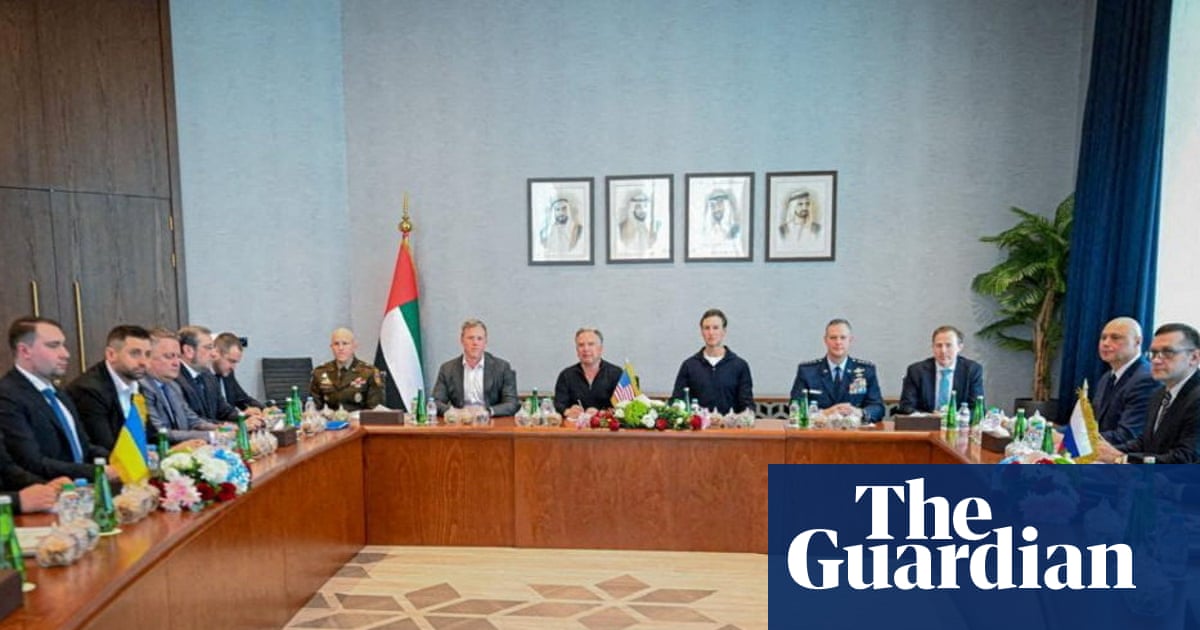
Ukrainian and Russian negotiators have held a “productive” first round of US-led peace talks in Abu Dhabi, as Washington seeks a pathway to end the nearly four-year war in Ukraine.
The two-day trilateral talks that are due to continue on Thursday come after Volodymyr Zelenskyy accused Moscow of exploiting a US-backed energy truce last week to stockpile weapons before launching a record number of ballistic missile attacks at Ukraine on Tuesday.
Rustem Umerov, Ukraine’s chief negotiator and the head of its national security and defence council, said the talks had been “substantive and productive, focused on concrete steps and practical solutions”.
A US official, who offered comment to Reuters on condition of anonymity, also called the talks productive.
Zelenskyy said it was critical for the talks to lead to real peace and not offer Russia a new opportunity to continue the war. Ukraine’s partners, he said, had to exert more pressure on Moscow.
“It must be felt now,” Zelenskyy said. “People in Ukraine must feel that the situation is genuinely moving toward peace and the end of the war, not toward Russia using everything to its advantage and continuing attacks.”
He added that Ukraine expected the talks to lead to a new prisoner exchange soon.
The president, interviewed by the television channel France 2, said the number of Ukrainian soldiers killed on the battlefield as a result of the war with Russia was estimated at 55,000.
Despite renewed diplomatic efforts by the Trump administration, the prospects for a viable peace deal remain unclear, with Moscow continuing to press its maximalist territorial demands. The Kremlin has said repeatedly any settlement must include Ukraine ceding the entire eastern Donbas region, including areas still under Ukrainian control. Kyiv has rejected such terms, saying the conflict should instead be frozen along the current frontline and ruling out any unilateral withdrawal of its forces.
Other major obstacles remain. Moscow has said it would not tolerate European troops on Ukrainian soil, a condition Kyiv sees as essential for credible security guarantees. Speaking to Ukraine’s parliament on Tuesday, the Nato secretary general, Mark Rutte, said European allies had committed to deploying forces to Ukraine once a deal was reached – a proposal Russia has so far flatly rejected.
The Kremlin spokesperson, Dmitry Peskov, said on Wednesday Russian forces would continue fighting until Kyiv made “decisions” that could bring the war to an end, underlining Moscow’s hardline stance even as negotiations resumed.
Kyiv was dealt a diplomatic blow before the talks when Trump declined to condemn Russia for pounding Ukraine’s energy grid with missiles and drones despite an apparent ceasefire.
“Taking advantage of the coldest days of winter to terrorise people is more important to Russia than turning to diplomacy,” Zelenskyy wrote after the attacks, urging western governments to denounce the strikes.
Trump said later on Tuesday that Vladimir Putin had “kept his word” on the ceasefire, adding that Russia’s pause in attacks was meant to last only until Sunday.
The second round of talks was initially supposed to start on Sunday in Abu Dhabi, but was postponed because of rising tensions in the region over Iran.
The US special envoy, Steve Witkoff, and Jared Kushner, Donald Trump’s son-in-law, travelled to Abu Dhabi for the negotiations. The two men have become fixtures in US diplomacy, shuttling between talks on the Middle East, the Iran crisis and the Ukraine war, but have faced criticism over their lack of formal diplomatic experience.
Ukraine’s team includes Kyrylo Budanov, the former head of military intelligence who now leads the presidential administration, and Andrii Hnatov, the chief of the general staff. The Russian delegation is led by Igor Kostyukov, the head of the GRU military intelligence service, alongside other senior intelligence officials and the Kremlin’s investment envoy, Kirill Dmitriev.
A potential meeting between Putin and Zelenskyy has been mooted, but the Kremlin said it would agree to such talks only if the Ukrainian leader were willing to travel to Moscow.
In a show of wartime alignment, Putin held a video call on Wednesday with China’s president, Xi Jinping, with both leaders hailing the strength of bilateral ties.
China has emerged as a crucial economic lifeline for Russia, stepping up trade and purchases of Russian oil as western sanctions have tightened. Ukraine and several European governments have accused Beijing of providing weapons to Russia, allegations China denies.
Washington has previously put pressure on India, another close partner of Moscow, to curb its purchases of Russian oil, which the west says help finance Putin’s war.
Disclaimer : This story is auto aggregated by a computer programme and has not been created or edited by DOWNTHENEWS. Publisher: theguardian.com