When the invite came through for a trip to Bahrain with Jumeirah Hotels, to stay at their Jumeirah Gulf of Bahrain Resort, the question that immediately came to mind was how different could it be from Dubai? My maiden voyage to the island country ended up being an eye-opening discovery that instantly melted away every outdated presumption I had.
Like Dubai, Bahrain has a level of grandeur, but with its own kind of majesty. The country reveals itself to be a place with a soul so old it remembers things the other nations of the GCC have perhaps forgotten. Its very name speaks to the idea of finding balance in life. Bahrain stems from the Arabic for “two seas” – bahr, meaning sea; and ain, meaning fresh water. A reference to the phenomenon of sweet water springs that bubble up from the seabed, especially along the northern shoreline where the oyster beds have always been richest.
For centuries, divers have known that they could descend through the saltwater surrounding Bahrain and reach places where it turns fresh beneath them, a quirk of geography that exists almost nowhere else on earth. And it is this convergence, marine biologists believe, that gives Bahrain’s famous pearls their renowned unique lustre, the saltier waters creating conditions for the oysters to produce nacre of exceptional quality and brilliance. The Kingdom has been fishing these pearls from its waters for four thousand years. Assyrian texts dating back to 2000 BCE mention “fish eyes” from Dilmun, the ancient name for this island. For millennia, this tiny stretch of land was the centre of the pearl trade, its oysters sought after by merchants from Bombay to New York. By 1904, an estimated ninety-seven per cent of the Gulf’s pearl turnover passed through Bahrain.
I knew none of this when I arrived. But on the first full morning, standing in the lobby of the Jumeirah Gulf of Bahrain, I met the man who would change that. His name was Bader AlSaad, and from the moment he greeted us I could tell that storytelling was not a job for him but something he did out of passion. He was someone whose love for his country was worn as casually and as impeccably as the pearl-encrusted wallet I would later notice him pulling from his pocket. The hotel had arranged for AlSaad to take us across to Muharraq Island to discover the Pearling Path, part of a curated experience they offer to guests who want to go beyond the usual sightseeing. It was the first of many moments that would reveal how deeply the resort is woven into the fabric of the place it calls home.
Perched on the pristine beaches of the Kingdom’s west coast, forty-five minutes from the airport, the Jumeirah Gulf of Bahrain opened in November 2022, taking architectural inspiration from the gentle movements of the sea. But what becomes clear very quickly is that this is not a property that exists in isolation. The resort positions itself as a gateway, a place from which to venture out and, just as importantly, a place to which you return carrying the memories formed from exploring the rich history and unique nature of the island.
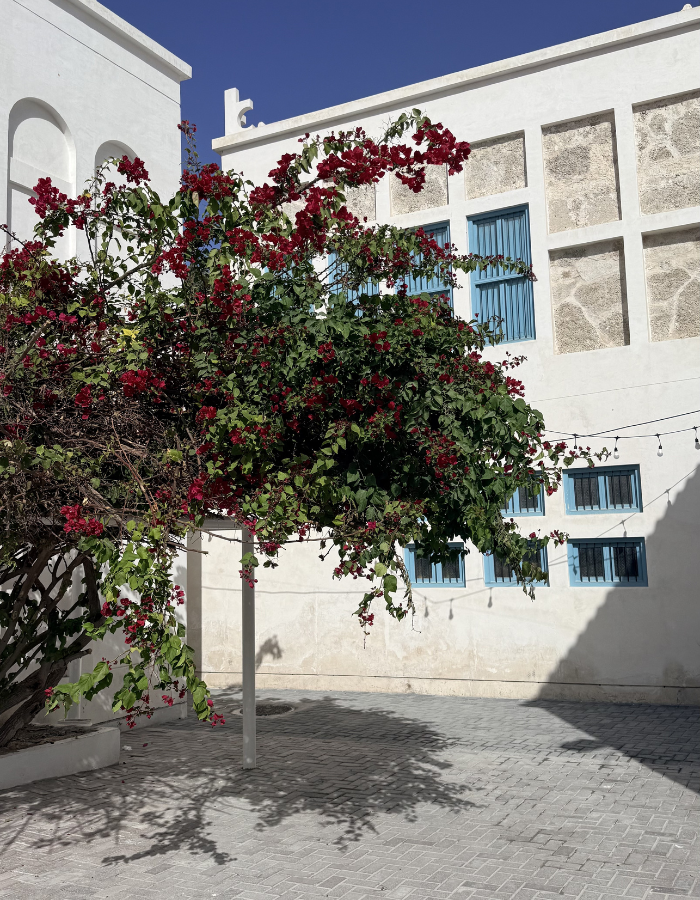
Case in point: The Pearling Path. A 3.5-kilometre trail that UNESCO inscribed as a World Heritage Site in 2012, winding between seventeen buildings from the time of the thriving pearl industry – shops and storehouses, a mosque, the homes of wealthy merchants, all constructed from coral stone that has somehow survived when so much else has crumbled. Walking between them with AlSaad pointing out details we would have missed, it’s easy to feel transported into a bygone era, when the entire island held its breath waiting for the dhows to return. The bigger the pearl merchant, the more elaborate the decor of his house, and AlSaad led us through majlises where coloured glass still fractures afternoon light onto hand-carved ceilings. There we learned that women had their own part in this culture, hosting gatherings while the men were away at sea collecting oysters for four months at a time, building networks that held entire communities together through the long seasons of waiting.

Halfway through the walk, we stopped at a tiny cafe called Bread and Paper for freshly baked focaccia and date iced coffee. One of the founders, Sara Abdulla, greeted us looking as stylish as the space itself with her designer shades and an unhurried aura that made you want to linger awhile.
Then there was Faten Ebrahim Mattar, a sixth generation natural pearl merchant from Mattar Jewelers, carrying on a hundred and seventy year family legacy. We took a tour around her humble office as she walked us through her treasured collection. There are twelve colours of natural pearls, she told us – not just white and cream, but rose and gold, silver and black. A single two-strand necklace of round pearls can take ten to twenty years to complete, because the rarity of finding a pearl between three and five millimetres is one in ten thousand. As a finale, she brought out her 4.2-kilogram hoard of pearls bundled in the Mattar Jewel’s signature red cloth and secured with a silk thread. It hard to conceptualise how many generations of Mattars sat exactly where we were and felt the weight of this same red bundle in their hands.

Bahrain is the only country in the world where cultured pearl farming is banned, a public notice first issued in 1928 and still enforced today. The Japanese perfected cultured pearls in the 1930s, flooding the market with gems that cost a fraction of what Bahrain’s natural pearls fetched, and the industry collapsed. By 1972, Bahrain was the only country in the Gulf to continue the ban, establishing a pearl-testing laboratory to ensure no cultured specimens entered the market.
The divers went to work in the newly discovered oil fields, but the ban remained – a testament to how deeply the reverence for natural pearls is woven into the island’s identity. All of this knowledge came together on the afternoon when the resort arranged a pearl chucking experience. We gathered around a table set with seventy or eighty oysters, each handed a small knife, and spent the better part of an hour working through them. From the entire lot only six pearls emerged. One oyster contained a cluster of fifteen to twenty tiny pearls, only two of which passed the three-to-five-millimetre quota. There was something almost foolish about the joy of it, the sense of having stumbled upon a small miracle. AlSaad told us how his family would buy a bucket of oysters for anywhere around a hundred to a thousand dirhams and sit together and chuck them at least two or three times a week. He described it as almost meditative, a communal rhythm his family would fall into.
On a separate afternoon we made our way to the Bahrain Fort, driving west from Manama until the structure came into view, standing like a sentinel on its ancient mound overlooking the sea. What is perceived first is the Portuguese fort, built in the early sixteenth century, but that is merely the most recent chapter in a story that stretches back five thousand years. Beneath it lies a tell, an artificial mound created by layer upon layer of human occupation, containing seven distinct strata from civilisations that came and went. The site was first settled around 2300 BCE by the Dilmun civilisation, the Bronze Age paradise described in the Epic of Gilgamesh. Later came the Kassites, then the Greeks in 323 BCE, and in the excavated ruins it’s easy to see how Greek architectural elements began to appear alongside the older Dilmun styles. The Islamic civilisation took over in the seventh century, adding its own layers, until the Portuguese came and built their fort on top of everything that had come before. Standing there, it’s possible to see it all at once, history stacked like the layers of nacre in a pearl.

Returning to the resort following afternoons like this, the design choices by the establishment begin to make a different kind of sense. Believed to be the former heart of the Dilmun Empire, Bahrain is a historically layered destination, and the resort embodies this sensibility without ever feeling like a history lesson. The cluster of villas and elegantly designed rooms, along with the award-winning Talise Spa, offer a sanctuary for travellers, but it is a sanctuary that knows what surrounds it.
The resort’s decor draws from flowing waters and the ripples of the Arabian Gulf. Guests are welcomed with blue hues and a prismatic mother-of-pearl lighting installation suspended from the ceiling. The sandy shades of the landscape are incorporated into floors, panels and furniture. Intricate stone carvings in arched hallways and doorways resemble the architectural styles of Bahrain’s streets and forts. The design also pays homage to the country’s fishermen and their boats, which can often be spotted sailing past in the distance. There are 196 rooms and suites spread across the property, from Deluxe Rooms to the 200-square-metre Royal Suite, each with contemporary designs incorporating accents of blue and local textiles. The Gulf Summer House Arabian Suite with Private Pool spans 170 square metres of indoor-outdoor living. Beautiful abodes, but what lingers is something harder to name. It’s the way the resort effortlessly carries the memory of what this coastline has always been that quietly acknowledges that refinement – at its best – is simply paying attention to where you come from.
The dining venues also reflect this sensibility. Due Mari serves homemade pastas on a terrace overlooking the Gulf, its interiors incorporating the famous Bahraini weaving technique. Zahrat Al Fayrouz offers Levantine mezze in a space where fisherman’s net patterns highlight the country’s heritage. While Ousoul sits directly on the private beach. And the signature bar, 25|50, uses local textiles to frame Gulf views alongside an impressive selection of libations.
The Talise Spa features thirteen treatment rooms, a ladies’ hammam, and separate gyms. Five pools dot the property – an adult-only pool, an executive pool, a family pool, a kids’ pool, and a ladies-only indoor lap pool. There’s a 36-seater cinema, a kids’ club, tennis courts, and an abra cruise around the resort’s canal. Amenities that could read excessive elsewhere, here feel like extensions of the landscape, built to offer genuine immersion.
From this base of quiet comfort we continued to explore. We walked the alleyways of the gold souq and watched the different cultures of the city come together harmoniously. The Shrinathji Temple, a Hindu temple established in 1817, stands quietly amidst the bustle – one of the oldest in the Gulf. The streets merge into the spice market, where locals buy their condiments, the air thick with cumin and cardamom. AlSaad tells us how his grandmother would send him here every week to buy a secret mix for their family stews. The next morning, we returned for an authentic Bahraini breakfast at Al Sana Restaurant & Café. On the weekends the place fills with families enjoying their Friday morning as they dip into the mehyawa, a tangy sauce made from fermented fish that travelled from Persia generations ago, spread on flatbread with cream cheese.

On the last evening, I sat on my balcony and watched the sun drop into the Gulf. The same water the divers had plunged into for four thousand years. I thought about the pearl divers who spent months at sea, about the women who hosted each other in their absence, about the merchants who built their coral-stone houses and filled them with coloured glass. I thought about Faten Mattar untying her red cloth bundle, about AlSaad pulling out his pearl-encrusted wallet, about Sara Abdulla greeting us at her cafe like old friends.

A pearl is born from an irritation, a grain of sand that finds its way inside an oyster’s shell. The oyster does the only thing it can: it begins coating it with nacre, layer upon layer, until the irritation becomes something beautiful. It takes years and patience, and in Bahrain this process is aided by something that exists almost nowhere else – the freshwater springs beneath the saltwater sea, the two waters mingling in ways that create conditions for something extraordinary to emerge.
Bahrain is like that. A small island in a big Gulf, carrying something that has taken millennia to form, patient in the knowledge that what it has cannot be manufactured or rushed. And a stay at the Jumeirah Gulf of Bahrain, proves that the best hospitality is not about escaping the past but about being invited into it. About finding yourself wrapped in layers of history like nacre around a grain of sand, transformed into something a little more beautiful than when you arrived.
– For more on luxury lifestyle, news, fashion and beauty follow Emirates Woman on Facebook and Instagram
Images: Supplied
Disclaimer : This story is auto aggregated by a computer programme and has not been created or edited by DOWNTHENEWS. Publisher: emirateswoman.com