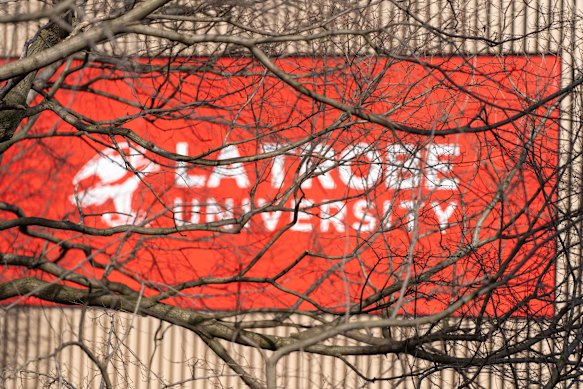

La Trobe University is facing resistance to a proposed tough “campus access” policy that would give management veto powers over banners, flags and even gazebos.
Students are pledging to fight the policy, arguing that it is aimed at further curtailing pro-Palestinian protests and other activism but will also give the university’s management sweeping powers to shut down any form of expression it finds embarrassing or inconvenient.
The proposed rules would give security guards the right to demand identification from people on university property and march protesters off campus, with lengthy bans potentially imposed by university authorities.
The policy would also give university management veto power over any banners or flags attached to university property and impose an Australian Electoral Commission-style authorisation regime on posters, pamphlets, flyers and other material distributed on campus.
The consultation period for the policy ends on Sunday, three weeks before the vast majority of students return to campus from their summer breaks for the start of semester 1.
La Trobe management told this masthead the policy was designed to provide for “reasonable and proportionate action” to be taken against activity that put campus users in danger, obstructed university operations or broke the law, and that much of the policy was not even new.
The university has endured months of bad publicity after one of its key sponsored events, the Bendigo Writers Festival, collapsed after La Trobe, urged on by pro-Israel activists, moved to impose a “code of conduct” on participants at the literary gathering.
University bosses are also embroiled in a bitter dispute with the La Trobe Student Union after trying to establish an alternative student representative council that gave university executives power to hire or fire council members or even bar people from standing for election.
Students for Palestine spokesman Xavier Dupe said the latest developments all pointed to an increasingly authoritarian regime at La Trobe, aimed at shutting down opposition and dissent on campus.
“Clearly, this is an attempt by the university to make it more difficult,” Dupe said. “They want to create an atmosphere where students feel afraid to speak out for fear of repercussions.”
The activist said that another aspect of the policy – mandating official permission for any sort of temporary structure on campus including tents and gazebos – would give management unprecedented control over more aspects of university life.
“Under this policy, you would need permission from the director to set up a table and hand out leaflets, the most basic campus activity,” Dupe said.
“What that means is, unless you get approval from the appropriate director, it would mean the student union could not set up a table to leaflet about students’ rental rights.
“It would mean the National Tertiary Education Union could not set up a table to try to recruit people to the union.
“Even for non-political clubs, it would place a massive burden. You would need permission to do something as simple as set up a table to ask people to join the Islamic Society or the Pakistani Society, or the arts and crafts club.”
The National Tertiary Education Union’s La Trobe representative did not respond to requests for comment.
A university spokesperson defended the proposed policy.
“The draft campus access, premises and facilities policy reflects La Trobe’s commitment to designing, building and maintaining premises that are fit for their intended purpose,” the spokesperson said.
“The draft policy sets out the university’s expectations associated with all those who enter or use our campus premises and facilities.
“The draft policy is intended to provide for reasonable and proportionate action to be taken where any activity or an individual presents an unacceptable health and safety risk, unreasonably disrupts operations or otherwise breaches the law or another university policy.”
The spokesperson said that comments from university staff and students would be considered as part of the consultation process.
“As with all policies, we have actively communicated about the consultation with staff and students and will carefully consider their feedback before the policy is finalised and approved,” the spokesperson said.
“The consultation period reflects that many of the proposed policy features align with existing regulations set out in university statute, as well as existing practice. ”
Get the day’s breaking news, entertainment ideas and a long read to enjoy. Sign up to receive our Evening Edition newsletter.
From our partners
Disclaimer : This story is auto aggregated by a computer programme and has not been created or edited by DOWNTHENEWS. Publisher: www.smh.com.au