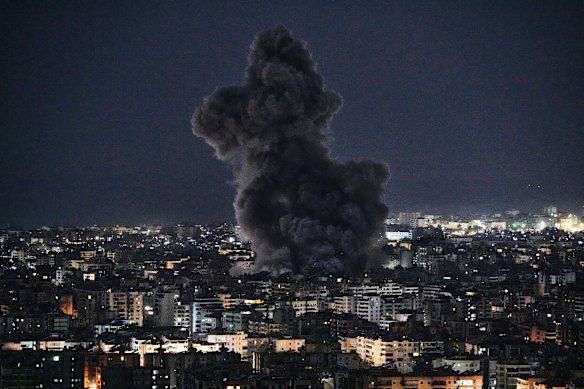
Welcome to our rolling coverage of the unfolding conflict in the Middle East. If you’re just joining us, here’s what you need to know today.
- US President Donald Trump has given his first public address since the war began, saying it could last “far longer” than four or five weeks and warning a “big wave of strikes” was coming. In an interview with The New York Post this morning, Trump did not rule out the possibility of US “boots on the ground” in Iran.
- An Iranian Revolutionary Guard senior official said today that the Strait of Hormuz is closed and vowed that Iran would fire on any ship trying to pass, Iranian state media reported.
- Three US fighter jets were mistakenly shot down by Kuwaiti air defences, but all six crew members ejected safely. The US Central Command confirmed today that the number of American military personnel killed in action had risen to six, after it uncovered the remains of two members previously unaccounted for.
- Iran has escalated its strikes on Israel, Lebanon, the UAE, Kuwait and Iraq. More than 70 missile and drone strikes have battered the Iraqi city of Erbil since Saturday, Iraq’s Foreign Ministry said today.
- Saudi Arabia’s largest oil refinery, Ras Tanura, was forced to close this morning after shrapnel from an intercepted Iranian drone caused a blaze to tear through the facility.
- Iran’s Red Crescent reported the total Iranian death toll from strikes had surpassed 550, as the US and Israel concentrate their strikes on the capital Tehran.
- The Australian government is looking into “contingency arrangements” to help Australians get home, Defence Minister Richard Marles said this morning, as most commercial planes to Australia remain grounded.
- Marles also confirmed earlier reports that Australia’s Al Minhad air base near Dubai was struck by Iranian drones over the weekend, but that personnel on the base were safe.
Read more on the US-Israel-Iran war:
Australians stranded in the Middle East are making plans to leave, as the Iran war has forced the closure of airspace in the region and limited options for flights.
Those unable or unwilling to wait for the resumption of air travel are finding alternative routes to leave the region, according to Australian travel agents.
Mark Trim, the founder of Adelaide-based Complex Travel Group, said travellers who had long-haul flights from Europe or Africa through the Middle East were now “rebooking via Asia at significantly higher price points, and seat availability is moving quickly at a premium”.
For travellers in the region where airspace is open – such as Saudi Arabia or Oman – but who have impacted flights on Emirates or Qatar Airways, his company had been booking various scenarios.
“Some are flying out through Johannesburg, and home on Qantas from there,” Trim said. “We just re-booked some clients in Cairo on that routing.”
Since Israel and the US began attacking Iran on Saturday evening (AEDT), 12,903 of the 32,003 flights that were scheduled to arrive or depart from the Middle East – or 40 per cent – had been cancelled, according to flight analytics data company Cirium.
At any time, about 11,000 Australians are transiting through the region, which is a hub for Emirates, Virgin Australia’s partner Qatar Airways, and Etihad. Travellers caught out by the military strikes during their transfer are now unable to fly out of the war-affected part of the Middle East.
Stranded in the Middle East? Read the full story here for the latest developments and advice on finding alternate travel routes.
Behind the turbulence that characterises US President Donald Trump’s actions in Iran lies a shrewd geopolitical strategy. In the short term, he wants to demonstrate leverage over China when he meets President Xi Jinping at a pivotal summit next month. In the long term, he wants a politically submissive Middle East.
China, the world’s largest refiner of oil, purchases about 14 per cent of its seaborne crude from Iran. The true figure is probably higher, disguised as shipments from Oman, the UAE and Malaysia to get around US sanctions. Independent low-margin Chinese refiners in Shandong province, known as teapots, also import high-sulphur fuel oil from Iran. Taken as a whole, China’s enormous plastics sector relies on Iran for almost a quarter of its liquefied petroleum gas. Control over what Iran can export and to whom allows the US to retaliate if China restricts rare earth mineral supplies to the United States.
Trump’s abduction of Venezuela’s Nicolás Maduro in January was driven in part by a similar logic; Venezuela has the largest proven oil reserves in the world, and its Merey grade is also high in sulphur, well-suited for China’s teapot refineries. Trump wants indirect but politically critical leverage over China through control over Iran and Venezuela.
The key word here is “control”. Control of oil rather than access to oil is the foundation of the United States’ Middle East policy. “Access to oil” implies that the United States simply wishes to buy oil like any other country; that it wants oil at a reasonable price. But the US already has access to oil. Its East Coast oil refiners (PBF Energy, Phillips 66 and Monroe Energy) have no trouble buying oil from West African suppliers. Thanks to its domestic shale revolution, the US is already self-sufficient. It is a major contributor to the global oil supply network.
Control is a very different beast. Control of oil means, among other things, controlling the terms on which its industrial rivals in Europe and Asia can access their oil.
Read the full opinion piece here.
Israeli Prime Minister Benjamin Netanyahu has vowed the US-Israel war on Iran will not become another “forever war”, and that he wants Iranians to form a democratic government.
“You’re not going to have an endless war. And Iran, this terror regime in Iran, is the weakest point that it’s been here since it hijacked Iran from the brave Iranian people 47 years ago,” he told Fox News.
“So this is going to be a quick and decisive action and we’re going to create the conditions first for the Iranian people to get control of their destiny to form their own democratically elected government, which will make Iran a different Iran altogether.”
Netanyahu said the Iranian people had the opportunity to “act and liberate themselves, free themselves from the yoke of this terror machine”.
“This is not an endless war. This is a gateway to peace,” he said.
Stocks extended losses as escalating conflict in the Middle East drove oil prices higher, stoking inflation concerns that also weighed on bonds. Gold added to its gains on haven appeal.
The American company MSCI’s Asia Pacific Index fund fell as much as 2 per cent, with more than two shares falling for every one that advanced. South Korea’s Kospi slid more than 4 per cent as trading in the country resumed after a long weekend. Futures contracts for the S&P 500 Index slipped 0.6 per cent, indicating stocks may remain under pressure.
Investors remained focused on oil with the commodity extending gains as the US and Israel stepped up their war against Iran, while Tehran threatened a full closure of the Strait of Hormuz – a crucial waterway for the movement of oil. Brent rose toward $US79.50 a barrel after spiking about 7 per cent on Monday. The rising oil prices stoked concerns about the outlook for global bonds with traders from Sydney to Tokyo offloading government debt.
Concerns about higher inflation have prompted traders to pare back bets on interest-rate cuts by the US Federal Reserve, with traders now fully pricing in a first US rate cut in September and expectations for a third reduction in 2026 nearly fading. That shift comes on top of richly valued global equity markets already unsettled by the billions companies are pouring into artificial intelligence and concerns over the technology’s disruptive impact.
“My guess is that markets traded as though the conflict would be relatively short last night. However, that view might be too optimistic,” said Nick Ferres, the chief investment officer of Vantage Point Asset Management in Singapore. “Prior to the conflict, markets were already concerned about the sustainability of AI capex, disruption and how it was financed.”
As US-Israeli strikes on Iran reverberated across the Middle East, US President Donald Trump insisted there was no fixed timeline, while US War Secretary Pete Hegseth rejected the idea of an “endless” war with Iran.
Bloomberg
Energy prices rose sharply as disruptions to tanker traffic through the Strait of Hormuz, off the coast of Iran, and damage to production facilities raised uncertainty about how US and Israeli attacks on Iran would affect supply to the world economy.
The biggest shock was to natural gas prices, which rose more than 40 per cent in Europe when QatarEnergy, a major supplier, halted production of liquefied natural gas after its facilities were reportedly hit by an Iranian drone attack. The state-owned firm blamed the war for the decision.
Qatar is a major gas supplier for Europe, which relies on shipments of liquefied gas, or LNG, to replace supplies of Russian pipeline gas lost due to the invasion of Ukraine.
“Infrastructure is at risk throughout the region, and it’s not just at risk because of deliberate attacks, but also inadvertent attacks,” said Kevin Book, managing director at Clearview Energy Partners.
“Shrapnel and debris from missile interceptions can fall onto facilities and disable them too, and so there are a number of challenges that come from this kind of conflict in an area with so much energy production.”
Oil companies extended their gains, adding more than 1 per cent today after surging about 6 per cent on Monday (Australian time).
AP
US Vice President JD Vance has insisted the US would not get into a conflict that would drag on for years, in an interview with Fox News.
“There’s just no way that Donald Trump is going to allow this country to get into a multi-year conflict with no clear end in sight,” Vance said.
“What is different about President Trump … is he’s not going to let his country go to war unless there’s a clearly defined objective. He’s defined that objective as: Iran cannot have a nuclear weapon and has to commit long term to never trying to rebuild a nuclear capability.
“I think that means that we’re not going to get into the problems that we’ve had with Iraq and Afghanistan.”
Vance has notably been largely silent on the issue until now, with sources saying the vice president had been sceptical about the attack.
Qantas chief executive Vanessa Hudson says the airline will do “everything we can” to support its customers who are trapped in the Middle East, and has acknowledged recent big moves in oil prices.
Hudson said Qantas had customers on code-share services with Emirates who were stuck in the region, while Qantas-operated services such as those flying to Europe via Perth and Singapore were not “materially impacted”.
“We are going to do everything that we can to support our customers, whether it be communication, working with our partners – we are in contact with DFAT. Clearly we stand ready to support where we can,” Hudson said at The Australian Financial Review’s business summit in Sydney.
Hudson said the airline had “pretty good hedging” to shield it from the spike in fuel prices in the short-term, while adding: “These are pretty significant impacts on aviation and obviously, we’re just continuing to watch how it all unfolds.”
Benjamin Netanyahu has claimed Iran had a nuclear program that would have become “immune” to attack within months, in an interview aired on Fox News in the US.
“If no action was taken now, no action could be taken in the future,” the Israeli prime minister said. He also said Iran had moved its facilities to new, underground locations.
Rafael Grossi, the chief of the UN nuclear watchdog, said yesterday there was no indication Iran’s nuclear facilities had been hit in the latest US-Israeli assault.
US President Donald Trump had previously claimed Iran’s nuclear facilities were wiped out in last year’s 12-day war.
Sirens are sounding in Bahrain as the government urges people to take shelter.
“The siren has been sounded. Citizens and residents are urged to remain calm and head to the nearest safe place,” the country’s interior minister posted on X.
Bahrain is one of the nine nations in the Middle East with US and Israeli military that Iran has targeted.
US President Donald Trump has told a White House reporter she would “find out soon” what his retaliation to the attack on the US embassy in Saudi Arabia would be.
News Nation correspondent Kellie Meyer has posted on X details of a two-minute phone call with the president, in which he also claimed he was “very close” to achieving his objectives.
Meyer said Trump told her that he would put American boots on the ground “only if necessary”, though he did not think it would be, and that attacks on US sites were a part of war.
Disclaimer : This story is auto aggregated by a computer programme and has not been created or edited by DOWNTHENEWS. Publisher: www.smh.com.au