Welcome to our ongoing coverage of the war in Iran. Keep reading for a summary of where we’re at two days after the US and Israel launched attacks on Iran (or head here for a more detailed version). We’ll be keeping an eye on these and other developments overnight and into Tuesday.
- US and Israeli forces have hit more than 2000 targets in Iran since first striking on Saturday. They have sunk nine Iranian naval ships and killed 48 of the country’s commanders, including Supreme Leader Ayatollah Ali Khamenei. In return, Iran has struck dozens of targets across at least eight countries that host US or Israeli assets. Iran would not negotiate with the US, the Islamic Republic’s security chief said.
- Israel opened a new front by targeting the Iran-backed Hezbollah militant group in Lebanon.
- Hundreds of civilians have been killed in Iran, according to the Red Crescent. At least nine people are dead in Israel, while US President Donald Trump reported that three American soldiers had been killed. He vowed to avenge their deaths.
- The leaders of Britain, France and Germany said they would defend their interests in the region. British Prime Minister Keir Starmer agreed to allow the US to use British bases for defensive operations; Iran later attacked one such base on Cyprus.
- About 115,000 Australians remain in the Middle East following the closure of airports and civilian airspace. Foreign Minister Penny Wong said arranging repatriation flights would be challenging. The airports in Dubai, Doha and Abu Dhabi are stopover hubs; Dubai and Abu Dhabi airports have been hit by shrapnel and other debris following Iranian counterattacks.
- Australian Grand Prix boss Travis Auld was confident the race would go ahead this weekend despite the travel chaos.
- Motorists face rising petrol prices as the conflict rattles energy markets amid fears that oil prices could blow past $US100 ($140) a barrel for the first time in years.
Read more on the US-Israel-Iran war:
In his 7.30 interview, Albanese also criticised a small number of Islamic centres in Australia that mourned the death of Khamenei.
“I don’t think they’re appropriate, and certainly, I think that, overwhelmingly, people won’t be participating,” he said.
“We are a country that believes in human rights, that believes in democracy, that believes in freedom, and we of course want to see that right around the world. It is up to the people of Iran now to determine their future. And over coming days and weeks and the period ahead, we await what comes.”
At least one Islamic Centre in Melbourne’s west offered its condolences for Khamenei publicly on social media and planned to honour him at a service last night.
NSW Premier Chris Minns also condemned plans by a Sydney prayer hall to host a vigil.
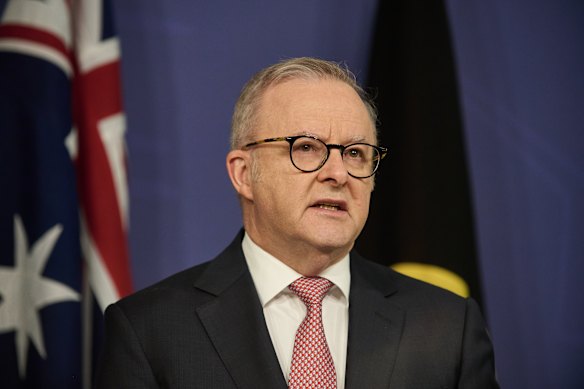
Iran’s retaliatory attacks on US and Israeli infrastructure in the Middle East are proof that the Islamic Republic remains “a threat to peace and stability,” Prime Minister Anthony Albanese told ABC 7.30 a short time ago.
“We’ve seen, even in hours, attacks on a British base Cyprus, on French forces stationed in Abu Dhabi, and on the Gulf,” Albanese said.
“Right across the board, a seemingly endless series of attacks, including in residential areas, in areas that are frequented by tourists in Dubai and Abu Dhabi and Qatar.”
Asked if Australia was concerned that the US may have broken international law by launching the initial attack on Saturday, Albanese said the government was supportive of the White House “stopping the role that Iran has played in undermining peace and security in the region” and that Iran’s assassinated Supreme Leader Ali Khamenei “will not be mourned”.
Oil prices soared today to their highest level in four years. The spike coincided with claims by Iranian authorities that they had attacked three oil tankers at the Strait of Hormuz.
That waterway is a critical choke-point in shipping. Its closure would be a disaster for the oil industry – something Stephen Bartholomeusz describes as a “nightmare” scenario.
And that would be bad news for Australian households as it would inevitably lead to a rise in petrol prices too.
This latest conflict has been a long time coming.
In announcing the strikes on Saturday, US President Donald Trump boasted that by hitting Iran, he was doing something no American president had done before: striking the country’s leadership and providing ordinary Iranians with the chance to rise up against the dictatorship.
Here’s a brief recap of how we got here.
One of the biggest developments of the day was an Iranian drone strike on Akrotiri, a British air base on Cyprus.
Britain has sovereignty over the territory of two bases on the eastern Mediterranean island, and British Prime Minister Keir Starmer had earlier given the US permission to use UK bases for “specific and limited defensive purposes”.
The UK is a member of NATO and member states have an obligation to defend each other in the case of attack.
Cyprus is, of course, a full member of the European Union.
This all means that the Iranian strikes on the UK’s Cyprus bases very much bring the war to Europe’s door.
A US pilot was forced to activate his parachute after his fighter jet was shot down over Kuwait in a suspected incident of friendly fire.
Video shared by regional media shows an American F-15 jet falling through the sky after being shot down. The White House acknowledged the reports were correct.
The Kuwait Ministry of Defence confirmed a number of US fighters had been shot down, but that the pilots were safe.
US President Donald Trump said three US personnel had been killed since hostilities began on Saturday.
Earlier, there were reports of an Iranian attack on the US embassy in Kuwait.
The aviation sector is in chaos following the closure of civilian airspace in the Middle East.
About 115,000 Australians are believed to be in the region, according to Foreign Minister Penny Wong. The airports in Dubai, Doha and Abu Dhabi, in particular, are major stopover hubs – thousands of people transit through those each day while flying to or from Australia in more peaceful times. Both Dubai and Abu Dhabi airports have been hit by missile shrapnel and other debris as a result of Iranian counterattacks on US bases.
The federal opposition has accused the government of not providing early enough no-fly warnings to Australians in the lead-up to the American assault on Iran. Coalition defence spokesman James Paterson said the government should now be looking to help Australians who are stuck in the region.
Wong says repatriation flights would be challenging. “Obviously, it’s very difficult at the moment for government to provide a great deal of assistance in circumstances where flights are being cancelled, disrupted and airspace is closed,” she said. “Given the numbers of people in the region, people will get home most quickly if we can facilitate people getting onto commercial flights. At the moment, the issue is not who is flying – it’s that people are not flying.”
You can read more on this from Matthew Knott.
Welcome to our ongoing coverage of the war in Iran. Keep reading for a summary of where we’re at two days after the US and Israel launched attacks on Iran (or head here for a more detailed version). We’ll be keeping an eye on these and other developments overnight and into Tuesday.
- US and Israeli forces have hit more than 2000 targets in Iran since first striking on Saturday. They have sunk nine Iranian naval ships and killed 48 of the country’s commanders, including Supreme Leader Ayatollah Ali Khamenei. In return, Iran has struck dozens of targets across at least eight countries that host US or Israeli assets. Iran would not negotiate with the US, the Islamic Republic’s security chief said.
- Israel opened a new front by targeting the Iran-backed Hezbollah militant group in Lebanon.
- Hundreds of civilians have been killed in Iran, according to the Red Crescent. At least nine people are dead in Israel, while US President Donald Trump reported that three American soldiers had been killed. He vowed to avenge their deaths.
- The leaders of Britain, France and Germany said they would defend their interests in the region. British Prime Minister Keir Starmer agreed to allow the US to use British bases for defensive operations; Iran later attacked one such base on Cyprus.
- About 115,000 Australians remain in the Middle East following the closure of airports and civilian airspace. Foreign Minister Penny Wong said arranging repatriation flights would be challenging. The airports in Dubai, Doha and Abu Dhabi are stopover hubs; Dubai and Abu Dhabi airports have been hit by shrapnel and other debris following Iranian counterattacks.
- Australian Grand Prix boss Travis Auld was confident the race would go ahead this weekend despite the travel chaos.
- Motorists face rising petrol prices as the conflict rattles energy markets amid fears that oil prices could blow past $US100 ($140) a barrel for the first time in years.
Read more on the US-Israel-Iran war:
Disclaimer : This story is auto aggregated by a computer programme and has not been created or edited by DOWNTHENEWS. Publisher: www.smh.com.au