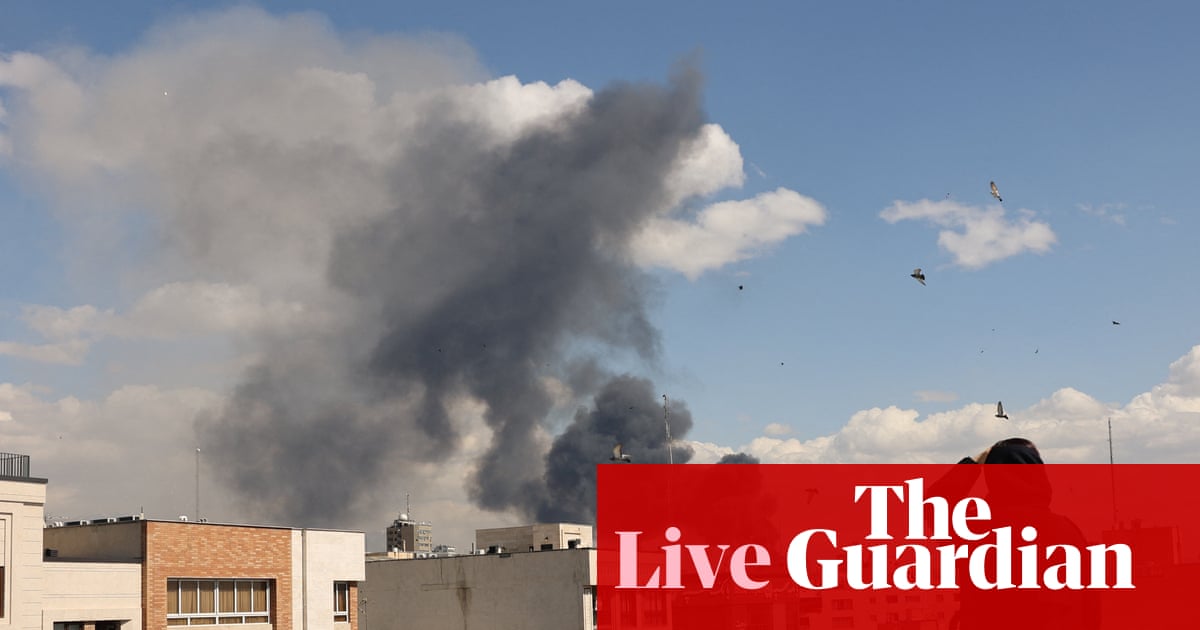
In a statement posted to social media, the Israel Defense Forces says it is now striking “targets” of the Iranian “regime in the heart of Tehran”.
“The Air Force, guided by military Intelligence, has now launched a broad wave of strikes against targets of the Iranian terror regime in the heart of Tehran,” a statement to X reads.
“Over the past day, the Israeli Air Force conducted large-scale strikes in order to establish aerial superiority and to pave the path to Tehran.”
Although Israel has said it has been targeting military assets in Iran, there have been reports of a high civilian death toll.
Amir Saeid Iravani, the Iranian ambassador to the UN, told an emergency UN security council meeting that hundreds of civilians had been killed or injured in the US-Israeli strikes. He accused them of deliberately attacking civilian neighbourhoods in multiple cities.
Emma Graham-Harrison, the Guardian’s chief Middle East correspondent, provides a report from the scene of an Iranian strike on Tel Aviv last night:
The blast from an Iranian missile ripped apart the front of Tel Aviv restaurant Flor on Saturday night, but left rows of wine bottles strangely untouched on shelves now open to the street.
Ben Sommerfield was there minutes afterwards, to survey the ruins of a space that is much more than a business for him and two partners. “This is our life,” he said. “In war everyone loses. We are not for all of this.”
The bomb hit an apartment block on the other side of a small park, killing one woman in her 40s – the first death reported from Iranian attacks – and injuring 25 others.
It also damaged dozens of buildings in the area, testament to the destructive power of the Iranian missiles that do make it through Israel’s sophisticated multi-layer air defence system.
Tom Yakoov, a 30-year-old tech worker, was sheltering in the reinforced safe room of his newly built apartment block, when he felt the whole building shake.
“There was a loud noise, the smell of explosive smoke. I couldn’t tell if the bomb fell right here, or 200 metres away,” he said.
When he emerged after half an hour, he found some windows blown out, but hopes to move back in soon, and fully backs the joint US-Israeli assault on Iran.
“Its like an Israeli story I can tell my children, the tyrant was down and my building was hit,” he said, hours after Iran confirmed supreme leader Ali Khamenei had been killed. “The only thing I’m sorry is that we didn’t do it earlier in last June.”
His neighbour Hen Shalom was less sanguine about surviving a near miss with a missile, and questioned why Israel was paying such a high price to attack a man in his 80s.
“I would prefer [Israel] had not done it,” he said of the attacks that unleashed Iranian retaliation on Tel Aviv. “The tyrant would have died in four years anyway.”
Security camera footage from Flor captured the moment of impact in their storeroom, where neatly ordered shelves exploded into chaos.
On Sunday as Sommerfield and his partners supervised the clean-up, customers stopped by to offer coffee, support and sometimes a little black humour. One posted a photo of the ruins on instagram with the caption “I understand Khamenei didn’t like that natural wine”, a nod to hipster drink tastes.
China said it “strongly condemns” the US and Israel’s killing of Iran’s supreme leader Ayatollah Ali Khamenei, calling again for a halt to military actions, AFP reports.
The killing was “a serious violation of Iran’s sovereignty and security, a trampling on the aims and principles of the UN Charter and the basic norms of international relations”, Beijing’s foreign ministry said in a statement.
“China firmly opposes and strongly condemns this,” it added, calling for an “immediate halting of military operations”.
The condemnation came just after Chinese state media reported a phone call between Beijing’s top diplomat Wang Yi and Russian counterpart Sergei Lavrov.
During the conversation, which state news agency Xinhua said was initiated by Lavrov, Wang said the “blatant killing of a sovereign leader and the incitement of regime change” by the US and Israel was “unacceptable”.
-
Israel says it is hitting targets “in the heart of Tehran” on the second day of attacks to overthrow Iran’s government with the US.
-
The American president, Donald Trump, said on Sunday that the US would strike Iran “with a force that has never been seen before” if Tehran carried out threats to retaliate after the supreme leader, Ayatollah Ali Khamenei, was killed yesterday. Trump has urged Iranians to “take back their country”.
-
Russian President Vladimir Putin said the killing of Khamenei, who ruled Iran since 1989, was “a cynical violation of all norms of human morality and international law”.
-
Other senior figures in the Iranian regime who were killed in Saturday’s strikes reportedly include the commander of the Revolutionary Guards, Gen Mohammad Pakpour, and defence minister Aziz Nasirzadeh. Israel says at least 40 Iranian “commanders” were killed in the “opening” strikes.
-
All three members have now been appointed to Iran’s temporary leadership council, which fulfils the role of the supreme leader until a successor is chosen.
-
It means the Iranian president, Masoud Pezeshkian, the judiciary chief, Gholamhossein Mohseni Ejei, and senior cleric Alireza Arafi will reportedly lead Iran in the transitional period following Khamenei’s death.
-
The death toll from a US-Israeli missile strike on a girls’ school in southern Iran has risen to almost 150, according to Iranian state media.
-
At least 133 civilians have been killed and 200 civilians injured during US-Israel strikes on Iran on Saturday, according to the US-based organisation HRANA (Human Rights Activists News Agency).
-
Iran has launched retalitory missiles and drones targeting Israel. Strikes have also been reported in Dubai, Qatar’s capital Doha, Bahrain and Kuwait.
-
Officials in Tel Aviv said about 40 buildings were damaged by retaliatory Iranian ballistic missile strikes, with two people reportedly killed.
-
The UK’s defence secretary, John Healey, said Iranian missiles and drones had landed within “a few hundred yards” of about 300 British troops at a base in Bahrain.
-
Hundreds of thousands of travellers were stranded or diverted to other airports after Israel, Qatar, Syria, Iran, Iraq, Kuwait and Bahrain closed their airspace.
-
Ships have reported hearing a radio broadcast purporting to come from the Iranian navy announcing that transit through the vital strait of Hormuz was banned, raising expectations of a sharp jump in oil prices. But there’s been no formal announcement from Tehran about the status of the strait, one of the world’s most important shipping routes.
Experts have said the attacks by Israel and the US on Iran – which came days after talks on Tehran’s nuclear programme ended without a deal – were illegal, as they were in violation of the ban on the use of force under the UN charter and international law.
Here is an extract from my colleague Julian Borger’s analysis on why the US strikes had no sound legal basis:
The attack on Iran is a clear violation of the UN charter, in any absence of any credible, imminent Iranian threat to the US. In an attempt at justification, Trump spoke in generalities, denouncing the Tehran leadership as “a vicious group of very hard, terrible people” and 47 years of enmity between the US and the Islamic Republic.
Over that half century, Iran has arguably never posed less of a threat than now, weakened both by the joint attack by the US and Israel last June that degraded its defences, and decades of sanctions combined with economic migration that brought mass protests on to the street.
The strait of Hormuz is one of the world’s most important arteries for global trade. About 20% of global oil supplies and about 20% of seaborne gas tankers pass through it.
The strait lies between Oman and Iran. It links the Gulf to the north with the Gulf of Oman to the south and the Arabian Sea beyond. It is 20 miles (33km) wide at its narrowest point, with the shipping lanes just 2 miles (3km) wide in either direction.
This location makes it a crucial choke point for oil deliveries from countries within the Organization of Petroleum Exporting Countries (Opec) to customers in Asia. Options to bypass the strait are limited.
For years, Tehran has warned that it could use its location to shut the strait in retaliation to military aggression against Iran, but has stopped short of a prolonged block on the trade route. Experts believe this time may be different. You can read more in this explainer:
A vessel was struck ealier today by an “unknown projectile” about 50 nautical miles north of Oman’s capital, Muscat, the United Kingdom Maritime Trade Operations agency (UKMTO) said in an update.
The UKMTO, which reports incidents and provides security information to mariners, shipping companies and regional authorities, said the attack resulted in a fire in the vessel’s engine room that has been brought under control. Earlier, the agency alerted another incident off Oman’s Kumzar in the strait of Hormuz.
The agency said in a separate statement that it was aware of “significant military activity” in the Arabian Gulf, Gulf of Oman, North Arabian Sea and the strait of Hormuz as it warned of an “elevated threat” to commercial shipping.
Within hours of the US-Israeli strikes, Iran’s Revolutionary Guards reportedly warned tankers in the strait that no ship would be allowed to pass via the world’s most critical oil trade route.
Here is a map showing Iran’s retaliatory strikes on countries across the region:
Here is a map put together by our visuals team showing the US-Israeli airtsrikes on Iran. Strikes hit across the country on Saturday, and then were followed up on Sunday with another round of strikes, including further attacks in the heart of Tehran, the capital.
The EU’s foreign policy chief, Kaja Kallas, has said the killing of Ali Khamenei marks “a defining moment in Iran’s history”.
“What comes next is uncertain. But there is now an open path to a different Iran, one that its people may have greater freedom to shape.” the former Estonian pime minister wrote in a post on X.
“I’m in contact with partners, including those in the region that bear the brunt of Iran’s military actions, to find practical steps for de-escalation.”
Many European countries have called for restraint and urged Tehran to seek a negotiated solution, but have avoided directly condemning the US-Israeli attacks.
Spanish prime minister, Pedro Sánchez, was an outlier, saying the US-Israeli strikes represented an “escalation” that added to “a more uncertain and hostile international order”.
“We likewise reject the actions of the Iranian regime and the Revolutionary Guard. We cannot afford another prolonged and devastating war in the Middle East,” he added.
According to reports, all three members have been appointed to Iran’s temporary leadership council, which is meant to fulfil the supreme leader’s role until a successor is chosen.
Alireza Arafi was appointed on Sunday as the jurist member of the council, ISNA news agency reported, joining Iran’s President Masoud Pezeshkian and chief justice Gholamhossein Mohseni Ejei.
We have not yet been able to independently verify this information.
The Iranian president, Masoud Pezeshkian, has said the killing of Iran’s supreme leader, Ali Khamenei, is “an open war against Muslims, especially Shiites, in all corners of the world”.
“The Islamic Republic of Iran considers bloodshed and revenge against the perpetrators and commanders of this crime as its legitimate duty and right, and will fulfill this great responsibility and duty with all its might,” Pezeshkian was quoted as having said.
In this video explainer, the Guardian’s diplomatic editor, Patrick Wintour, explains what we know so far about the US-Israel attacks, and Iran’s retaliation, and what to expect next:
Hundreds of thousands of travellers were either stranded or diverted to other airports after Israel, Qatar, Syria, Iran, Iraq, Kuwait and Bahrain closed their airspace.
There also was no flight activity over the United Arab Emirates, flight tracking website FlightRadar24 said, after the government there announced a “temporary and partial closure” of its airspace.
That led to the closure of key hub airports in Dubai, Abu Dhabi and Doha, and the cancellation of more than 1,000 flights by major Middle Eastern airlines.
The three major airlines that operate at those airports – Emirates, Qatar Airways and Etihad – typically have about 90,000 passengers per day passing through those hubs and even more travellers headed to destinations in the Middle East, according to aviation analytics firm Cirium.
Dubai international airport is the world’s busiest airport for international flights. You can read more here:
Emirates airline has said it has temporarily suspended all operations to and from Dubai until at least 15:00 UAE time tomorrow due to airspace closures across the region.
Key transit airports, including Dubai and Abu Dhabi in the UAE and Doha in Qatar, were shut or severely restricted as of this morning.
Dubai International Airport was damaged during Iran’s retailitaroy attacks, while airports in Abu Dhabi and Kuwait were also hit.
British Airways and Virgin Atlantic are among carriers to have cancelled flights to the region as attacks continue and airspace remains closed or restricted.
Russian President Vladimir Putin has described the killing of Iran’s supreme leader, Ali Khamenei, in a large-scale air attack by the US and Israel as a “cynical violation of all norms of human morality”.
Putin said in a note to Iranian counterpart Masoud Pezeshkian:
Please accept my deep condolences in connection with the murder of the Supreme Leader of the Islamic Republic of Iran, Seyed Ali Khamenei, and members of his family, committed in cynical violation of all norms of human morality and international law.
In our country, Ayatollah Khamenei will be remembered as an outstanding statesman who made a huge personal contribution to the development of friendly Russian-Iranian relations and bringing them to the level of a comprehensive strategic partnership.
I ask you to convey my most sincere sympathy and support to the family and friends of the Supreme Leader, the government and the entire people of Iran.
Russia is key trade partner and supplier of weapons and technologies for Iran. Meanwhile, North Korea’s foreign ministry spokesperson said Israel’s attacks on Iran and the US military operation were “illegal aggression” and a violation of national sovereignty.
Disclaimer : This story is auto aggregated by a computer programme and has not been created or edited by DOWNTHENEWS. Publisher: theguardian.com