Jammu and Kashmir is an integral and inalienable part of India. New Delhi has consistently maintained its position in the face of repeated unfounded claims by Pakistan. Recently, India’s stance has been acknowledged by one of its most trusted allies and the world’s leading superpower, the United States.
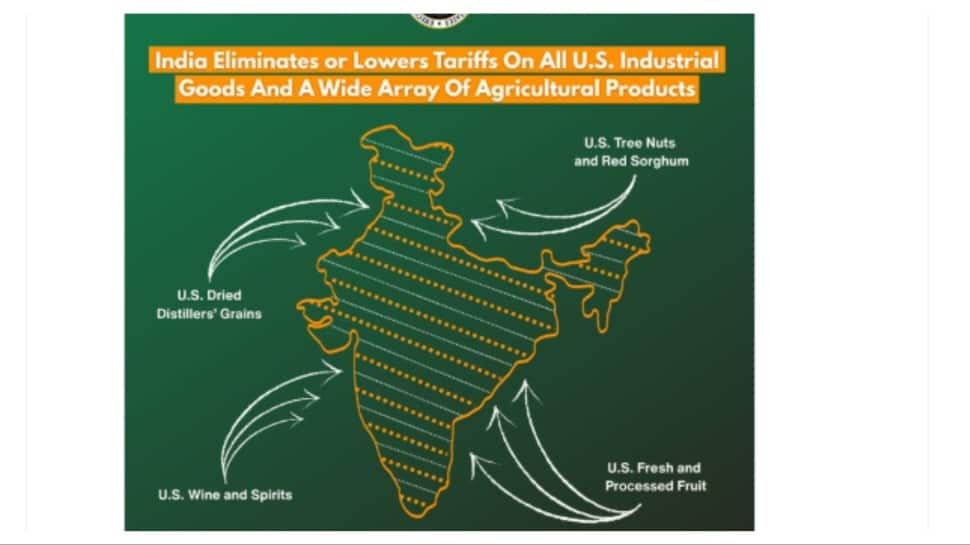
The US has affirmed India’s territorial integrity by showing entire Jammu and Kashmir in India’s official map. The US Trade Representative office released the map while announcing an interim trade agreement with India, showing the entire northern Union Territory, including Pakistan-occupied Kashmir (POK), and Aksai Chin (claimed by China), as part of India, without any dotted lines, demarcations, or labels indicating it as non-disputed territory.
Add Zee News as a Preferred Source

This move has attracted significant attention on social media, highlighting Washington’s recognition of India’s borders and sending a clear diplomatic signal amid ongoing regional dispute.
However, India’s territorial sovereignty over Kashmir has never depended on any external validation, as the country has always asserted that the region is an integral part of its territory. Nevertheless, the Washington’s latest acknowledgement marks a shift from its previous position.
Why It Matters?
Previous US government maps (often from the State Department or other agencies), typically included clear distinctions—such as dotted lines or annotations—for PoK to reflect Pakistan’s claims and the disputed status, while sometimes marking Aksai Chin separately or in line with China’s position.
Additionally, the context includes reports of President Trump’s approach to re-hyphenating India and Pakistan in US policy discussions—reversing the “de-hyphenation” strategy (treating India and Pakistan separately) pursued since the George W. Bush administration and continued by later presidents. This map’s release, amid improving US-India ties post-turbulent trade talks, underscores a perceived tilt toward India on territorial representation.
India has long protested such depictions of its borders by US State Department and other international agencies, particularly regarding Jammu & Kashmir and Arunachal Pradesh, viewing them as inaccurate and inconsistent with its territorial integrity.
Whether intentional or not, it has conveyed a clear diplomatic message to Pakistan: that the US leadership recognises and aligns with India’s territorial claims.
The timing is particularly relevant, as it coincides with the US-India interim trade framework announced on the same day February 7, 2026. Under this deal:
1. The US reduced tariffs on Indian goods to 18% (reciprocal rate), down from a high of 50% imposed earlier during trade frictions (including penalties linked to India’s Russian oil purchases).
2. This is described as among the lowest for Asian nations in the context of the agreement.
3. India committed to lowering or eliminating duties on various US products (e.g., industrial goods, agricultural items like tree nuts, dried distillers’ grains, sorghum, fruits, and more), shifting away from Russian oil toward US energy supplies, and advancing toward a broader Bilateral Trade Agreement.
Disclaimer : This story is auto aggregated by a computer programme and has not been created or edited by DOWNTHENEWS. Publisher: ZEE News