By Aamer Madhani and Konstantin Toropin
Washington: The United States has seized an oil tanker off the coast of Venezuela amid mounting tensions with the government of Venezuelan President Nicolas Maduro.
A team of special forces, coast guards and Marines stormed aboard the crude carrier Skipper just after dawn on Wednesday, US media reported, citing military sources.
“We’ve just seized a tanker on the coast of Venezuela, a large tanker, very large, [the] largest one ever seized, actually,” US President Donald Trump told reporters at the White House.
The move is the Trump administration’s latest effort to increase pressure on Maduro, who has been charged with narco-terrorism in the US. American forces have conducted a series of deadly military strikes in the Caribbean Sea and the eastern Pacific Ocean on boats that Washington alleges are carrying drugs.
Responding to the tanker seizure, Venezuela accused the US in a statement of “blatant theft”.
Speaking in Washington, Trump said “other things are happening”, but did not offer additional details, saying he would comment further later.
According to US broadcaster CBS, citing military sources, the operation began at about 6am US time (10pm AEDT) on Wednesday, after the ship had just left port in Venezuela.
The mission was launched from the aircraft carrier USS Gerald R. Ford, which arrived in the region weeks ago as part of a broader build-up of American forces, the sources told CBS.
The operation involved two helicopters, special operations forces, 10 members of the US Coast Guard and 10 Marines, the sources said. The boarding team was composed of the Coast Guard’s Maritime Security and Response Team, an elite maritime interdiction unit based in Chesapeake, Virginia.
Footage posted to social media by US Attorney-General Pam Bondi showed US personnel landing on the ship’s deck by helicopter.
“This seizure, completed off the coast of Venezuela, was conducted safely and securely – and our investigation alongside the Department of Homeland Security to prevent the transport of sanctioned oil continues,” Bondi said in an X post.
According to ship-tracking site Marine Traffic, the Skipper is 332.9 metres long and sails under the flag of Guyana. The vessel is classed as a “very large crude carrier” (VLCC), capable of transporting up to 320,000 deadweight tonnes of oil.
Latest positional data showed the ship about 100 kilometres off the coast of Venezuela.
Formerly named Adisa, the tanker was sanctioned by the US in 2022 over accusations of belonging to a sophisticated network of “ghost tankers” that smuggled crude oil on behalf of Iran’s Revolutionary Guard and Lebanon’s Hezbollah militant group.
Venezuela has the world’s largest proven oil reserves, and its economy relies on oil production of about 1 million barrels a day.
Locked out of global oil markets by US sanctions, the state-owned oil company sells most of its output at a steep discount to refiners in China via a complex network of shadowy intermediaries, many of which are shell companies registered in jurisdictions known for secrecy.
The buyers deploy ghost tankers that hide their location and hand off their valuable cargoes in the middle of the ocean before they reach their final destination.
A day earlier, the US military flew a pair of fighter jets over the Gulf of Venezuela in what appeared to be the closest that warplanes had come to the South American country’s airspace since the start of the administration’s pressure campaign.
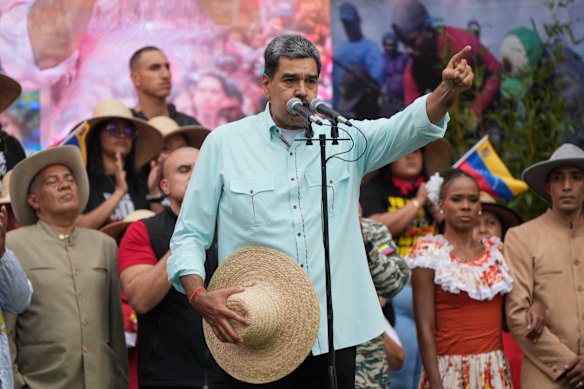
Venezuelan President Nicolas Maduro speaks to supporters at an event commemorating the Battle of Santa Isabel on Wednesday.Credit: AP
Washington has built up the largest military presence in the region in decades, and Trump has said land attacks are coming soon, but has not offered any details on location.
Among the concessions the US has made to Maduro during past negotiations was approval for oil giant Chevron to resume pumping and exporting Venezuelan oil. The corporation’s activities in the South American country provided a financial lifeline to Maduro’s government.
Speaking at a rally on Wednesday, Maduro said anyone who wants Venezuelan oil must respect the law and that Venezuela would never again be an “oil colony”, the BBC reported.
Channelling the 1988 Bobby McFerrin hit, Maduro also addressed “American citizens who are against the war”, telling them “don’t worry, be happy”.
“Not war, be happy. Not, not crazy war, not, be happy.” The BBC said it was unclear whether Maduro knew of the tanker’s seizure before the rally.
During a November phone call between the two leaders, Trump reportedly offered Maduro and his family safe passage out of Caracas if he relinquished power immediately.
But Washington was unwilling to agree to Maduro’s demands, which included legal amnesty and the removal of US sanctions for him and over 100 Venezuelan officials.
Oil futures rose following news of the tanker seizure. After trading in negative territory, Brent crude futures rose US27¢, or 0.4 per cent, to settle at $US62.21 ($93.70) a barrel, while US West Texas Intermediate crude futures gained US21¢, also 0.4 per cent, to close at $US58.46 per barrel.
Venezuelan Nobel winner misses ceremony
In a separate development, Venezuela’s opposition leader Maria Corina Machado was absent from the ceremony in Norway in which she was to receive this year’s Nobel Peace Prize.
Machado’s daughter accepted the award on her behalf in a ceremony that became a rally for democracy and an indictment of Venezuela’s government, with attendees hearing in detail documented human rights abuses carried out against real or perceived opponents of Maduro.
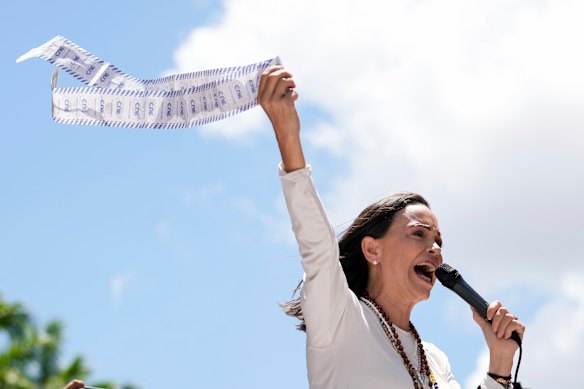
Maria Corina Machado holds up tally sheets during a protest against Maduro’s re-election last year.Credit: AP
In an audio recording of a phone call published on the Nobel website ahead of the event, Machado said she wouldn’t be able to arrive in time for the ceremony but should be in Oslo. She added that she was “very grateful” to the many people who had “risked their lives” for her to travel to Norway.
Machado has not been seen in public since January 9, when she was briefly detained after joining supporters in an anti-government protest in Caracas, Venezuela’s capital. The following day, Maduro was sworn in to a third six-year term despite credible evidence that he lost the presidential election.
AP, Reuters
Get a note directly from our foreign correspondents on what’s making headlines around the world. Sign up for our weekly What in the World newsletter.
Most Viewed in World
Disclaimer : This story is auto aggregated by a computer programme and has not been created or edited by DOWNTHENEWS. Publisher: www.smh.com.au