
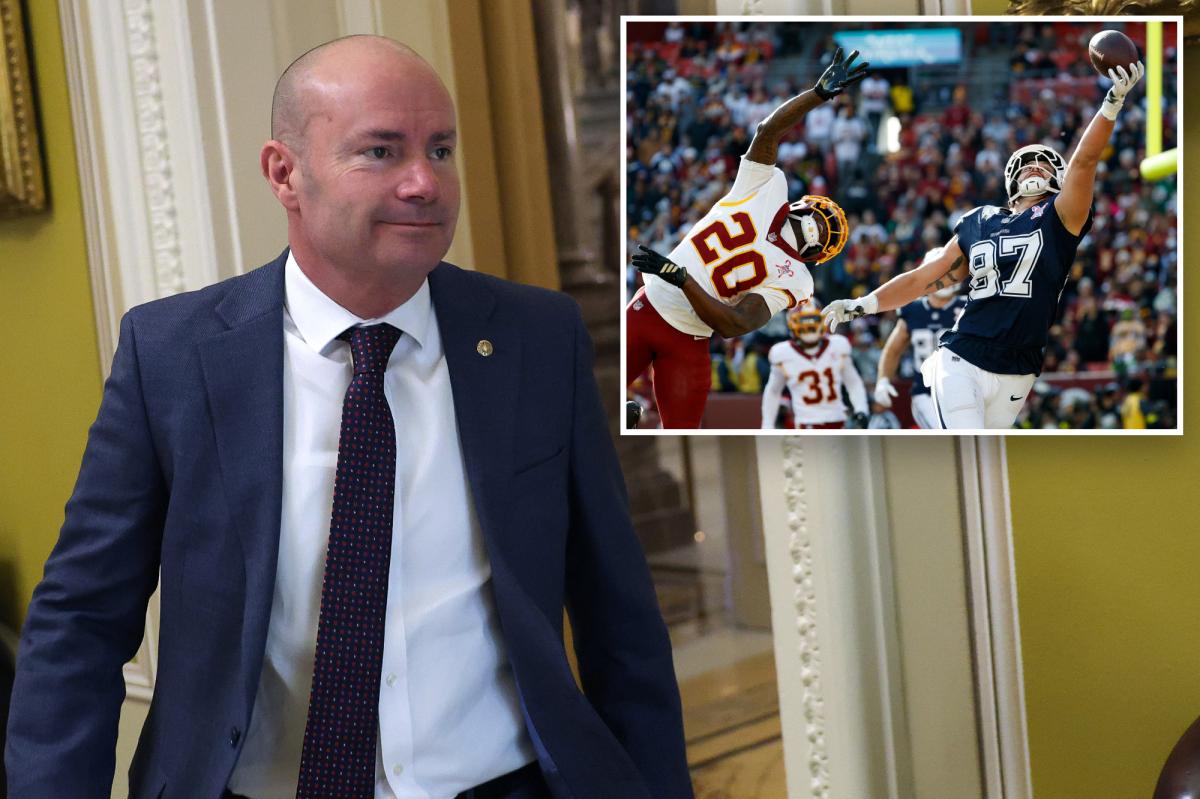
Sen. Mike Lee is urging the Justice Department and Federal Trade Commission to probe the soaring costs of watching NFL and other sports games, as the FCC has signaled it may crack down on pro leagues’ deals with streamers, The Post has learned.
The Utah Republican, who chairs the Senate’s antitrust subcommittee, on Monday called on the DOJ’s Acting Assistant Attorney General Omeed Assefi and FTC Chairman Andrew Ferguson to probe whether the law governing rights to air games serves consumers in the age of streaming, according to a copy of a letter obtained by The Post.
Under the Sports Broadcasting Act of 1961, leagues have been able to pool their individual teams’ TV rights into massive packages and hold deals with multiple streamers – forcing football fans to spend roughly $1,000 on cable and streaming services if they wanted to watch every NFL game this past season, Lee wrote.
“I request that your antitrust enforcement agencies examine the Sports Broadcasting Act and its applicability to current media landscape,” the senator wrote in a copy of the letter obtained by The Post.
“The Subcommittee on Antitrust, Competition Policy, and Consumer Rights welcomes your expertise as we evaluate whether the statute continues to serve consumers or should be revised to reflect modern market conditions.”
The DOJ and FTC did not immediately respond to The Post’s requests for comment.
Last week, the Federal Communications Commission asked the public for comment on how the shift from traditional TV broadcasts to streamers has impacted consumers – a potential first step before a more serious investigation.
NFL games, for example, aired on Amazon Prime Video, Peacock, Netflix, YouTube and six other streamers last year, the FCC Media Bureau noted in its filing — citing a higher estimate to watch every pro football game, on the order of about $1,500.
“For decades, Americans enjoyed turning on their TV & quickly finding the game they wanted to see. Yet watching your favorite team play isn’t as easy these day,” FCC Chairman Brendan Carr tweeted last week alongside the public notice.
The commission also called out the Sports Broadcasting Act, noting that sports media rights fees have “exponentially increased” since Congress passed the legislation decades ago.
In 1961, for example, the National Football League clinched a two-year rights agreement with CBS worth $9.8 million – far below its most recent deals valued at more than $10 billion annually, according to the FCC.
The National Association of Broadcasters applauded Lee’s call for an investigation, as well as the FCC’s public notice.
“Live sports have long been a unifying, free and widely accessible part of our culture. When those games become increasingly fragmented across paid services, fans face higher costs and greater confusion, and too many families are left out,” NAB spokesperson Grace Whaley told The Post in a statement.
“The consequences are not just about sports. For local stations, sports programming helps fund the trusted local journalism that communities rely on every day and especially during emergencies.”
Top-dollar media rights deals have turned the NFL into a serious money-making business, with nearly all of the league’s 32 teams led by billionaires.
The Denver Broncos are owned by Walmart heir Rob Walton, who has an estimated net worth of $148 billion, while the Kansas City Chiefs are owned by the Hunt family, worth roughly $24.8 billion, according to estimates from Bloomberg and Forbes.
The NFL currently holds media rights agreements with streamers owned by Disney, Paramount, Fox Corporation, NBCUniversal, the NFL Network, Amazon, Google and Netflix – which are expected to rake in more than $100 billion in sports rights fees, the FCC noted.
Fox Corporation shares common ownership with News Corporation, The Post’s parent company.
Other major professional sports leagues similarly hold several media rights deals with varying streaming services worth billions of dollars.
In some cases, subscription payments are so huge that they have surpassed revenue from ticket sales as the leagues’ largest source of revenue, the FCC stated, citing Sports Business Journal and Sportico.
The FCC also noted that deals with streamers could harm local broadcasters, which typically rely on advertising revenue from sporting events to fund TV newsrooms.
Disclaimer : This story is auto aggregated by a computer programme and has not been created or edited by DOWNTHENEWS. Publisher: nypost.com



