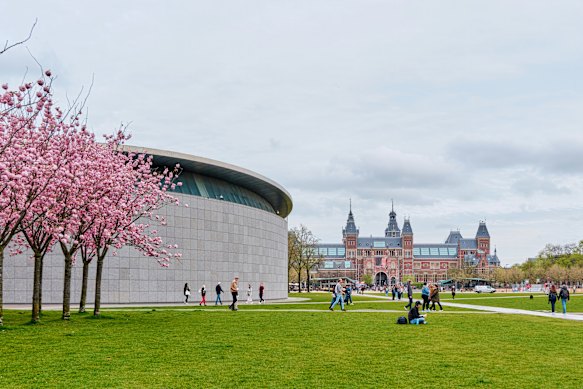

There’s a glut of tulips in Amsterdam, but Vincent van Gogh’s sunflowers are hidden from view.
Early risers stoop to photograph bulbous blooms spilling from pots outside the Van Gogh Museum, and straighten to snap cherry blossoms frothing on trees around Museumsplein, the largest square in Amsterdam which is bordered by some of the city’s major museums.
Meanwhile, my daughter and I hurry to the yet-to-open museum, where a queue is already forming.
“Do you have tickets?” asks a security guard.
We don’t. It’s fully booked today, he says. In fact, the museum’s timed visitor slots are sold out for the next 10 days, the entirety of our Netherlands stay.
Sign up for the Traveller Deals newsletter
Get exclusive travel deals delivered straight to your inbox. Sign up now.
The flood of tulips attracts a deluge of tourists who are also keen to catch van Gogh’s Sunflowers (1888-1889), which bloom perennially behind the museum’s doors. Note to self: next time, book ahead.
Plan B kicks in. At the Rijksmuseum, we admire van Gogh’s Wheatfield (1888), Self Portrait (1887) and View of Amsterdam from Central Station (1885), a work inspired by his visit to this museum when it opened in 1885.
Then we hatch Plan C: a jaunt to Van Gogh Village, Nuenen, in the southern Dutch province of Brabant, where the master perfected his technique.
It’s a 90-minute train ride from central Amsterdam to Eindhoven, and there, friends collect us for the short drive to Nuenen. On the way, I imagine the 30-year-old Vincent arriving by train from Drenthe in late 1883, the sweeping farmland smothered in snow, the peasants who’d soon become his subjects swaddled against the cold.
“You will certainly find the fact that I love the countryside here very understandable,” he later wrote to his brother, Theo, a Paris-based art dealer.
The town’s centrepiece is an interactive museum, which was expanded and reopened in 2023 by Dutch Queen Maxima. Across the road stands the parsonage where van Gogh initially stayed with his mother and pastor father. Depictions of the dwelling and garden are included in his Nuenen oeuvre. But most famous among this prodigious output is The Potato Eaters (1885), “the best thing I have done after all”, he said.
The masterpiece was inspired by encounters with a peasant family, the De Groots, whose hut stood on the edge of town. It no longer exists, but van Gogh evoked the setting in a letter to Theo: “You see, I really have wanted to make it so that people get the idea that these folk, who are eating their potatoes by the light of their little lamp, have tilled the earth themselves with these hands they are putting in the dish, and so it speaks of manual labour and — that they have thus honestly earned their food.”
The oil on canvas – “something like the colour of a really dusty potato, unpeeled, of course” – is held by the fully booked Van Gogh Museum in Amsterdam. But here in its birthplace, we’re immersed in the artist’s milieu: the elegant residence of Margot Begemann, with whom van Gogh had a doomed love affair; the carpentry workshop where his canvases were stretched and paintings framed; the mailman’s house from which he dispatched new works to Theo in exchange for financial assistance.
Down the road is Van Goghkerkje, the chapel where his father preached. It’s cheerier than the melancholic vision painted for his mother when she was bedridden and unable to attend church services.
In the museum, we find sketches of the peasants scattered around the replica studio; an interactive lightlab where we test the artist’s use of colour, light and perspective; and a mock-up of the De Groots’ cramped kitchen, where we pose for photographs in imitation of these immortalised subjects.
Like them, we’ve now earned our food. We stroll to De Aardappeleters (The Potato Eaters), a cafeteria where fries of every description are served.
I order friet oorlog (war fries), a street food staple topped with satay sauce, raw onion and mayonnaise. Potatoes, I find, are a most satisfactory substitute for those elusive sunflowers.
THE DETAILS
TRANSPORT
Eindhoven is an hour by train from central Amsterdam. From Eindhoven, you can take a Line 6 bus to Nuenen, which takes about 15 minutes with tickets costing about €3. Alternatively, you can use Uber.
VISIT
Admission to Van Gogh Village Museum costs $24 for adults; see vangoghvillagenuenen.nl/en
Entry is free if you have a Netherlands Museum Pass ($134 for adults for one year; includes entry to more than 500 museums). See museum.nl/en/museumpass
The writer travelled at her own expense.
 Catherine Marshall has worked as a journalist for more than three decades and has received awards for her travel writing and reportage in Australia and abroad. She specialises in emerging destinations, conservation and immersive travel.Connect via X.
Traveller Guides
From our partners
Disclaimer : This story is auto aggregated by a computer programme and has not been created or edited by DOWNTHENEWS. Publisher: www.smh.com.au