
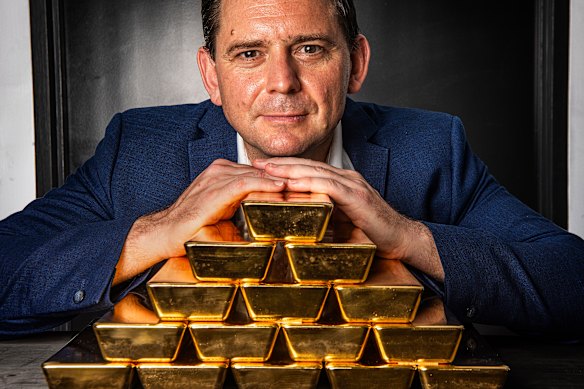

The cold beer at Kalgoorlie Hotel’s main bar is as frothy as the price of gold, and news of the metal’s stellar rise is on drinkers’ lips.
“It’s a hot topic,” says Lauriska De Billot, one of the hotel’s managers. Punters are talking about nearby mines expanding, and new workers are arriving in town because of the boom in activity. “The only downside is we don’t have enough accommodation for them,” she says.
About a dozen blocks away from the pub on the edge of town is the Super Pit, one of Australia’s deepest open cut mines. It exposes a golden mile of some of the richest deposits in the world that has produced more than 60 million ounces of the precious metal since the 1980s.
That wealth lode is flowing into the share price of the mine’s owner, Northern Star Resources, and engineering a seismic shift in the status of gold producers on the Australian Stock Exchange.
Gold miners are well represented among the ASX’s top 200 companies, says Atlas Funds Management’s Hugh Dive, as even junior producers have clawed their way onto the list. “They’ve gone from almost nothing, or just a rounding error, to something you cannot ignore,” he says.
Even on the small ordinaries index, which tracks 200 of the ASX’s smaller companies, gold stocks now account for about 15 per cent, a change which has complicated funds allocation for managers such as Michelle Lopez from Pie Funds Management. New Zealand-based Pie looks after $3.2 billion in funds, about half of which is in Australian equities.
“The benchmark … has skewed massively to commodities now in a much greater way than it was 12 months ago,” Lopez says. “That’s what we’re trying to navigate through.”
In just two years, Northern Star’s shares have shot up 122 per cent. The miner’s market capitalisation – now $40.8 billion – is pulling ahead of retail heavyweights Coles and Woolworths, which are languishing at about $29 billion and $38 billion respectively.
Gold’s glow is not confined to just one producer.
Evolution Mining’s shares rose an astounding 400 per cent over two years to January 29, reflecting the success of its six mines across NSW, WA, Queensland and Canada. “We positioned ourselves exceptionally well to make a lot of money during a gold price environment like this. Our margins are at record levels,” says Evolution’s chair Jake Klein.
“It’s a cyclical business. We want to be countercyclical,” Klein says. “When prices are high, we want to be harvesting cash, like we’re doing now. When prices are low, we want to be growing.”
Others, like South32, are also surfing the commodities boom. Its Cannington operation in north-west Queensland, one of the world’s top producing silver mines, has helped push South32 shares up nearly 40 per cent over the same period.
The rich seams they’re mining are fuelling another of history’s big gold booms.
Gold’s meteoric rise
The Minerals Council of Australia says gold will overtake coal and natural gas to become the nation’s second-largest export earner this year. Record global prices and expanding mine output are underpinning a 28 per cent export growth forecast to $60 billion, up from $47 billion last year.
The price of gold, and its sister metal, silver, tends to spike in response to globe-shaking geopolitical or economic events.
The most recent years-long rally can be traced to early October 2023. Almost immediately after Hamas launched its devastating attack against Israel, massacring more than 1200 people, the upwards pressure on gold and other precious metals began to pick up inexorably.
Israel’s ferocious response – resulting in an estimated 70,000 Palestinian deaths – added another war to an already fractious global geopolitical landscape struggling to contain Russia’s assault on Ukraine.
A year later, another big event – Donald Trump’s second election as US president in early November 2024 – put another booster under gold’s lustre.
The subsequent trade wars with China, on-again-off-again tariffs targeting Canada, Mexico and the rest of the world, the bombing of mountain bunkers in Iran, seizure of Venezuelan strongman Nicolás Maduro, and talk of annexing Greenland have roiled equity markets and fractured old alliances.
But not gold. Seasoned investors, sovereign central banks bulking up their reserves, exchange-traded funds, migrant workers, high-vis tradies, delivery drivers and well-dressed city workers are all piling in.
“We have seen retail buyers snapping up coins and bars in the final quarter of 2025 at the fastest pace in 12 years,” says Ryan Felsman, chief economist at Australia’s largest equities trading platform Commsec. “That’s amplified the impact of rampant ETF [exchange-traded funds] demand as well.”
In September last year, the biggest ETF on the ASX, GOLD, had about $5.4 billion in funds. Now it boasts nearly $6.8 billion, an increase of 25 per cent.
Structured as trusts, ETFs hold physical bullion in secure vaults to back their traded shares. They generally mirror the price of gold which has nearly doubled over the year to January 29 when it reached an all-time high in intraday at about $US5600 ($8000).
Silver’s trajectory has been even more stratospheric. It rose a staggering 298 per cent from about $US30 to $US121 per ounce over the same timeframe. Even the crypto sector has jumped on the gold frenzy.
Bloomberg reported crypto giant Tether Holdings now controls the world’s largest known hoard of bullion outside of banks and nation states, which it stores in a high-security vault in a former nuclear bunker in Switzerland.
But precious minerals’ march came to a sudden halt at the end of January. Silver experienced its biggest ever daily drop on Friday, January 30, and gold plunged the most since 2013. “That bubble popped temporarily on Friday and continued into Monday,” says Felsman.
The volatility was widely attributed to Trump’s announcement of new Federal Reserve chair Kevin Warsh, a choice investors think may be less aggressive on lowering US interest rates than other candidates.
Commonwealth Bank commodities analyst Vivek Dhar says given Warsh’s history and the context of his nomination, it’s difficult to see his appointment as the beginning of a sustained downturn for gold and silver prices. “Such a view would mean sustained stability to the US policy landscape. And we think it is too early to believe this is the case.”
“We think this is a buying opportunity for both gold and silver as the market eventually resumes their preference for hard assets relative to the US dollar,” Dhar says.
Investors seem to agree that the fundamentals that drove bullion to record highs remain intact. Last week, gold was bouncing back. After sliding to above $US4500, it edged above $US5000 again.
Other safe haven assets aren’t performing as well as gold despite its sharp slump. Bitcoin, often touted as a digital gold, has tanked since its value peaked above $US124,000 in October last year, plunging nearly 40 per cent to about $US74,000, and is still heading down.
Jordan Eliseo, general manager at gold trading house ABC Bullion, says queues at the company’s Martin Place store are still commonplace. “It’s an incredibly busy time in the precious metals industry.”
“The number of people selling has increased quite notably. However, that has been dwarfed by the increase in the number of people coming in to buy for the first time, particularly in the last year. For every 100 people lining up in our queues … about 80 to 85 of them would be buying, and 15 to 20 of them would be selling,” Eliseo says.
Over the past 20 years, key upticks in the gold price came with the 2008 global financial crisis, Brexit and Trump’s first election in 2016, and the onset of the global pandemic in 2020.
“This [latest] is the biggest surge that I have seen,” he says.
About a quarter of ABC’s bullion sells to self-managed super fund trustees. “It’s people that are either pre-retiree or retiree. They’re more conservative in terms of how they want to manage their wealth. Buying as a wealth protector is very attractive,” Eliseo says.
He believes today’s bull market is still on “very solid legs and has some way to go”.
Central banks, hedging against the US dollar, are still purchasing, so are consumers in Asia and the Middle East, and there is plenty of local demand for bullion and ETFs, Eliseo maintains.
John Kochanski, a specialist advisor to Australian gold producers, says gold has never experienced a price crash. “Over more than a century, the metal has undergone periodic corrections and consolidations back to trend, but it has not suffered the structural collapses seen in some modern commodities, especially among the so-called strategic metals.”
He maintains gold’s structural resilience will continue to underpin its role as a long-term store of wealth, and explains why, even at record prices, people are still buying.
“Corrections occur. Volatility is normal. Price collapse is not,” he says.
The Business Briefing newsletter delivers major stories, exclusive coverage and expert opinion. Sign up to get it every weekday morning.
 Simon Johanson is a business journalist at The Age and The Sydney Morning Herald.Connect via X or email.
From our partners
Disclaimer : This story is auto aggregated by a computer programme and has not been created or edited by DOWNTHENEWS. Publisher: www.smh.com.au


