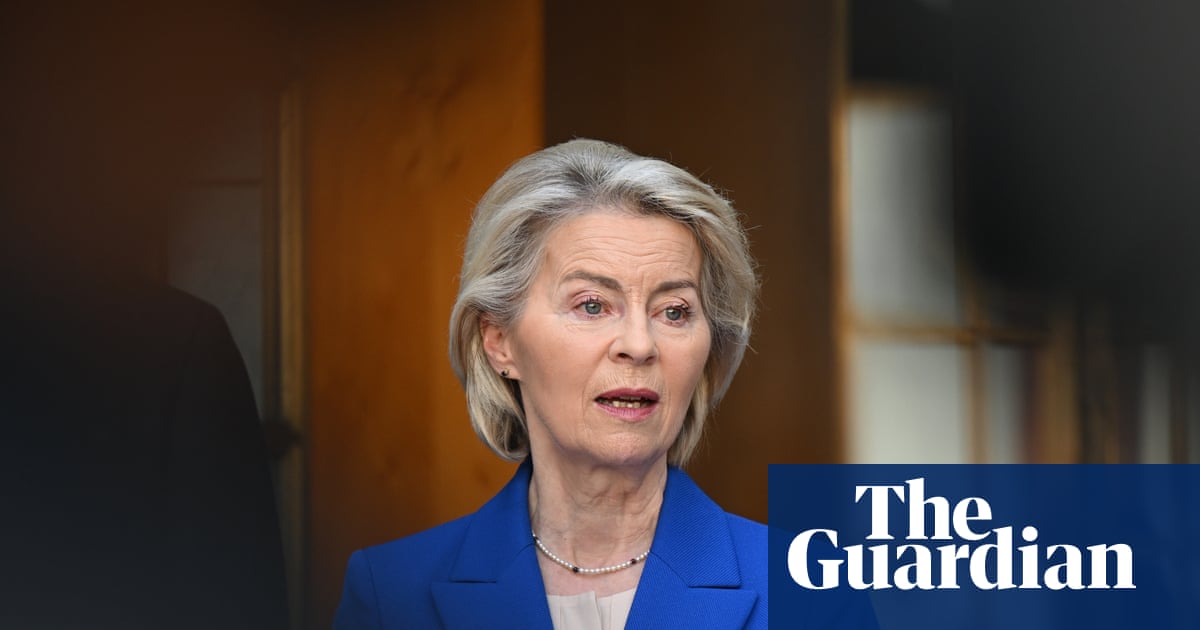
The US and Iran must come to the negotiating table to immediately end the de facto closure of the strait of Hormuz and stop hostilities in the Middle East, the head of the European Commission says.
Ursula von der Leyen, the European Commission president, said Iran’s efforts to block the strategic waterway via attacks on unarmed commercial vessels and critical infrastructure “must be condemned”.
Visiting Australia to sign a new free trade agreement, von der Leyen said an end to the war was necessary to stop growing global economic disruption. About 20% of global oil supplies travel through the strait.
“Iran has to cease immediately the threats, [the] laying of mines, drones and missile attacks, and other attempts to block the strait to commercial shipping,” she said in Canberra on Tuesday.
“The situation is critical for … energy supply allies worldwide.
“We all feel the knock-on effects on gas and oil prices … but it is of utmost importance that we come to a solution that is negotiated, and [that] this puts an end to the hostilities that we see in the Middle East.”
Later, in an address to the Australian parliament, she warned that the country could no longer rely on distance to protect it from war and chaos.
“Countries that built economic models on the very premise of the stability and safety they provide are facing a new reality.
“The world we live in is brutal, harsh and unforgiving. It feels upside down. What we knew as certainties are in question. The comfort blanket of yesterday is ripped away.”
The comments came amid reports that Donald Trump’s special envoy, Steve Witkoff, and son-in-law, Jared Kushner, were communicating with the speaker of the Iranian parliament, Mohammad Bagher Ghalibaf, about possible peace negotiations.
But after more than three weeks of conflict, and with surging oil prices hurting consumers around the world, von der Leyen likened the pain to the fallout felt in Europe after Russia’s 2022 invasion of Ukraine.
The first foreign female political leader to address both houses of the Australian parliament, she said economic shocks meant diversification was necessary for advanced democracies, and called for Australia and the EU to cooperate to deal with China’s export-led growth model.
“With geopolitics at a boiling point, we know first-hand that the more you build homegrown energy, the sooner you get independent and thus can shield yourself from energy price shocks,” von der Leyen said.
“We are in a race to electrify our economies. This is what future generations will judge us on.”
The free trade agreement will see nearly 98% of Australia’s goods enter the EU duty-free. Producers will gain increased access to about 450 million consumers.
A carve-out on geographic indicator rules will allow Australian wine and cheese makers to continue to use European product names, such as prosecco and feta.
Farmers will get preferential access for beef and lamb, with tariffs eliminated on dairy, horticulture and manufactured goods.
European champagne, wine, spirits, biscuits, chocolates and pasta are expected to be less expensive in Australia, as well as auto parts, machinery and equipment.
Australia agreed to enhanced cooperation on critical minerals, avoiding a dual pricing structure for the products considered critical for smartphones, electronics and aircraft.
Australia and the EU will both eliminate tariffs on environmental goods, including energy-efficient products, renewable energy technology and batteries.
The deal does not include carbon border adjustments or provisions on deforestation.
The Australian prime minister, Anthony Albanese, said navigating geopolitical difficulties would be easier through enhanced cooperation.
He said a new defence and security deal signed with the EU would lift collaboration on defence industry, maritime security, cybercrime, terrorism, and the combating of hybrid threats.
“It speaks for our shared commitment to stability and security, anchored in sovereignty,” Albanese said.
Australia also agreed to begin negotiations to enter Horizon Europe, the EU’s research and innovation funding program.
Disclaimer : This story is auto aggregated by a computer programme and has not been created or edited by DOWNTHENEWS. Publisher: theguardian.com