There are a few ways to wrap your head around watching a seven-and-a-half-hour movie.
When I was a kid I used to mark time in “Roseannes,” where 30 minutes would equal one Roseanne—the run time of the sitcom. My junior hockey games were two Roseannes. The drive to my uncle’s was 12. A seven-and-a-half-hour movie is 15 Roseannes, or a flight from New York City to Paris in an economy seat with no headrest. It’s a long time to sit and watch a movie, or do anything, these days. But that didn’t stop 250-plus people from doing it on a recent early-spring Saturday in Manhattan.
Sátántango, Hungarian filmmaker Béla Tarr’s 1994 miserabilist epic about a failed Hungarian farming collective, clocks in at 439 minutes. The centerpiece of Film at Lincoln Center’s Farewell to Béla Tarr program this week (the director died in January, age 70), the film is something of a holy rite for hardcore cinephiles. It is rarely screened, and rarely seen.
Sitting still and watching a black-and-white movie for 7.5 hours is the sort of experience that’s in increasingly short supply. Despairing reports warn of the “attention-span crisis.” Parents are suing social media giants—and winning—for stealing their kids’ ability to focus with allegedly addictive short-form video scrolls. Film professors have lamented that, post-pandemic, their students have trouble sitting through even regular-length movies. A whole genre of memes has emerged celebrating the rotting of the brain itself. Netflix, allegedly, mandates that movies and TV shows repeat plot points for the benefit of half-watching viewers.
Sometimes I find myself having a tough time even sitting through an episode of The Real Housewives of Beverly Hills without reaching for my phone so I can look up hockey scores, google “Amanda Frances scams,” or just swipe mindlessly.
“We’ve weakened the muscle of sustained attention,” says Film at Lincoln Center programmer Tyler Wilson. “Here’s an opportunity to be in a room, with the expectations that I’ll stay, and not look at my phone, and not chit-chat. There’s a shared discipline.”
Sátántango is notable not just for its length. Lots of things are long. Superhero blockbusters routinely push three hours. Bingeing the latest streaming TV sensation has become the de facto mode of viewing. Tarr’s film is not just long. It feels long. Across its 439 minutes, there are only 171 shots, with an average shot of about 2.5 minutes, about 60 times the length of the average shot in a Hollywood film.
Sátántango offers an extended experience of duration itself. It’s a key text in a subgenre of art-house movies sometimes termed “slow cinema.” (And it’s not even the longest entry. I once spent a whole day watching Chinese director Wang Bing’s 2018 doc Dead Souls, about the survivors of a Mao-era “reeducation camp,” which runs more than eight hours.) Where modern editing often aims to tighten the pace of time—making it seem faster, or zippier—slow cinema prolongs it.
“Slow cinema is really a cinema that makes you spend time,” says Lexi Turner, who teaches seminars on slow cinema at Marymount Manhattan College. “There’s an aspect of contemplation. And a demand of patience.” Often employing nonprofessional actors and settings unfamiliar to western audiences, Turner says, these share a certain dignity. By spending time watching someone trudge across a field or the sun set slowly across the horizon, these filmmakers are stressing that these experiences and images are worthy of capture and consideration.
Even describing Sátántango risks making the movie feel bleaker than it is: the length, the monochrome, all the mud and the ceaseless rain, the Hungarian-farming-commune of it all. It sounds like an SNL parody of festival-circuit art movies. One chapter claustrophobically captures a bloated country doctor (Peter Berling) as he methodically moves fruit brandy from bigger vessels to smaller ones, his shallow, Darth Vader breaths rumbling on the soundtrack. A nearly 20 minute sequence follows a mentally disturbed little girl (Erika Bók) as she stalks, abuses, and finally kills a kitty cat. (No actual cats were harmed, Tarr has since assured us.) “There’s kind of a trance, a meditative state, that these films put you in,” says Justin Benz, a 31 year-old Long Islander who attended the Sátántango screening. “There’s moments of silence, where you just have to sit there, and quote-unquote nothing happens.”
Like other marathon movies in this mold, Sátántango is a cinematic experience that is truly experiential. You remember not just seeing it but also the associated feelings. Getting sucked into a film for that long reshapes the senses. You become extra attentive. The eye begins to scan the images onscreen, like they’re oil paintings hung in a gallery. You notice little things, like the way raindrops bead on the fur collar of jackets or the mystery of a drunkard balancing a crusty cheese roll on his forehead. Otherwise minor moviegoing irritations—someone shifting in their seat, the telltale crinkle of an audience member attempting to open a bag of Twizzlers, my stupid smartwatch buzzing with a notification needling me, “Time to stand!”—seem almost unbearably annoying.
Frankly, the film also goes a long way to putting some contemporary issues around the attention-span crisis in perspective. Complaining about the stuff risks making you look like a major-league weenie. My watch is too bright! These Twizzlers are too loud! My movies are too long and beautiful! First-world problems, as they say. Just look at all the hardship those wretches on the busted-out Soviet farming collective had to deal with!
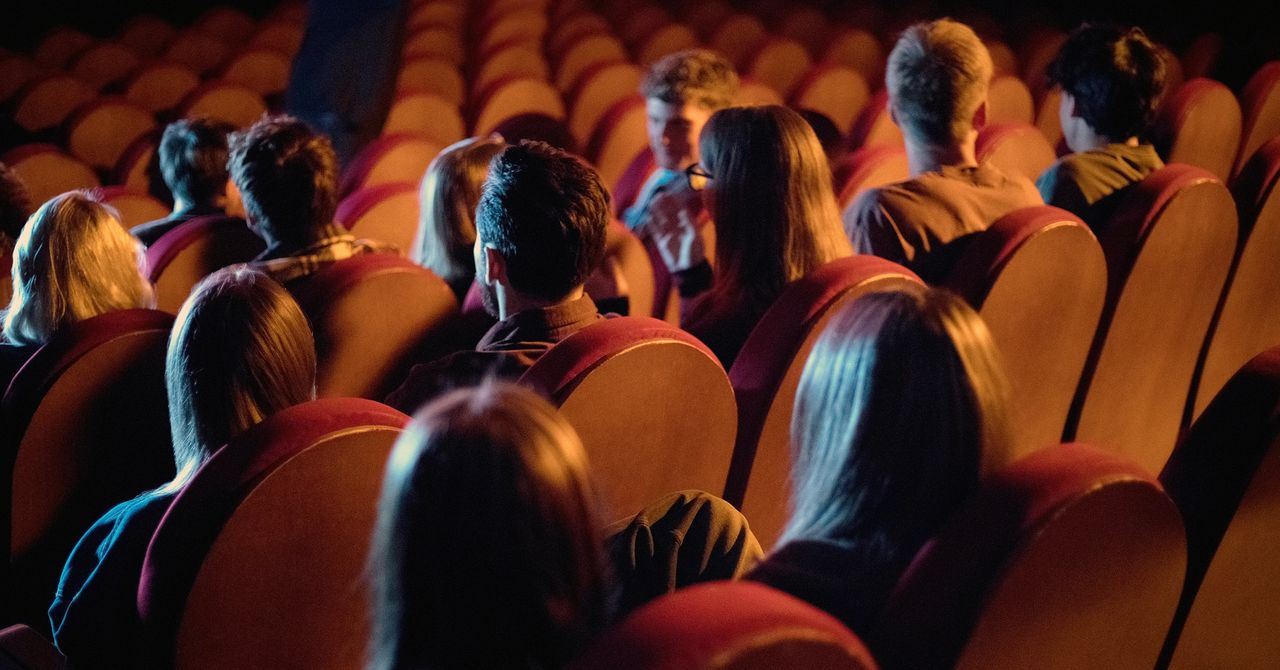
I had seen the film before, on a series of bootlegged .mkv files, split across three evenings during the Covid-19 lockdowns, where free time, and attention, seemed like surplus commodities. But watching it in person, in a cinema, split up by just two short intermissions, and with a bunch of other people, was a completely different deal. The audience skewed mostly young. I clocked one guy wearing a T-shirt with the name Béla Tarr styled like the Black Flag logo. A few heads bobbed and nodded off in places (including, probably, my own). The mind wanders a bit: thinking of what’s for dinner or of the status of one’s March Madness bracket. But for the most part, my own attention was undivided, and the audience seemed rapt, hanging off every slow pan of the camera, every trudging footfall through the mud. No snorting-snores. No one sneakily checking the time. Not a cell phone in sight. There were even a few scattered chuckles, as the crowd began to vibe with the wavelength of the film’s bitter humor and its mordant, practically cosmic pessimism.
Wilson sees Sátántango’s popularity as a cause for optimism. Where prevailing cultural trends may speak to a hopeless winnowing of patience and sustained attention, he has noticed a reaction. He says that audiences are reading longer books, buying tickets to more formally radical films, and generally taking a serious interest in preserving the sanctity of attention. (Just think of the recent trend of “rawdogging” long flights or other ostensibly boring situations.) To wit: his Sátántango screening sold out so briskly, that the cinema had to add two additional engagements this week. “People do have attention, they just don’t have many places where they can use it,” Wilson says. “This movie’s going to take a day for you to watch. That in itself is almost a challenge.”
Benz brushes off the idea that spending a day with a towering masterwork of modern cinema is just some sort of attention nourishing exercise or cinephilic merit badge. “People would roll their eyes!” he laughs, when asked if he’s earned movie-buff bragging rights. “Who gives a fuck? You’re a crazy person! Nobody cares. Except for us.”
Disclaimer : This story is auto aggregated by a computer programme and has not been created or edited by DOWNTHENEWS. Publisher: wired.com