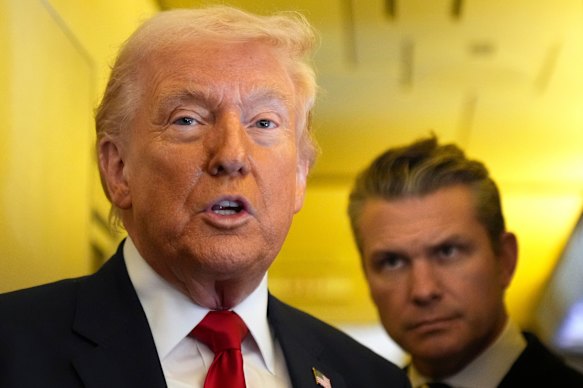

Donald Trump had a lot to say about Iran on Monday (US time), and while the tenor was to suggest the war would come to an end sooner rather than later, there were more than enough mixed messages to make you wonder.
The markets heard what they wanted to hear. They liked his remark in an interview with CBS News that the campaign was “very complete”, and his promise at a later press conference that it would end “very soon”.
“I think you’ll see it’s going to be a short-term excursion,” he told Republican lawmakers at a conference in Miami.
Add to that Trump flagging that more oil sanctions might be lifted to boost supply at a time when the war is choking traffic in the crucial Strait of Hormuz.
Lost, perhaps, in the optimism was all the other stuff we heard from the US president. That while the US had already won the war in many ways, “we haven’t won enough”.
That if the Iranians did anything else to block oil supply through the strait, the US would hit them “TWENTY TIMES HARDER” than they’ve been hit so far.
And when Trump was asked about the discrepancy between his assertion that the war was “very complete” and the remark only a night before from his defence secretary, Pete Hegseth, that this was “just the beginning”, the president said both could be true.
“It’s the beginning of building a new country,” he told reporters. “We could call it a tremendous success right now, or we could further. And we’re going to go further.”
There were mixed messages elsewhere too. Trump simultaneously tried to play down oil price spikes, saying they would be temporary, while wiping away sanctions on Russian oil to boost supply, and entertaining the idea of never putting them back on again.
And he professed himself disappointed by the Iranian clerics choosing Ali Khamenei’s son to replace him as supreme leader, while also saying he would like a regime insider to take over because that formula seemed to have worked well in Venezuela.
If you were starting to get the impression they’re just working it out on the fly, nothing Trump said on Monday would dissuade you from that notion.
Perhaps that’s inevitable. This is war, after all: you can go in with plans and backup plans, but much depends on what actually happens and how others react.
Trump moves at such a pace that weeks can feel like forever, but at the end of the day, we are still operating well within the four- to five-week time frame he gave at the operation.
It is still shorter (just) than the 12-day war of June 2025, which began with Israeli strikes and was effectively finished when the US bombed Iranian nuclear facilities at Natanz, Fordow and Isfahan.
The Iranian regime is pumping out the propaganda about how it is ready for a long fight, with Foreign Minister Abbas Araghchi posting on Monday that Iran is “fully prepared” and has “many surprises in store”,
That can be dismissed as bluster, but the choice of Khamenei’s son as leader suggests the regime is not about to capitulate. Trump wouldn’t be drawn on Monday about whether the new supreme leader has a target on his back, but Israel has already vowed to kill him.
The US has a coalition partner that has maximalist goals for this war and is far less worried about the impact on markets and petrol prices. And Trump is still enticed by the prospect of regime change, even if it means he can’t walk away now and claim victory.
For all the talk, not much actually changed.
Read more on the US-Israel-Iran war:
Get a note directly from our foreign correspondents on what’s making headlines around the world. Sign up for our weekly What in the World newsletter.
 Michael Koziol is the North America correspondent for The Age and Sydney Morning Herald. He is a former Sydney editor, Sun-Herald deputy editor and a federal political reporter in Canberra.Connect via X or email.
From our partners
Disclaimer : This story is auto aggregated by a computer programme and has not been created or edited by DOWNTHENEWS. Publisher: www.smh.com.au