Andy Weir’s novels, and the films they spawn, have been praised for their scientific accuracy – but not by everyone. Which is just how he likes it.
Rocky, the extraterrestrial creature befriended by Ryan Gosling’s astronaut-scientist in the sci-fi dramedy Project Hail Mary, is such an odd creature that you’ve almost certainly never imagined anything like him.
And until the film’s VFX team presented their rendering of him, nor had Andy Weir – despite the fact he dreamt him up.
“I don’t really have a very visual imagination,” says the author of The Martian and Project Hail Mary, the 2021 novel that has been brought to the screen by The Lego Movie directors Phil Lord and Christopher Miller. “When I finished writing the book, I couldn’t have drawn a picture of Rocky even if I had artistic skill, which I do not, because I didn’t really know what he looked like.”
That’s quite incredible, I suggest, because you do describe him in the book in some detail.
“Well, I knew his overall morphology as a creature, but I didn’t really have an image of what he looked like,” Weir explains. “I describe him, but I describe him as ‘well, he has five limbs and a central carapace’ [shell]. I had this idea for what he looked like, but it was just a blobby carapace and I didn’t know what the legs looked like. Were they thick, were they thin, were they smooth, were they crenellated? None of that was in my visual imagination.”
Weir places himself on the aphantasia scale, which rates people’s ability to picture things from 1 (low) to 5 (high), near the bottom end. But while that might sound like an impediment for someone creating work that has a tendency to end up on the big screen, he reckons it isn’t all bad.
“Other authors have to deal with the cognitive dissonance of what they saw in their head versus what’s on the screen,” he says. “I don’t have that problem. I’m just like, ‘Oh, so that’s what Rocky looks like; now I know.’ It just becomes canon in my head, so it’s actually very easy for me.”
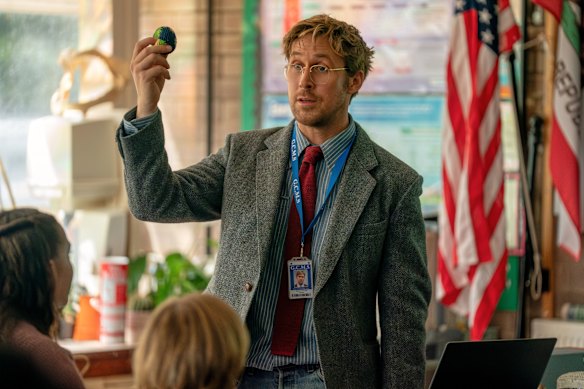
Project Hail Mary – PHM for short – is both massive and intimate in scope. It’s a story about the imminent end of the world (as a result of a sunlight-gobbling organism called astrophage) that will within decades make the Earth uninhabitable for humans and many other life forms. But it’s also about the strange and touching friendship that develops between Ryland Grace (Gosling), a middle school science teacher who improbably becomes our only hope of survival, and Rocky, an engineer on a spacecraft from another similarly afflicted planet who is the sole survivor of his own rescue mission.
It is tempting to see a big message in Weir’s story – about overcoming differences (of appearance, of language, of physics) to find common cause and mutually beneficial outcomes, among other things. But the man himself is quick to brush aside such readings.
“I never have an overall message,” says the American writer of his approach to storytelling. “I’m not trying to make you think about anything. There’s no subtext, there’s no symbolism and no meaning. I want nothing more than to entertain. That’s it. So when you’re done with the book or when you’re done with the movie, I want you to think, ‘That was cool, that was fun. I’m glad I did that.’ And that is it. If people ascribe some meaning, like this is clearly a climate-change metaphor, they’re just seeing that on their own. Nothing to do with me.”
One thing he does aim for, though: scientific accuracy.
According to the official press notes for the movie, Weir has “developed a reputation for marrying rigorous science with emotional clarity in stories anchored in near futures”. And there are plenty of people – scientists and otherwise – who would echo that, praising his work as “hard sci-fi” full of “genuine problem solving” and for its treatment of science not as the domain of individual genius but of “a co-ordination technology we built to synchronise our predictions about nature”.
But by the same token, there are those who insist his stories display “a modicum of poor understanding of science”, and others who take issue with the author’s mathematical calculations (a central point of pride for Weir, a former computer programmer).
None of which troubles him in the slightest.
“I absolutely get taken to task on the forums, all the time, and righteously so,” he says gleefully. “I write books and I say, ‘this is scientifically accurate’, and they’re like, ‘really?’
“By claiming that I’m being as scientifically accurate as possible I’m inviting that criticism, and I love it. These are my people.
“The only thing I find annoying,” he qualifies, “is when people really want to talk about a detailed math issue in The Martian or something that I wrote 10 years ago. I’m like, ‘Dude, I don’t remember. You’re probably right …’”
But you’re not going to show them your working?
“I can’t find it,” he laughs. “I have the organisational skills of a writer.”
Thanks to this adaptation, Weir now has the skills of a film producer too. Well, nominally at any rate.
“For The Martian, they just gave me a check and told me to go away, which worked totally fine with me. But they gave me the title of producer on this one so I can be involved in the front-end gross [profit participation],” he says.
“I had to approve casting and the directors, and I watched every cut, I gave feedback, and my feedback was sometimes paid attention to. But I’m not a real producer; for the most part I tried to stay out of the way of the real producers and let them get on with their work.”
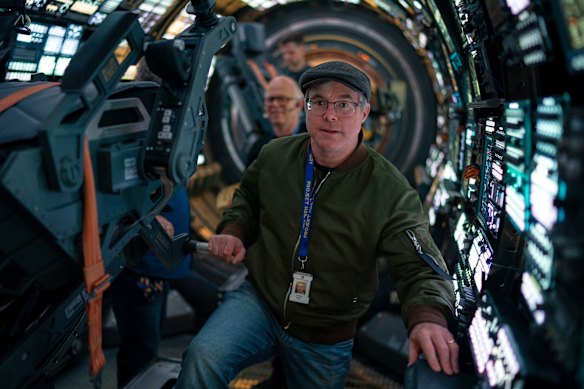
But he was on set at Pinewood in London for the entire shoot, an experience he describes as “awesome” and “really neat”.
“It was the best combination of being just enough of a big shot that I can walk around and do what I want on set and kind of get my way on things, but also irrelevant enough that I don’t really have the ability to screw things up, to ruin the movie. Basically, I just got to walk around, and hang out with famous people.”
His presence did serve some practical purpose, though; almost every day, he says, there would be some maths equation relating to space travel, where the numbers would be visible on a screen in Grace’s capsule.
“The directors would come to me and say, ‘We want that number to be accurate for that point in the script, so figure out what that is and let us know’,” he says.
“That I’m good at. That I can do.”
OK, maths geeks, take that as a challenge. Your time starts now.
Project Hail Mary is in cinemas from March 19
Must-see movies, interviews and all the latest from the world of film delivered to your inbox. Sign up for our Screening Room newsletter.
Disclaimer : This story is auto aggregated by a computer programme and has not been created or edited by DOWNTHENEWS. Publisher: www.smh.com.au