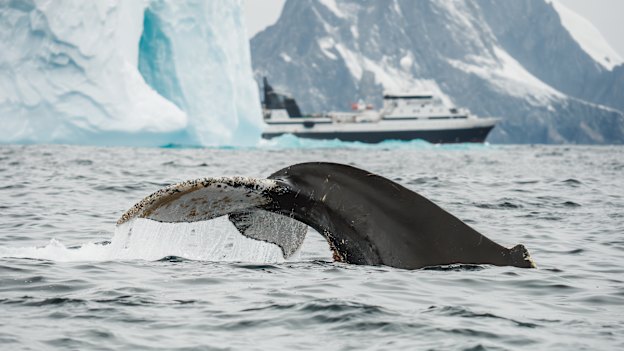
Ted Cheeseman has spent a lifetime studying whales and been to Antarctica 30 times, but what he saw last week left him gobsmacked.
As the research fellow at University of California, Santa Cruz, and former Antarctic expedition leader sailed into the main krill fishing area in the South Orkneys, he saw more whales than he had ever seen before. Over seven days so far, Cheeseman and his fellow scientists have logged about 1000 whales, mostly humpbacks but also fin whales and other species.
“Literally, as the krill vessels came into sight, we started seeing whales everywhere,” says Cheeseman, speaking from Sea Shepherd’s ship Allankay. “It’s mostly humpback whales but also fin whales in genuinely stunning numbers. Every time we approach the krill fishery, the number of whales goes very high and that makes sense because they’re all targeting the exact same thing.”
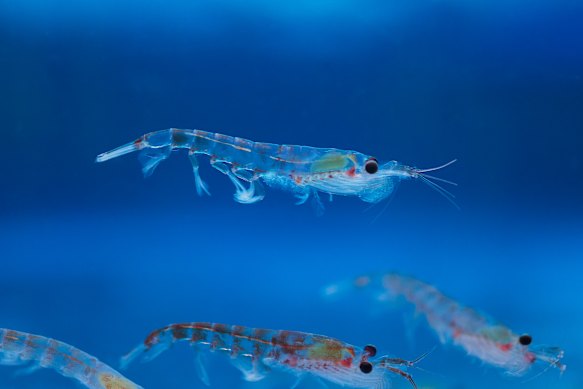
Both the whales and ships are hunting krill, a tiny crustacean that is the keystone species of Antarctica – one already under threat from climate change. Without krill, many species of whales, penguins, seals and fish would starve and the ecosystem would collapse.
The whales come down to Antarctica every summer to get fat on krill before returning to warmer waters to breed.
Yet krill is also prized for its commercial value – increasingly used in health supplements, fish feed including for the farmed salmon industry, and pet food.
Every year there are new and bigger fishing vessels sucking up Antarctic krill – the addition of a new Chinese super-trawler this year brought the total fleet to 15 – and better technology to locate the krill swarms. Last year the fishery hit the catch limit of 620,000 tonnes for the first time and shut down three months early.
Environmental groups are mobilising to fight krill fishing, arguing that it is unsustainable, a claim the industry hotly contests.
Viewers of the Animal Planet channel in Australia from 2009 to 2016 may recall Whale Wars, a weekly reality show produced by Discovery in the US that followed conservation activist group Sea Shepherd, then led by founder Paul Watson, as it took on Japanese whaling.
Now, in 2026, prepare for the krill wars.
The Captain Paul Watson Foundation split off from Sea Shepherd in 2022. The breakaway organisation has 22 activists, including nine Australians, on board ice class vessel the Bandero somewhere in the South Pacific after departing Eden on the NSW South Coast last week. The ship will pick up more crew in Chile and should arrive in Antarctica within a fortnight.
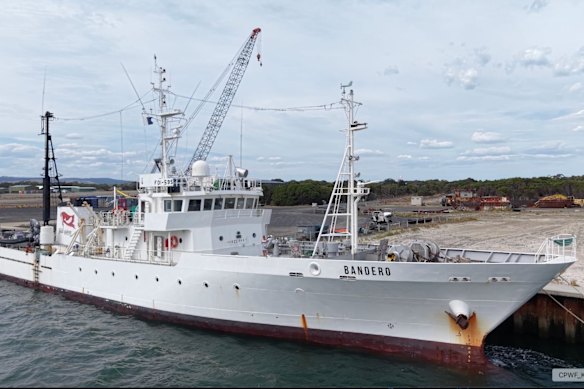
The foundation’s communications manager Charlotte Kanter says the plan is to disrupt krill fishing, particularly the Norwegian fleet since Norway is pushing to expand the catch limit to 1.2 million tonnes. (The change would need consensus by all member nations in the Commission for the Conservation of Antarctic Marine Living Resources, or CCAMLR, and this is unlikely.)
“Captain Paul Watson’s entire history is on direct action,” says Kanter, speaking from the ship. “He believes that if you want to get anything done, that it is non-aggressive direct action.”
While Kanter did not give away operational plans, some of the tactics in the Whale Wars era included getting in the way of fishing vessels and opportunistically interfering with their nets. Kanter says the organisation believes it has legal justification for its actions, but will consider the risk of arrests when deciding where to return to port. Watson, who spent five months in prison in Greenland in 2024 while the Japanese unsuccessfully tried to get him extradited, is not on board.
The Norwegian company in the activists’ sights is Aker QRILL, which has three krill trawlers and a support ship. Communications director Tormod Sandstø says the company has made a standing offer to provide a support vessel for the Captain Paul Watson Foundation to safely observe the fishery.
“Scrutiny around Antarctica is welcome,” Sandstø says. “It keeps everyone sharp. What we push back on is the idea that disrupting a tightly regulated fishery somehow protects the ocean. It doesn’t. Neither does it do anything to CCAMLR’s ability to find consensus solutions between 27 member states.”
Sea Shepherd is also in Antarctica with five Australians among the crew, applying pressure by documenting the krill fishing and supporting scientific research. Captain Peter Hammarstedt, director of campaigns, says the group takes direct action against illegal fishing, but the krill harvest is legal and requires a different approach.
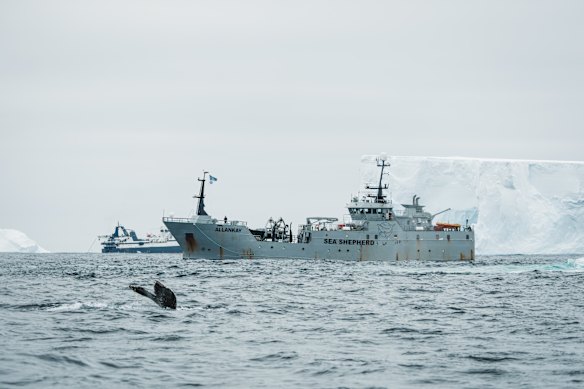
Sea Shepherd has spent the past few Antarctic summers shadowing the krill fleet, including capturing footage that was used in David Attenborough’s influential documentary Ocean. It has also successfully lobbied British-based pharmacy chain Holland & Barrett to cease stocking krill supplements by April this year.
Hammarstedt says Sea Shepherd was inspired to return to Antarctica after the Whale Wars era by reports of an aggregation of 1000 fin whales amid several massive krill trawlers.
“What we’ve seen over these years is that this is a daily occurrence, that every day these massive super trawlers with lengths of up to 138 metres pull nets that are big enough to swallow a jumbo jet right through feeding frenzies of whales,” Hammarstedt says. “This fishery is very lightly regulated, and it would shock most people to learn that it’s perfectly legal to drag a massive net through a feeding frenzy of endangered whales.”
This month, Sea Shepherd is hosting an independent scientific team led by Matthew Savoca, a research scientist at Stanford University. The scientists, including Cheeseman, are trying to put hard data around the conflict between whales and humans over krill.
“Each boat you could consider to be consuming roughly 200-300 humpback whales worth of prey or 100-200 fin whales worth of prey every day,” Savoca says. “If you have three of these boats fishing tightly with each other, that would be the equivalent of 1000 whales moving through the ecosystem, sucking up krill. It means we’ve just added another predator to the ecosystem that doesn’t actually give back to the system in the way that whales do, so it definitely sets up a situation for conflict.”
Sustainability certification
Another front in the krill wars opened up last week when the Antarctic and Southern Ocean Coalition (ASOC) and WWF lodged formal objections to the recertification of the Antarctic krill fishery as sustainable under the Marine Stewardship Council (MSC) program. This certification is jointly for Aker QRILL, Chilean and South Korean vessels, while Russian, Chinese and Ukrainian operations sit outside the program. In 2024 slightly more than half the Antarctic krill catch was certified, MSC figures suggest.
ASOC says the growing pressure from fishing is compounding the impacts of climate change and pollution on krill in the planet’s last true wilderness. A famous 2004 Nature paper found the Southwest Atlantic – where the krill fishing occurs – had more than half the Antarctic krill, but stocks there had plummeted by about 80 per cent between the mid-1970s and early 2000s. More updated research has found that krill abundance has declined most dramatically in the northern parts of the Southern Ocean because of warming and reductions in sea ice, but is still strong close to the South Pole where the fishing occurs.
“This is all the more reason not to mess with it,” says Stanford’s Savoca. “We are still learning and working to conserve these last strongholds of Antarctic krill in the high latitudes of the Southern Ocean.”
The krill industry points to a 2025 United Nations report that describes the krill catch in the Southern Ocean as “under-exploited”, and a 2021 paper in the Journal of Crustacean Biology that says the fishery location has a standing krill biomass of 63 million tonnes. This means the catch limit is less than 1 per cent of the krill biomass.
Sandstø from Aker QRILL notes the fishery closed automatically as soon as it reached the limit last year – “exactly how the system is designed to work” – and argues that science would support a much higher limit.
The real enemy of ocean protection, Sandstø says, is illegal, unreported and unregulated fishing, rather than a fishery with transparency and international oversight.
Environmentalists say the 1 per cent statistic is misleading because krill fishing is so concentrated, and the local impact is much higher. Last year, the CCAMLR rule forcing the krill fishing vessels to spread out their operations expired and almost the entire catch was from one location.
The Marine Stewardship Council does not directly control fishery certification. The body sets out science-based requirements, but the assessment process is done by third-party independent assessors.
Matt Watson, who leads MSC’s work on Antarctic fisheries, says the Aker QRILL fishery met the criteria for recertification, but the objections would be independently assessed with a decision later this year. It remains certified during the process.
Aker QRILL’s main market is aquaculture feed, followed by pet food. The company also supplies raw material for health supplements through Aker BioMarine.
Complementary Medicines Australia says krill oil contains omega-3 fatty acids, which support cardiovascular, brain, joint and eye health, and antioxidants. Alternative sources include fish or algal oil. Krill oil is the fastest-growing source for omega-3 in the Australian supplements market, a spokesperson says, and the industry body “supports consumer choice and informed decision-making”.
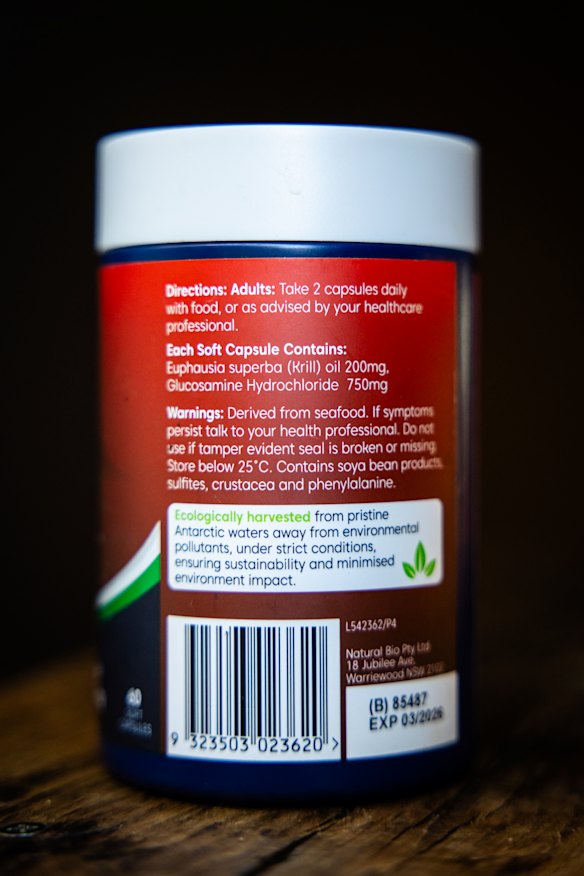
There is an array of krill supplements on Australian retail shelves. The packaging claims of one brand, Bioglan, include that the krill is “ecologically harvested from pristine Antarctic waters away from environmental pollutants, under strict conditions, ensuring sustainability and minimised environmental impact”.
Bioglan referred questions to its supplier; Aker BioMarine’s local general manager, Ross Norris, says the science is clear that krill fishing is sustainable.
The Pet Food Industry Association of Australia says krill oil is not a common ingredient in Australian-made pet food, while lack of regulation means there is no oversight of imported products.
Salmon Tasmania referred questions to supplier BioMar, whose local managing director David Whyte points to the MSC certification and says the company uses the krill meal, a byproduct after oil extraction.
Argentina and Chile have proposed a marine protected area where most of the krill fishing occurs, but this has been blocked so far in CCAMLR by Russia and China. Norris says the Aker family of companies supports protection, as well as reinstating rules to spread out fishing.
Some might argue the presence of whales in the fishery is a sign of coexistence, but the scientists on board Sea Shepherd see an unnecessary stressor. Humpback whales have rebounded from whaling, but other species such as fin whales and blue whales have not.
“Clearly, it’s a globally special place,” Savoca says. “Do we also need to have our industrial presence here, extracting krill for marginal products that humanity is not in dire need of?”
Get to the heart of what’s happening with climate change and the environment. Sign up for our fortnightly Environment newsletter.
Disclaimer : This story is auto aggregated by a computer programme and has not been created or edited by DOWNTHENEWS. Publisher: www.smh.com.au