Richard Roxburgh is slurping a heaving bowl of noodle and vegetable soup in a rehearsal lunch break for the upcoming production of French playwright Yasmina Reza’s play, Art.
“I met a couple of people recently that I would describe as radically honest,” he says, lowering his spoon. “They were kind of fascinating. Real kooks but incredible minds. It was really interesting, but also very disturbing, because it’s so unusual.”
Roxburgh’s fascination with unbridled honesty has been sharpened by being part of Art’s central debate. Three longtime friends, Marc, Serge and Yvan – played by Roxburgh, Damon Herriman and Toby Schmitz – become enveloped by a disagreement sparked by an issue of taste. Feathers are ruffled. Dynamics are changed. Male friendship is run through a caustic mill of frankness.
Will it topple here because of one minimalist white canvas? In this spiky comedy, translated from the French by Christopher Hampton, the 90-minute three-person argument is as relevant as the play’s denouement.
Directed by Lee Lewis, co-produced by Rodney Rigby and opening in Sydney on February 10 before seasons in Melbourne, Brisbane and Adelaide, Art has a simple premise.
Serge, a successful dermatologist, buys a work by a famous artist called Antrios for a six-figure sum (200,000 francs in the original French script). The piece is a painting and entirely white, save for some fine white diagonal lines – visible if you “screw up your eyes” while looking at it.
Serge’s longtime friend Marc, an aeronautical engineer, visits and views the painting. He is shocked. To him, it is laughable, a total waste of money. He is appalled by, as he calls it, “this shit”. He is even more outraged by Serge’s decision to buy it.
Serge, who may initially have had doubts about the work, is mortally offended. He defends his purchase, seeing it as a modern masterpiece. A serious spat ensues.
Into the fray comes Yvan, the third of the trio. He is about to inherit a job in wholesale stationery due to his upcoming marriage and becomes a kind of mediator in Marc and Serge’s disagreement.
Overall, the three friends’ different reactions to the painting illuminate the varied ways they see their friendships with each other. The canvas may be blank, but the detail, colour and intricate workings of each person’s thinking are vividly unveiled. Ego, identity and pettiness spark a raging, increasingly personal debate, with much comic banter.
“The point of Marc telling Serge the painting is shit is about bringing things to a head,” Roxburgh says. “It’s to say, ‘Unless we can get through this, the absolute that you have bought a piece of shit – and paid an astronomically stupid amount of money for it – we are in trouble as a friendship.’”
Herriman agrees.
“I think we’ve all got those long-term friends, where you go, ‘I didn’t sign up for this person,’” he says. “And now I’m stuck with them. This is not what we had 15 to 20 years ago at all. It’s, ‘How can I stick with this person based on who they’ve become?’ With Serge and Marc, particularly, they have become very different people over time.”
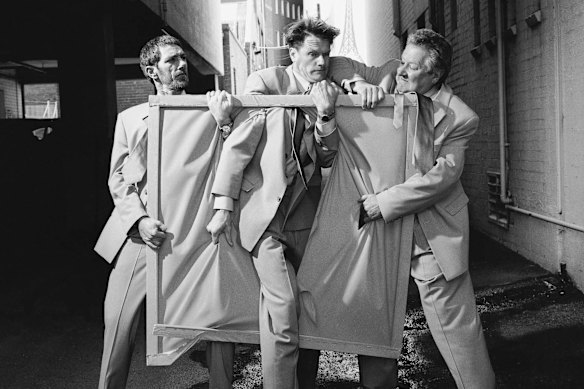
Marc, he says, is just as annoyed by Serge changing – ostensibly into someone who would buy a white-painted canvas for thousands of dollars – as Serge is by Marc not changing since they first met.
“It’s like, ‘Grow up! Stop being such a …’,” Herriman pauses. “What’s the word?”
He swings his gaze to the ceiling, trying to recall a term.
“Someone who’s such a …,” he says. “Oh god, a c, c, c, c … it starts with a c … ”
Roxburgh: “Cicada?”
Herriman, stoically ignoring Roxburgh: “Someone who’s always negative. A c… c…”
Roxburgh: “A curmudgeon?”
Herriman: “A curmudgeon. But also someone who’s always negative. A … ”
Roxburgh: “Contrarian?”
Herriman: “A contrarian.”
Roxburgh returns to his slurpy soup. Herriman continues.
“We talk about the fact that, 20 years ago, Marc was cool because he was a contrarian,” he says. “He didn’t like anything. Serge was, ‘This guy’s so cool’. But now Serge is just, ‘Oh, come on. Really? Honestly, grow up, mate.’”
Roxburgh chuckles.
“But, is that because you’ve changed?” he says. “Or I’ve changed?”
“No, Marc hasn’t changed but I think you should have changed with maturity,” Herriman says. “I’ve definitely changed. Serge has changed. I’ve started mixing with all these contemporary artistic types.”
Roxburgh: “Ooh, listen to you. Ohh right, ohh, I see.”
Like its cast members at lunchtime, Art is full of humour. Quips, whip-smart timing, sulfurously sharp exchanges and illustrious putdowns fill its pages. But perhaps the funniest part is Yvan’s central minutes-long monologue about a wedding-invitation drama between his fiancee, his fiancee’s stepmother and his own stepmother.
Highly strung, Yvan is a wreck. Meek, vulnerable and ever-changing in his opinions, the role is relished by Schmitz.
“I think it’s easy to say we’ve all got a friend like Yvan,” he says. “Unless you are Yvan and then, well, you don’t have a friend like Yvan, you are him, and you probably don’t know you are.”
Schmitz vividly remembers reading Art almost three decades ago as a 19-year-old and being entranced.
“I thought, ‘Oh my god, I hope I’m still around when I’m eligible to play one of these middle-aged men roles’,” he says. “And then you get to my age, and you’re fortunate enough to do it. And you go, ‘Oh, it was written by a French woman. Wicked.’ No wonder it’s still around.”
Reza wrote Art in 1994, apparently in a matter of weeks, and it has since won many theatre awards, including a Moliere, an Olivier and a Tony. Translated into more than 30 languages, it is billed as a comedy. Yet, after collecting the Olivier Award in 1997 for best new comedy, Reza said, “The category surprised me. I thought I had written a tragedy.”
Actor-driven, with monologues addressed to the audience and conversations moving between two and then three characters, the play frequently attracts famous faces. West End and Broadway productions have featured actor trios ranging from Bobby Cannavale, James Corden, and Neil Patrick Harris (2025) to Rufus Sewell, Tim Key and Paul Ritter (2016/17) and Albert Finney, Ken Stott and Tom Courtenay (1996).
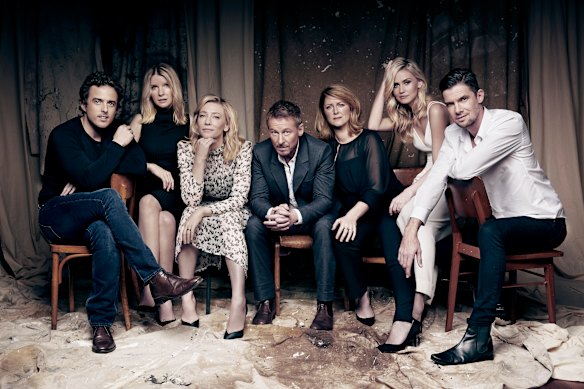
Like their characters, Herriman, Roxburgh and Schmitz have known each other for years, but only two have worked together. Ten years ago, Roxburgh and Schmitz were in Sydney Theatre Company’s production of The Present, Andrew Upton’s adaptation of Chekhov’s Platonov, which also featured Cate Blanchett.
Schmitz, who now plays Yvan after Ryan Corr left the production due to an unforeseen scheduling conflict, says the production is a treat. “I find it very hard not to just be in hysterics or tears watching Damon and Richard,” he says. “So to be on stage with them is wonderful.”
Such is his delight for the play’s writing, Roxburgh is considering bringing his eight-year-old daughter to see Art. “She came to The Tempest [in 2022],” he says. “She wouldn’t have understood that, but this, I think she’ll get some fun out of it.”
He chuckles. “I mean, I’m not recommending it for eight-year-olds. But, it is hilarious.”
Art is at Roslyn Packer Theatre, Sydney, February 10 to March 8; and the Comedy Theatre, Melbourne, April 22 to May 3.
Disclaimer : This story is auto aggregated by a computer programme and has not been created or edited by DOWNTHENEWS. Publisher: www.smh.com.au