
Germany doesn’t just offer dietary advice – it actually publishes ten weekly meal plans designed to show residents how to eat. In the finest traditions of intrepid journalism, The Local’s Tom Pugh decided to investigate.
Do you eat to live? Or do you live to eat?
Did you know that a healthy diet, according to the German Nutrition Society (DGE), should consist of roughly three‑quarters plant‑based foods and no more than one‑quarter animal‑based foods?
Alongside this and other general guidance, the publicly funded DGE also publishes ten week-long and extremely comprehensive meal plans, intended to demonstrate how a healthy, sustainable diet should work in practice.
Originally, I imagined I might follow these menus one by one for two and a half months.
But after looking more closely – and notwithstanding the ‘finest traditions of investigative journalism’ – I’m afraid I completely lost my nerve, scaling back the scope of the mission to just one week.
Of the ten available options, I went for the first – poetically named S1V3W1 – on the basis that whoever designed these menus would logically make the first one the most accessible, tastiest and easiest to prepare.
What follows is not an exposé of what most Germans actually eat each week. Instead, it’s a look at what the state thinks we should be eating – and could plausibly be persuaded to eat.
One official menu. Seven days and 21 meals. How hard could it be to eat like a model German for a week?
READ ALSO: Germany’s top regional food products and how to spot them in the supermarket
Getting started
Following one of Germany’s official weekly menus is not something to embark on casually.
To follow the suggested menu, I found I needed specific breads, specific berries, several types of dairy products and lots of vegetables. I also needed intimidatingly large quantities of cream cheese and beetroot spread.
You cannot wing this menu. You have to commit to it.
As I wandered the supermarket aisles, it became increasingly clear to me that this menu had not been designed as an adventure into gastronomic pleasure.
In fact, pleasure appears to be largely beside the point – which is to improve public health and encourage environmental responsibility.
In a very German way, I found myself being nudged into thinking about eating as an act of solidarity – as a way to minimise the resources I consume or might consume in the future. Also how my dietary choices my impact systems bigger than myself, like the country’s healthcare system.
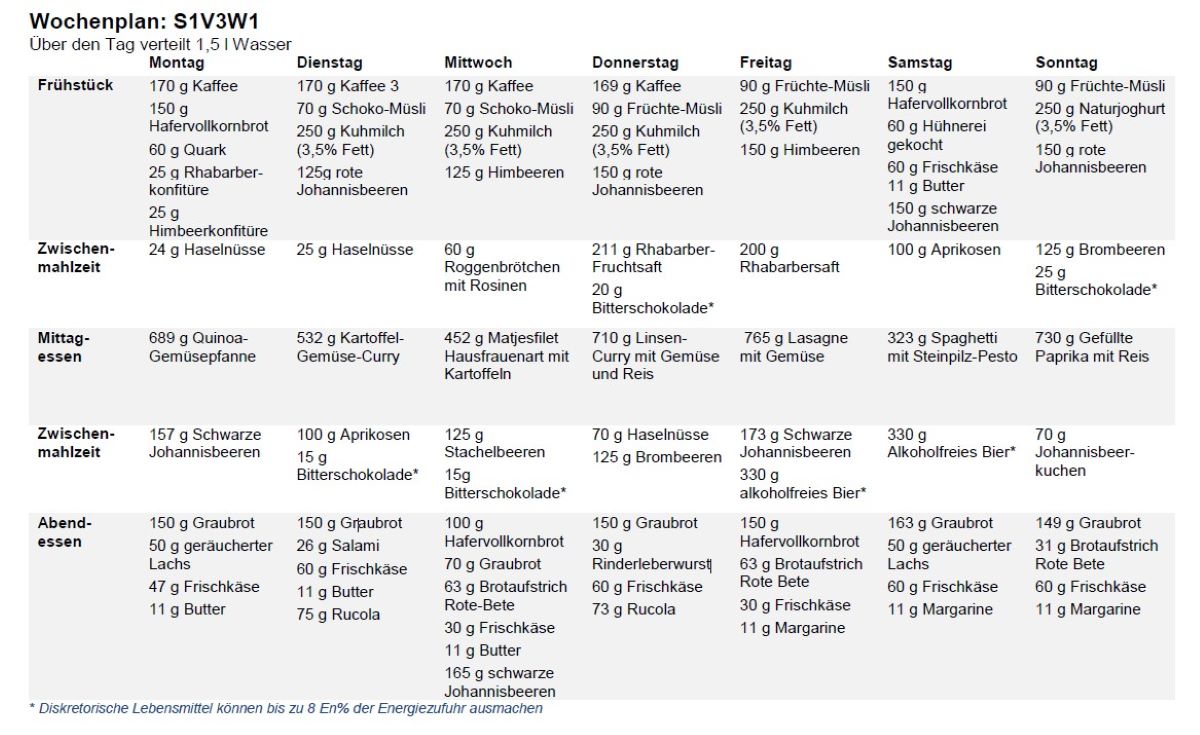
Screenshot of menu S1V3W1, designed and published by the German Nutrition Society.
Frühstück
The breakfasts on menu S1V3W1 are repetitive by design. If you want to follow them properly, that means eating either muesli with milk or yoghurt, or bread with dairy.
Five of the seven mornings are built around muesli, milk and berries, with coffee listed as standard until Thursday (when it quietly disappears for the rest of the week).
Bread is recommended on the remaining two days, once with quark and once with a hard‑boiled egg.
Quark, for the uninitiated, is a dairy product made by fermenting milk and straining the curds. It is high in protein, low in fat and extremely earnest.
But of all the meals, breakfast was comfortably the easiest part of the menu to stick to – repetitive, predictable and functional.
READ ALSO: German word of the day – Feinschmecker
Mittagessen
Lunch is where the menu began to reveal its true character – and where I began to struggle to stay aboard.
Every single lunch in the plan is a cooked meal. Not reheated leftovers, not sandwiches and not something that can be assembled at a desk.
Instead, I was tasked with preparing proper dishes: a quinoa and vegetable stir-fry, potato‑vegetable curry, lentil curry with rice, vegetable lasagne, stuffed peppers and spaghetti with porcini pesto.
These dishes were, to be fair, mostly tasty and easy to cook. Many are one‑pot meals and several would reheat well.
But what they require is time and, crucially, that I have time to cook a hot meal in the middle of the day (or prepared the night before).
These menus were only published in 2024, but they still seem to imagine a rhythm of life in which the children and (let’s face it) the husband come home from school and work at midday to find mum waiting with a cooked lunch.
As if to prove the point, Wednesday’s lunch is Matjesfilet Hausfrauenart mit Kartoffeln – “housewife‑style herring fillets with potatoes”.
My children are at school all day and my wife is at work. I did my best to stick to the menu, but by the end of the week I’d started cooking these dishes for the family’s evening meal rather than my own lonely lunch.
And thank God I did, because dinner is where the plan really falls apart.
Abendessen
Dinner, according to this menu, largely means Graubrot (grey bread).
Admittedly, this sounds worse than it is. Graubrot is earnest but edible: a mixed rye‑wheat loaf, darker than white bread, lighter than heavy rye and entirely normal in Germany.
Amazingly, every single evening meal in the plan but one features ‘grey bread’ and every single meal is cold. All essentially versions of what Germans often call Abendbrot, that is a collection of bread, spreads, cheese, cold cuts or smoked fish and some raw vegetables.
Graubrot might dominate, but it’s not alone. Whole‑grain oat bread also makes an occasional appearance – not instead of Graubrot but alongside it.
READ ALSO: Early dinners with Sauerkraut – The German food and drink habits that foreigners are adopting
Butter and margarine appear on three days each, and I had to make do without either on Thursday when the recommendation was to use Rinderleberwurst (beef liver sausage) instead.
What had become striking, by midweek, was how much dinner mirrored breakfast: bread, dairy and spreads. Minimal preparation. Familiar ingredients.
Beetroot spread appeared on three separate occasions and Frischkäse (cream cheese) was there every night.
And not even a beer or a glass of wine to wash it down with. Alcohol is entirely absent from the meal plan because “there is no safe amount”, according to the guidance.
Interestingly, alcohol‑free beer does appear – but not alongside a meal. Instead, it’s recommended as a snack to be enjoyed on Saturday and Sunday afternoons.
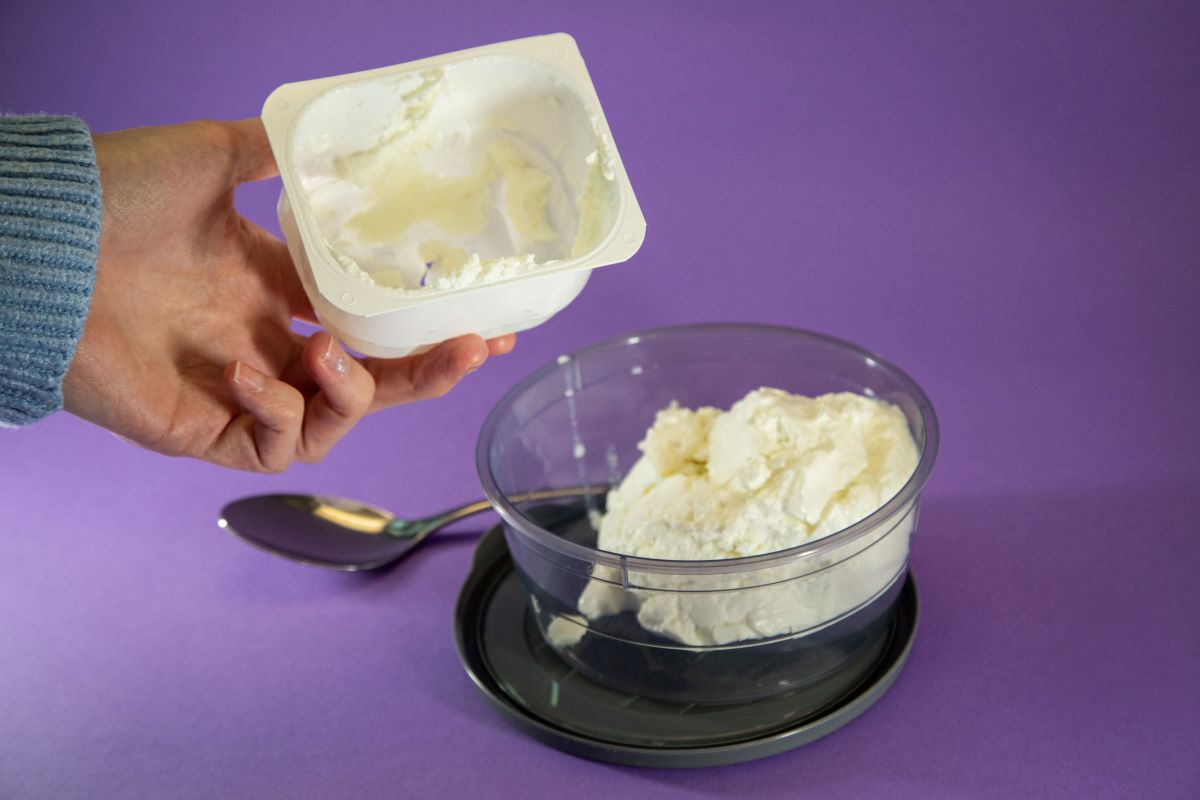
Quark. Photo: picture alliance/dpa/dpa-tmn | Christin Klose
Sweets
Treats exist on the menu, but they’re tightly managed.
Dark chocolate appears repeatedly, always in small amounts. Cake appears once. Apart from that, snacks are limited to fruit and nuts – alongside the alcohol‑free beer.
This isn’t quite joyless, but it’s far from indulgent.
Germany’s official idea of eating seems to assume that people are busy, capable and willing or even eager to suffer a little for the common good.
Cook one proper meal a day. Eat simply the rest of the time. Trust bread. Respect quark. Enjoy treats – minimally.
It may sound simple, but it’s not an experiment I intend to replicate any time soon.
Disclaimer : This story is auto aggregated by a computer programme and has not been created or edited by DOWNTHENEWS. Publisher: thelocal.de



