If this year’s best picture nominees had a theme, it’s: Back off and let me do my work, whether it’s lady-bossing, creature-building, race-car driving, “Hamlet”-writing, ping-pong playing, revolution-stoking, juke-joint opening or logging the timber that built America. I dug moments in every one of them. But my work isn’t done until I pick the nominee I wish would win in each of these categories — and then shout out to the skipped films that deserved to be in the conversation.
Best picture
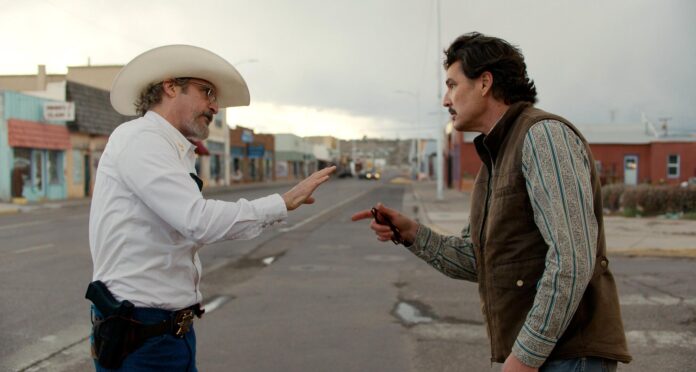
Joaquin Phoenix, left, and Pedro Pascal in Ari Aster’s “Eddington.”
(A24)
“Bugonia”
“Frankenstein”
“F1”
“Hamnet”
“Marty Supreme”
“One Battle After Another”
“The Secret Agent”
“Sentimental Value”
“Sinners”
“Train Dreams”
Should win: “Sinners.” A best picture Oscar for “Sinners” is damned near superfluous. Ryan Coogler already made his point that people will show up for original blockbusters. This Jim Crow-era murder musical is the best kind of smart filmmaking, a barn-burner about religion and art and race that ditches the speeches for scenes of action and romance. Every character — from Miles Caton’s rebellious guitarist and Jack O’Connell’s lilting vampire to Wunmi Mosaku’s soulful witch and Michael B. Jordan’s bootlegging twins Smoke and Stack — has been scarred by life in 1930s Mississippi. What’s at stake for them is the chance to leave their own mark on the world in whatever time they’ve got left (possibly forever). That’s Coogler’s challenge too, and this is his moment to encourage the industry to get back to making ambitious populist hits.
Should’ve been a contender: “Eddington.” This year, I squabbled more about this mean and grisly pandemic satire than any other movie. But that’s in keeping with “Eddington’s” pugnacious spirit. Against some audiences’ will, Ari Aster’s merciless black comedy drags us back to May 2020 when tempers, temperatures and misinformation were heating up across America. Dueling civic leaders Sheriff Joe (Joaquin Phoenix) and Mayor Ted (Pedro Pascal) agree that COVID has yet to arrive in their New Mexican hamlet. Yet Aster diagnoses them, and everyone else, with a deadly case of social media brain rot. “Eddington” scrutinizes our national psyche so intensely that it makes folks itchy. Give it a decade or two, and this will be the movie people reach for when they want to explain how this moment in history felt. And when they do, the room will sputter, “Wait, how did this not get a single Oscar nomination?”
Director

Director Paul Thomas Anderson, right, with Leonardo DiCaprio on the set of “One Battle After Another.”
(Warner Bros. Pictures)
Paul Thomas Anderson, “One Battle After Another”
Ryan Coogler, “Sinners”
Josh Safdie, “Marty Supreme”
Joachim Trier, “Sentimental Value”
Chloé Zhao, “Hamnet”
Should win: Anderson. More like should have won, won, won — many times before. Paul Thomas Anderson is on everyone’s list as one of our greatest working directors, whether you prefer his shaggy ensemble comedies or his uncompromising epics. “One Battle After Another” blends both together to become the perfect showcase for Anderson’s knack for capturing human idiosyncrasies and spinning them into grand-scale storytelling. First, he hooks us on the interpersonal drama of a revolutionary group called the French 75. Then, he reveals that they’re just one squadron in the never-ending war for liberation. It isn’t my favorite Anderson film, but it’s arguably the most Anderson film. He’s earned this victory lap.
Should’ve been a contender: Nia DaCosta, “Hedda.” DaCosta’s ferocious adaptation of Henrik Ibsen’s “Hedda Gabler” stars Tessa Thompson as a calculating wife who goes after — and gets — nearly everything she wants, from a gorgeous mansion and an obedient husband to a tryst with her lady lover in the hedge maze. If I had one-tenth of her manipulative skills, I could have gotten more people to watch this movie. (Perhaps I should have opened by firing off an antique pistol for attention.) DaCosta fathoms the deepest notes in Ibsen’s classic as though they were whale song, remixing them into her own ode to a woman who needs healthier hobbies. She will get this nod someday. Like Hedda herself, she’s too brazen, brilliant and entertaining to go ignored.
Lead actress

Amanda Seyfried, center, in the movie “The Testament of Ann Lee.”
(Searchlight Pictures)
Jessie Buckley, “Hamnet”
Rose Byrne, “If I Had Legs I’d Kick You”
Kate Hudson, “Song Sung Blue”
Renate Reinsve, “Sentimental Value”
Emma Stone, “Bugonia”
Should win: Byrne. When did it hit you that Rose Byrne can do anything? Who else could follow up the horror hit “Insidious” with “Bridesmaids,” all the while earning Emmy nominations for the legal series “Damages”? Even so, her performance in “If I Had Legs I’d Kick You” feels like rediscovering her range all over again. As the harried solo parent of a sick child, Byrne lets the camera zoom in so close to her character’s insecurities that the audience breaks out in a cold sweat. She makes us laugh when she cries, and scream for her as she desperately tries to hold it together. Mary Bronstein’s movie defies genres, straddling domestic drama, thriller and comedy. Just call it a Rose Byrne showcase.
Should’ve been a contender: Amanda Seyfried, “The Testament of Ann Lee.” Skeptics could argue that there’s one sure piece of evidence that God doesn’t exist: Amanda Seyfried getting snubbed for her rapturous turn as 18th century Shaker leader Ann Lee. The hair-whipping, chest-thumping church founder uprooted her polarizing sect from Manchester, England, to Manhattan before fleeing farther still into the countryside. It’s a staggering portrait of a woman who can’t escape her detractors or the personal trauma that triggered her vow of celibacy. As a bonus, Seyfried does it in song.
Lead actor

Benicio Del Toro and Mia Threapleton in the movie “The Phoenician Scheme.”
(TPS Productions / Focus Features)
Timothée Chalamet, “Marty Supreme”
Leonardo DiCaprio, “One Battle After Another”
Ethan Hawke, “Blue Moon”
Michael B. Jordan, “Sinners”
Wagner Moura, “The Secret Agent”
Should win: Chalamet. Marty Mauser wants to be the greatest ping-pong player on Earth. Timothée Chalamet wants to be the greatest actor of his generation. Both have the talent to back up their dreams. Naked ambition gets a bad rap. But ego isn’t just Chalamet’s engine, it’s also his muse, whether he’s swinging a paddle, riding a sandworm or strumming a guitar as Bob Dylan. He knows that “Marty Supreme” holds an unflattering mirror up to his own drive and allows that to become its own backhanded compliment to the thrill of watching an actor chase success at all costs.
Should’ve been a contender: Benicio Del Toro, “The Phoenician Scheme.” If “One Battle After Another” made you hungry for more Benicio Del Toro, his star turn in Wes Anderson’s “The Phoenician Scheme” is a hearty meal. His fat cat industrialist Zsa-Zsa Korda is no underground rebel. He’s an amoral tycoon who would enslave an entire country to make a buck. But Del Toro gives the role the same irresistible moxie that earned him a supporting actor nomination for “One Battle.” He’s a master of both Andersonian acting styles: the freewheeling scamp and the scoundrel who speaks with a sniper’s precision. I’ll drink a few small beers to that.
Supporting actress

Teyana Taylor in the movie “One Battle After Another.”
(Warner Bros. Pictures)
Elle Fanning, “Sentimental Value”
Inga Ibsdotter Lilleaas, “Sentimental Value”
Amy Madigan, “Weapons”
Wunmi Mosaku, “Sinners”
Teyana Taylor, “One Battle After Another”
Should win: Taylor. Taylor’s great betrayal comes a half-hour into “One Battle After Another,” when she disappears from the movie. The audience isn’t ready to say goodbye to her rabble-rousing activist Perfidia Beverly Hills. Until then, in between explosions — and with zero apologies — Taylor reveals a woman struggling to control her own rage. She’s a Molotov cocktail of contradictions, sacrificing her body to the vile Col. Lockjaw to serve the greater cause. But put her in a domestic cage and she’ll blow up her own family to escape. Her fight for freedom leaves everyone scarred.
Should’ve been a contender: Ariana Grande, “Wicked: For Good.” I wasn’t that excited to return to Oz. But Ariana Grande’s nimble Glinda makes it worth the trip. In the first film, Cynthia Erivo’s not-so-wicked witch Elphaba has the more interesting character arc. Here, the drama is in Glinda’s disillusionment as she realizes she’s become the pretty face of fascism. Her great, big burlesque performance is a striptease that, layer by layer, reveals her narcissism, her naïveté and her broken heart. Of course she can sing too, but I was doubly impressed that she’s a heck of a physical comedian.
Supporting actor

Diego Luna, right, and Tonatiuh in the movie “Kiss of the Spider Woman.”
(Sundance Institute)
Benicio Del Toro, “One Battle After Another”
Jacob Elordi, “Frankenstein”
Delroy Lindo, “Sinners”
Sean Penn, “One Battle After Another”
Stellan Skarsgård, “Sentimental Value”
Should win: Skarsgård. Maybe if I buy Skarsgård a bottle of Absolut, he’ll reveal to me which old lion (Ingmar Bergman? Philip Kaufman?) inspired his portrayal of “Sentimental Value’s” Gustav Borg, a faded filmmaker aching to make one more masterpiece. Years earlier, Borg ditched his Norwegian family to seek out art-house fame abroad. His options have dwindled; his self-regard hasn’t. Skarsgård doesn’t shy away from scenes that expose why his older daughter, Nora (Renate Reinsve), rejects his awkward attempts to reconnect, like when he flatters himself that strangers probably assume the two of them are on a date. His dynamic with Elle Fanning’s American starlet is even more engaging: two strivers on opposite ends of their career arcs cheerfully negotiating how much they can help each other.
Should’ve been a contender: Diego Luna, “Kiss of the Spider Woman.” Both of Luna’s co-stars signed onto “Kiss of the Spider Woman” with something to prove: Jennifer Lopez, that she remains a dynamic triple threat; and Tonatiuh, that he’s a new talent worthy of landing on every casting directors’ list. They succeeded — this musical is an underrated gem — but its Luna’s less showy performance that truly winds up stealing your heart. Playing a hard-line political prisoner in 1983 Argentina, his Valentin starts the film rejecting everything it stands for: romance, fantasy, overwhelming emotions. His slow thaw makes you melt, especially when Bill Condon whirls him into a dreamscape and he begins to sing. No wonder the other characters see him as the ideal hero.
Adapted screenplay

Josh O’Connor, left, and Daniel Craig in the movie “Wake Up Dead Man: A Knives Out Mystery.”
(John Wilson / Netflix)
“Bugonia”
“Frankenstein”
“Hamnet”
“One Battle After Another”
“Train Dreams”
Should win: “Frankenstein.” Guillermo del Toro chased after remaking his favorite monster movie for over a decade. Yet when he finally did, he added a new ghoul: an Industrial Age venture capitalist (Christoph Waltz) who funds Dr. Frankenstein’s laboratory for his own selfish means. Think Peter Thiel with a pocket watch. Del Toro updated his passion project because he seems genuinely scared of where the modern world is headed. If anything, his adaptation proves Mary Shelley’s prescience. She’s been warning us since 1818 that vainglorious innovators will destroy the earth.
Should’ve been a contender: “Wake Up Dead Man: A Knives Out Mystery.” It’s a mystery to me why Rian Johnson’s third and best “Knives Out” movie didn’t scare up more awards attention. Until now, his detective franchise has been a romp. But “Wake Up Dead Man” is a funny gothic whodunit in which the twist is an ending that squeezes out a tear. Narratively, Daniel Craig’s returning lead Benoit Blanc takes a back pew to the conflict between a sensitive priest and a malignant monsignor who has turned away from Jesus’ teachings. Murder is afoot but we’re as invested in witnessing today’s church go to war over its own ideals. It’d make a good double feature with last year’s adapted screenplay winner, “Conclave.”
Original screenplay

Théodore Pellerin in the movie “Lurker.”
(Mubi)
“Blue Moon”
“It Was Just an Accident”
“Marty Supreme”
“Sentimental Value”
“Sinners”
Should win: “Sinners.” Ryan Coogler’s screenplay keeps every one of its promises. Even lines that feel casually tossed off at the start of the film — say, when one character threatens to shoot another where he stands — eventually come true. Call it Chekhov’s Tommy gun. Despite “Sinners’” oiled mechanics, what’s truly marvelous about the script is the space it gives the characters to breathe and the room it leaves the audience to decide whether they agree with the vampires that death is preferable to a life of subjugation. I’ve seen it three times now and I’m still amazed at Coogler’s ability to reveal his cards and still have them feel like a surprise.
Should’ve been a contender: “Lurker” At the risk of sounding like a creep, I’m a big admirer of Alex Russell’s psychodrama about a rising L.A. musician and the fanboy stalker who weasels into his inner circle. “Lurker” is one part cringe comedy, one part inquiry into the limits of online celebrity — an ideal recipe for Russell, a former writer and producer on “The Bear” and “Beef.” A hilarious entourage attempts to fend off Théodore Pellerin’s awkward social climber with the year’s most perilous, pitfall-laden dialogue. But there’s real depth in how the screenplay also shows Archie Madekwe’s charismatic aspiring singer running face-first into the contradictions of building his brand on being an internet goofball.
Animated feature

A scene from the animated movie “KPop Demon Hunters.”
(Netflix)
“Arco”
“Elio”
“KPop Demon Hunters”
“Little Amélie or the Character of Rain”
“Zootopia 2”
Should win: “KPop Demon Hunters.” No contest, “KPop Demon Hunters” slays. Like the idol supergroups it celebrates, this Netflix hit has been engineered to entertain. Directors Maggie Kang and Chris Appelhans clearly dote on every frame of this crowdpleaser, from its style and speed to the earwormy songs. Several films seized the zeitgeist this year but only this one kept returning to theaters for an encore. What a testament to the theatrical experience that it topped the box office when fans could have continued streaming it at home.
Should’ve been a contender: “Predator: Killer of Killers.” The setup of this animated film sounds like a gag: A Viking, a ninja and a World War II pilot are thrown into a Predator movie that plays like a grisly triptych. Each faces a fight to the death that’s so spine-rippingly gruesome you can’t imagine how it could be filmed in live-action. I resisted for a while and then fully succumbed to its warrior spirit. Dan Trachtenberg (who also directed “Prey” and “Predator: Badlands”) is going to extremes to prove that franchise sequels can feel unique. You can’t argue with his conviction — and you won’t want to once you see him inventively kill an animated character every minute. Hulu may have wagered that “Killer of Killers” was too brutal for academy voters, but I kinda wish it had followed “KPop’s” lead and soldiered ahead with giving this streaming-only film a for-consideration theatrical release.
Documentary feature

Ksenia Mironova in the documentary “My Undesirable Friends: Part I — Last Air in Moscow.”
(Julia Loktev)
“Come See Me in the Good Light”
“Cutting Through the Rocks”
“Mr. Nobody Against Putin”
“The Alabama Solution”
“The Perfect Neighbor”
Should win: “The Perfect Neighbor.” This wrenching documentary takes place on a Florida cul-de-sac where kids play outside from dawn till dusk. Sounds idyllic, except one neighbor keeps summoning the cops — and eventually someone gets shot. Documentarian Geeta Gandbhir retraces this slow-moving tragedy through the body camera footage of the exasperated officers who know that the caller, not the children, is the problem. Nevertheless, it persists. These citizens become a 21st century Greek chorus and, compellingly, Gandbhir keeps checking in on them after the murder so that we feel the victim’s absence.
Should’ve been a contender: “My Undesirable Friends: Part I — Last Air in Moscow.” Buckle in. Nothing about Julia Loktev’s monumental project is a comfortable watch. First, there’s the five-and-a-half-hour running time. And second, there’s the audience’s uncomfortable tingle of recognition watching Vladimir Putin’s tightening stranglehold on the Russian press. (For one, he refuses to let journalists call the war in Ukraine a “war.”) The friends of the title host a young and punkish TV station that the government claims is full of so-called “foreign agents” — as in, people who say things Putin doesn’t like. They drink wine, they joke about the hidden spy bugs in their apartments and they wonder openly how they’ll know when it’s time to flee their beloved homeland before they wind up in prison. Loketv already has a sequel in the works: “My Undesirable Friends: Part II — Exile.”
International feature

An image from the movie “Sirāt,” directed by Oliver Laxe.
(Festival de Cannes)
“It Was Just an Accident”
“Sentimental Value”
“Sirāt”
“The Secret Agent”
“The Voice of Hind Rajab”
Should win: “Sirāt.” Oliver Laxe’s road movie about a father and son who caravan across Morocco with a pack of tattooed strangers is set in a vast desert where you still somehow never see the plot’s curveballs coming. The first time I saw this apocalyptic adventure, it felt like a prank. On a second watch, “Sirāt” became a philosophical provocation — a movie that questions everything we believe about family and security and community and faith. Like the techno-thumping soundtrack that powers the action and sets our nerves on end, it leaves you with the best kind of headache.
Should’ve been a contender: “A Useful Ghost.” A man buys a vacuum. It’s possessed by a sexy ghost. That’s a strong hook, but Thai filmmaker Ratchapoom Boonbunchachoke is just getting started with an erotic political tragicomedy that, like a Roomba, is forever veering off in unexpected directions. The film hands off its plot like a baton, passing from this dissatisfied shopper to a factory owner to her dead daughter-in-law (another ghost) who petitions the government for her civil rights despite being in the body of an appliance. On days when the world (forgive me) sucks, I take solace that moviemakers are still creating wonders.
More to Read
Disclaimer : This story is auto aggregated by a computer programme and has not been created or edited by DOWNTHENEWS. Publisher: latimes.com