As the US’s military operation in Iran escalates into a wider regional war, Germany has managed to stay on President Donald Trump’s good side. But the war in Ukraine and tariffs remain two uncomfortable sticking points between the nations.
German Chancellor Friedrich Merz met with US President Donald Trump in the US capital on Tuesday.
Merz spent three and half hours at the White House, and he and Trump addressed the press in a joint question and answer session.
In front of a circle of US leaders and running cameras, Trump did most of the talking by far. During the 35 minute discussion, Merz spoke for just three.
If Merz’s primary goal was to stay on Trump’s good side and maintain a relatively positive Germany-US relationship, then he succeeded. The US president referred to him as an “excellent leader” doing a “great job”.
But before the US had launched a large-scale military operation against Iran over the weekend, Merz’s purported goal at the meeting had been to present a common European position on Trump’s tariffs and clarify points around the EU-US trade agreement.
There was no progress to that end.
Following Merz’s third visit to Trump in Washington, here’s where the German and US heads of state seem to be in agreement, and where they do not.
The US approves of Germany’s stance on Iran
In his comments to reporters, Trump described Germany’s stance on the Iran war as “great”. He added, “We are not asking them to send ground troops or do anything like that.”
Prior to the meeting Merz had already made clear that Germany had no intention in actively participating in the conflict. Germany had joined France and Britain in saying they would assist their allies in the Gulf with “defensive action” against Iran, and left it at that.
Merz has notably not expressed any direct criticism of the US’s military operation, or said anything about its legality.
After the meeting he again confirmed that no requests for military aid had been expressed by the US or Israel.
For now Trump appears contented that the US is able to use its military bases in Germany without restriction.
Spain has refused to let the US plane use its bases for attacks on Iran, a move that Trump described as “terrible”. He threatened to “end” trade with Spain over the issue.
Merz did urge the US to seek an end to the conflict “as soon as possible”.
The chancellor had been among Europe’s more hawkish voices on Iran. He had criticized Iran’s ruling clerics sharply over their deadly crackdown on protests in January, and here he reiterated again that he and Trump “are on the same page in terms of getting this terrible regime in Tehran away.”
But seated next to the US president, he made an economic argument for avoiding a long war: “This is, of course, damaging our economies. This is true for the oil prices, and this is true for the gas prices as well.”
READ ALSO: How will war in Iran impact life in Germany?
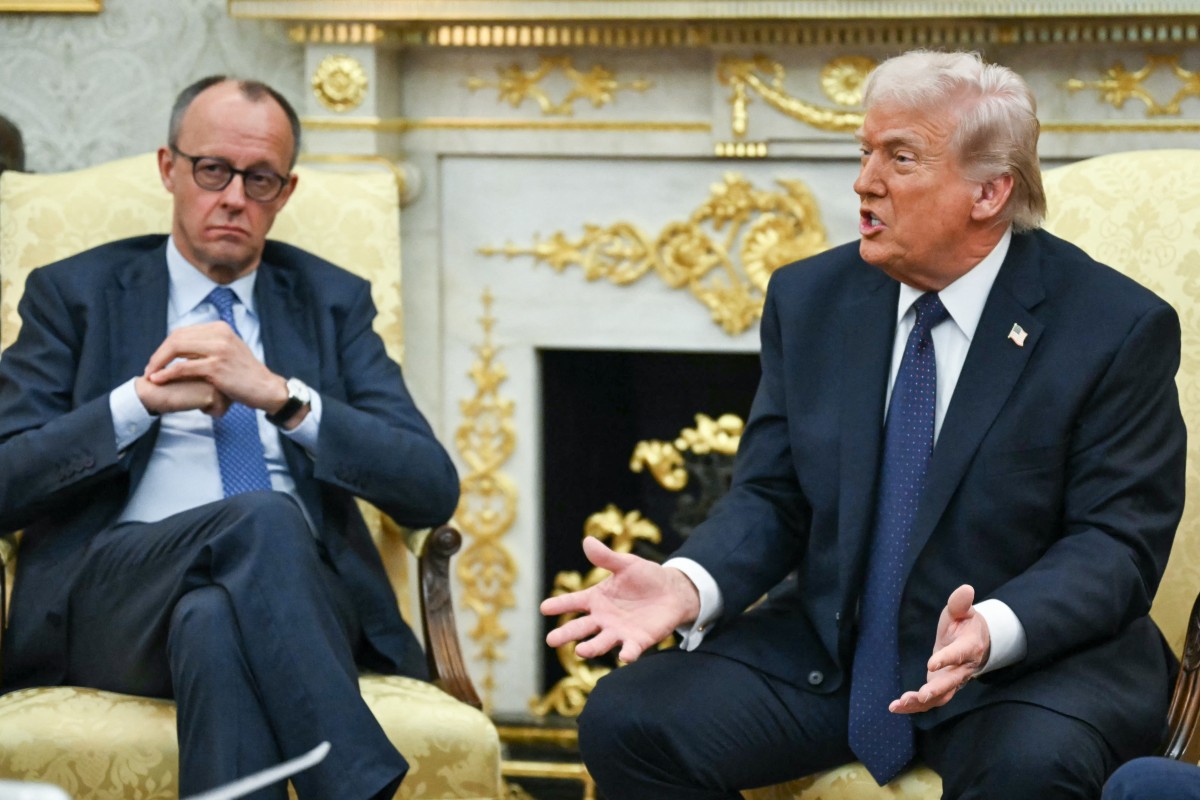
Trump speaks during his meeting with Merz in the Oval Office. (Photo by ANDREW CABALLERO-REYNOLDS / AFP)
Cooperation on Ukraine looks strained
Virtually eclipsed by Iran, Russia’s war in Ukraine was not addressed until the very end of the interview when a reporter asked Trump where it sat among his priorities
Trump replied simply that resolving the conflict was “very high” on his priority list.
“I thought this was going to be much easier than it is,” Trump said.
Talking about Russia’s and Ukraine’s presidents, he added, “Sometimes I blame one, sometimes I blame the other.”
These comments seem to suggest a view on the conflict that is a world apart from Germany’s position.
Merz has repeatedly underscored the need for further cooperation on Ukraine, and Germany’s position that the country should not cede territory to Russia.
“We all want to see this war coming to an end as soon as possible. But Ukraine has to preserve its territory and their security interests,” Merz had told reporters at the beginning of his visit to the Oval Office.
No progress on tariffs
Merz had attempted to make US-Europe trade agreements a top-line issue in the talks, but to little success.
In his opening statements, the chancellor said, “We have to talk about our trade agreement, which I would like to have in place as soon as possible.”
But when the topic was raised later, Trump addressed US trade Representative Jamieson Greer instead of speaking to Merz directly. He said, “How are we going to treat Germany? I think you should hit them very, very hard.”
He gave Merz, who looked uncomfortable, a slap on the knee and moved on before Merz had said a word.
Trump reiterated his intention to introduce global tariffs on imports into the US of 15 percent, and suggested his government is looking into other tariffs for different countries.
Trump likes Merz
Trump flattered Merz at the beginning of their joint interview, calling him a “friend of mine” and a “very successful man”.
During his previous term in office, Germany’s then Chancellor Angela Merkel had notoriously been quite the opposite of a friend to Trump. At that time he disliked Germany’s refusal to spend more on its military, among other points of contention.
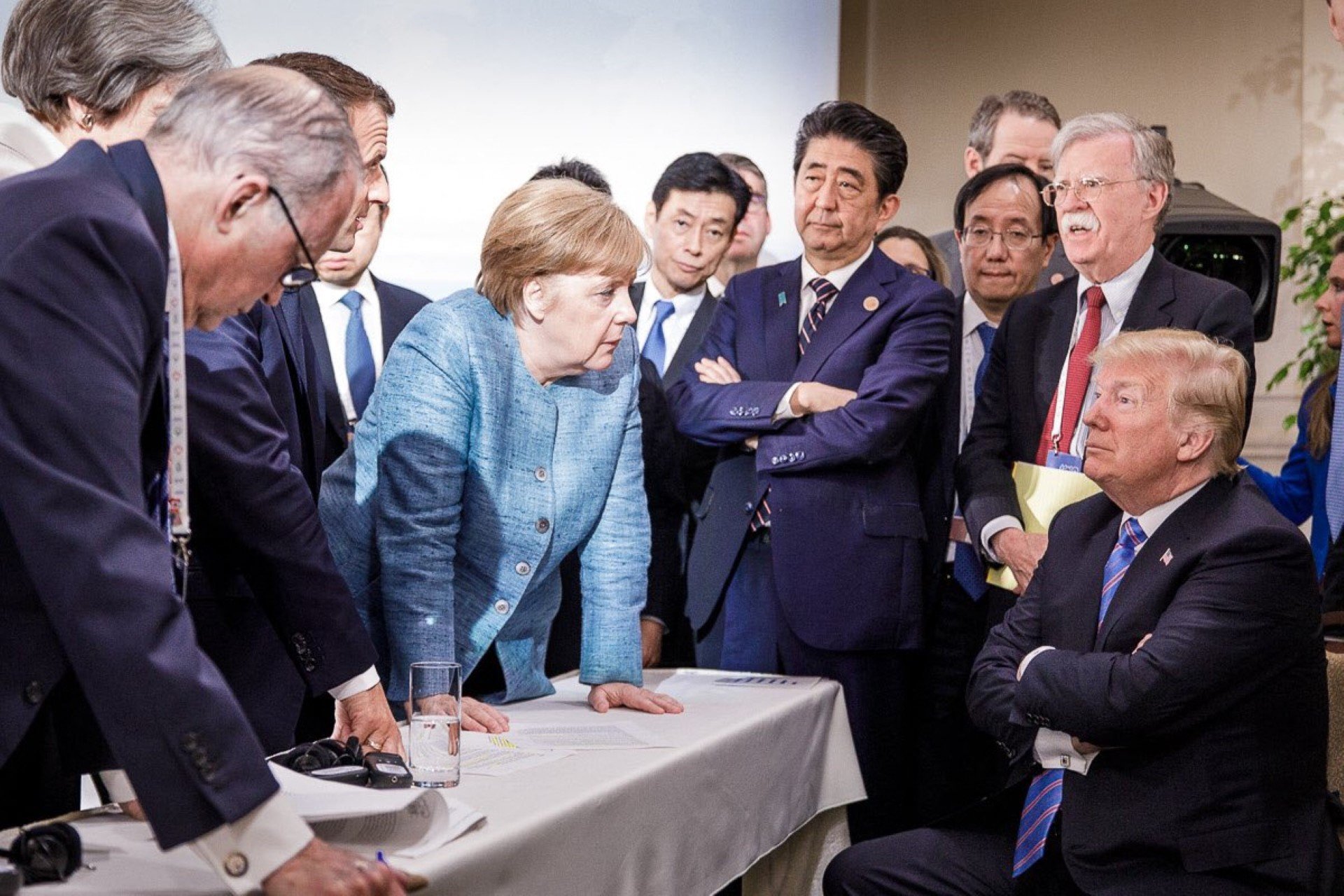
Then Chancellor Angela Merkel stares down then US President Trump at a G7 meeting in 2018. Photo by JESCO DENZEL / Bundesregierung / AFP
Now Germany has dramatically upped its military spending, and following the outbreak of Russia’s war on Ukraine, Germany is also buying large quantities of gas from the US.
The chancellor seems to have established himself as one of Trump’s favourite Europeans, along with Italian Prime Minister Giorgia Meloni, Finnish President Alexander Stubb and Hungarian Prime Minister Viktor Orban.
With reporting by DPA and AFP.
Disclaimer : This story is auto aggregated by a computer programme and has not been created or edited by DOWNTHENEWS. Publisher: thelocal.de