
Updated ,first published
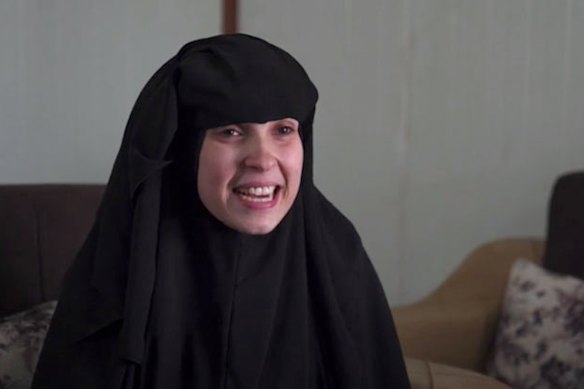
Eleven family groups – 34 individuals – who have been stuck in Syrian internment camps for years are trying to make their way home. Who are they, and what do they say about how they got into Syria?
This is what we know about the women – 10 of whom are still eligible to come home, while one has had a Temporary Exclusion Order imposed on her. It’s unknown which woman is subject to that order.
Nesrine Zahab
Nesrine Zahab, from Sydney, was 21 when she claims she was tricked into going into Syria by her cousin Muhammad Zahab – a former maths teacher at the centre of a network that delivered at least a dozen of his own family members into Islamic State’s so-called caliphate.
Nesrine told the ABC she and a female cousin had been in Turkey to help refugees from the Syrian civil war on the Turkish side of the border, and had no intention of entering the war-torn country.
“I had a whole thing going on. I was doing uni,” she said on Four Corners in 2019. “Who walks into a war zone? I was going to see Syrians, yes, because of what they’re going through.”
She married Islamic State fighter Ahmed Merhi – a friend of her cousin’s – and gave birth to a son, Abdul Rahman, in the al-Roj camp in northern Syria in 2019. Merhi was convicted and sentenced to death by hanging in Baghdad in 2018.
Zahab is in on the record saying she is willing to help Australian authorities.
Aminah Zahab
The mother of Muhammad Zahab also says she and her husband, Hicham, were tricked by their son into going to Syria. She told the ABC in 2019: “We’re clueless parents; we had a lot of trust in our children.
“As we raised our children, we just let the children rule our lives … I feel very angry.”
Sumaya Zahab
Another member of the family of Muhammad Zahab – this time his sister.
Muhammad’s widow, Mariam Raab, was repatriated to Australia in 2022 by the Albanese government. She was charged with willingly entering a prohibited “declared area” and pleaded guilty. She was not convicted.
Kirsty Rosse-Emile
Rosse-Emile was the Melbourne-based daughter of two former Christians who converted to Islam when she was nine. She grew up in a close-knit family home in south-east Melbourne and attended the Muslim private school Minaret College.
Her social media posts as a young teen showed a flirtation with the idea of jihad, along with a love of pizza, chocolate and the Fremantle Dockers AFL club.
At 19, in 2014, she travelled to Syria after meeting and marrying a much older Moroccan immigrant, Nabil Kadmiry – a one-time attendee of the infamous al-Furqan prayer room in Melbourne. Kadmiry then became an IS fighter and took Rosse-Emile to Syria.
Her father said in 2019: “I know Kirsty didn’t fight; she was just a housewife.”
Zahra Ahmed
Formerly from Melbourne, Ahmed was the most talkative of the group of women I met at the al-Hawl camp in Syria in 2019. She’s part of the largest single Australian family in the camps in north-east Syria.
She insisted she and her extended family, led by patriarch Mohammed, left their home in Melbourne’s outer suburbs to do humanitarian work. She said they were abruptly prevented from leaving Syria when Islamic State closed the borders of its self-proclaimed “caliphate”.
Some male members of her family reportedly joined IS, but Ahmed insists the women had no choice but to follow. She said they had suffered under its strictures, and wanted nothing more than to return home, help police as much as they could, and raise her children as Australians.
“We’re willing to talk, and we’re willing to tell them and we’re willing to share our stories,” she said. “But they haven’t even tried to come and reach out to us, and when we ask they don’t want to.”
Kawsar Abbas
An older relative of Zahra Ahmed and the wife of the patriarch, Mohammed Ahmed, who told the ABC in 2019 that they had travelled from the headquarters in Turkey of the charity they were working for – Global Humanitarian Aid – to attend the wedding of his son, Omar, in 2014. Then the border closed.
The charity was at one time suspected of directing resources towards Islamic State – a charge the family denies. A number of the male members of the family fought for Islamic State. Kawsar insisted the women were unwitting victims.
She told us in 2019 she feared the coming winter, and the small children’s health: “One of our tents flooded and then it dried up … But winter is not going to be like that. It’s not going to dry up,” she said.
Zeinab Ahmed
One of the daughters of Kawsar and Mohammed Abbas.
She told the ABC last year that the group the Australian government took back to Australia in 2022 had made the rest of them “so happy”. No further repatriations have been arranged.
Hodan Abby
Abby, from a Somalian family in Sydney, ran away from home with a friend when she was 18 after reportedly telling their parents they were going on a holiday. The pair entered Syria, reportedly willingly, with hopes of becoming jihadi brides. The parents of her friend believe she was radicalised online.
Abby had a daughter in Syria who suffers from wounds she received when she was a baby, with shrapnel in her head, back and hip making it difficult for her to walk and causing delayed speech and development. Abby also has a piece of shrapnel in her chest.
Abby told this masthead in 2021 she agreed to be under a Terrorism Control Order, which would give the government powers to monitor her.
Kawsar Kanj and Hyam Raad
Little is known about the final two women.
Start the day with a summary of the day’s most important and interesting stories, analysis and insights. Sign up for our Morning Edition newsletter.
 Michael Bachelard is a senior writer and former deputy editor and investigations editor of The Age. He has worked in Canberra, Melbourne and Jakarta, has written two books and won multiple awards for journalism, including the Gold Walkley.Connect via X or email.
From our partners
Disclaimer : This story is auto aggregated by a computer programme and has not been created or edited by DOWNTHENEWS. Publisher: www.smh.com.au