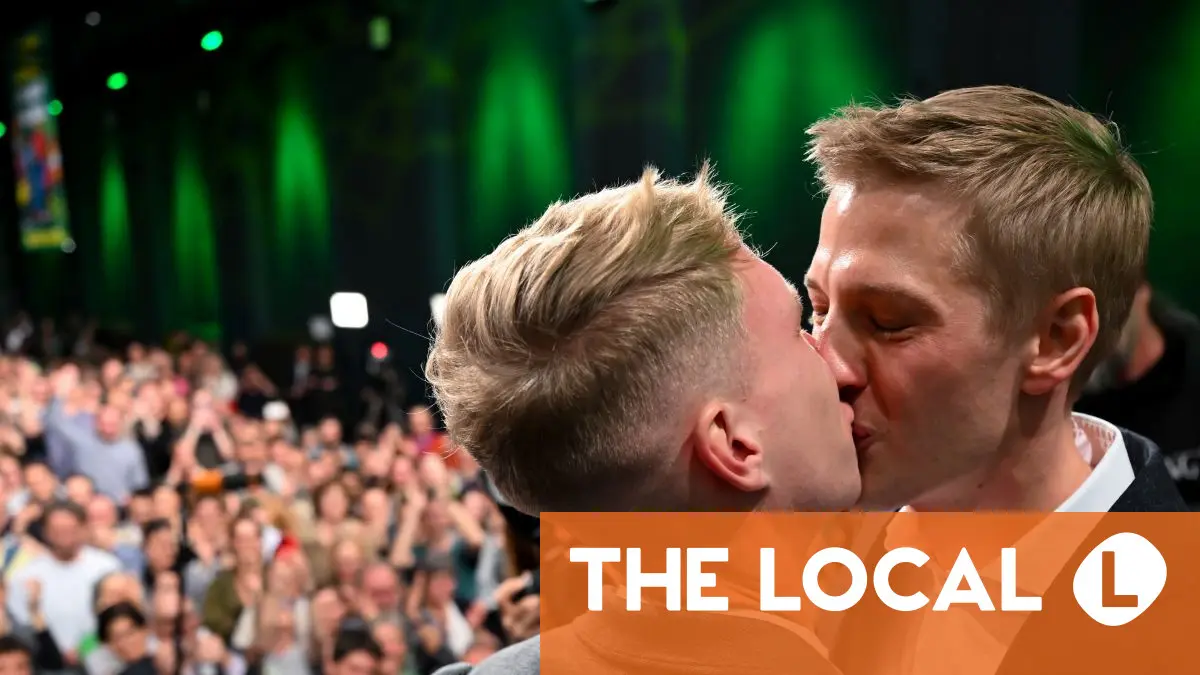
Following the run-off mayoral election on Sunday, the capital of Bavaria is set to have a Green party mayor for the first time – and that’s not the only surprising detail of this sensational election.
The city of Munich is soon to have a Green party mayor, after Domink Krause won the run-off election on Sunday.
Krause, who had served as the city’s deputy mayor in the previous term, defeated the incumbent mayor Dieter Reiter (SPD), who had served as mayor for the past 12 years.
Krause’s mayorship is marked by a few interesting firsts: He is Munich’s first Green party mayor, and the first to defeat the Social Democrats in the Bavarian capital in 42 years. He is also Munich’s first openly gay mayor, and is engaged to a man who is set to be the city’s first ‘first gentleman’.
Notably, Krause can be seen as the political antithesis to Bavaria’s staunchly conservative Minister President, Markus Söder. His victory therefore could be read as an omen of a new era of politics coming to the Free state, and a warning that legacy candidates shouldn’t expect to keep their power based on tradition alone.
Who is Dominik Krause?
Born in Munich in 1990, Dominik Krause is 35-years-old. Relatively young for a German politician, Krause has already racked up significant experience, having joined Munich’s city council in 2014 at the age of 23.
Interestingly this means that Krause had served on the city council as long as his competitor, Rieter, had been in the mayor’s office. Krause most recently served as the city’s deputy mayor.
Outside of politics, Krause is a Munich man through and through. He attended high school at the Louise-Schroeder-Gymnasium in the Allach-Untermenzing district, and did community service at a Montessori school in Großhadern.
He studied physics at the Technical University of Munich and graduated with a master’s degree in Applied and Engineering Physics.
REVEALED: Germany’s ‘Universities of Excellence’ for science and research
Krause is said to love the mountains — often going for summer hikes and winter ski trips in the nearby Alps.
He also plays piano and loves dancing. It was in a dance class, at the age of 17, that he first met his now fiancé, Sebastian Müller. The two have been together 19 years.
Krause highlights both his green and queer identities publicly: On Instagram he shares photos of himself on the green banks of the Isar River, or with his partner on holiday in Italy.
In his campaign, Krause voiced support for more affordable housing, even by converting vacant offices into apartments and potentially expropriating private properties for large housing projects. He is supportive of e-mobility, strengthening public transport and expanding pedestrian zones in the city.
A loss for Söder
In the initial election, on March 8th, Rieter had actually beaten Krause – the former mayor getting 35.6 percent of votes and Krause getting 29.5.
But since no candidate had won a real majority (of 50 percent or more), the two candidates were pitted against each other in Sunday’s run-off election, which Krause won with 56.4 percent of the vote.
Rieter’s campaign was marred by scandal after he admitted he had been receiving €20,000 per year for voluntary work on the FC Bayern administrative advisory board – a role he had not approved with the city council.
But Krause’s victory can also be seen as a warning for Bavaria’s conservative Christian Social Union (CSU), and against Markus Söder in particular.
The CSU had backed Rieter’s campaign in the run-off election. Previously, CSU-leader Söder had effectively opened the door for Rieter to continue as mayor when he scrapped a state-wide age-cap on mayors that would have prevented him from running in this election.
Söder has long targeted the Greens, vocally criticising many of their policies.
READ ALSO: Planned immigration crackdown by Bavaria’s CSU slammed as ‘propaganda’
Now, according to regional tradition, he will have to accept the first beer at Oktoberfest from the hands of a young, progressive Green leader.
Other run-off elections in Bavaria
Mayoral run-off elections took place in a number of other Bavarian cities on Sunday.
In Bavaria’s second-largest city, Nuremberg, the incumbent Marcus König (CSU) maintained his position, beating SPD challenger Nasser Ahmed.
In Augsburg, current Mayor Eva Weber (CSU) lost to the SPD candidate Florian Freund. And in Regensburg, too, an SPD candidate, Thomas Burger, beat the CSU’s Astrid Freudenstein.
In Bamberg, following the decision of incumbent Andreas Starke (SPD) to down, a Green candidate narrowly missed their chance to flip the city; instead Sebastian Martins Niedermaier (SPD) won in the run-off.
The Free Voters party won mayoral positions in Kempten and in Amberg. The Free Voters also had a relatively strong showing against CSU candidates in many administrative posts in rural districts.
EXPLAINED: Who can become a mayor in Germany and what do they do?
Disclaimer : This story is auto aggregated by a computer programme and has not been created or edited by DOWNTHENEWS. Publisher: thelocal.de