
When Oliver Bearman’s Haas went off the track and into the grass, trying to avoid Franco Colapinto’s Alpine, he was travelling at Shinkansen-like speed – and had barely slowed down before hitting the wall moments later. A right knee contusion as a result of a 50G impact is as good an outcome as there could have been after a crash just a few corners away from the place where F1 had once already lost a future Ferrari superstar.
There was nothing abnormal about what the Argentinian driver did just before that.
“Once I looked in the mirror, he was spinning in the grass,” he recalled right after the finish in the media pen, indicating he did not see Bearman launching an attack.
He probably didn’t even think about defending, as that kink leading to Spoon isn’t exactly a place for overtaking. Or at least it wasn’t until 2026 – bar some desperate attempts, like Sebastian Vettel on Max Verstappen back in 2018, which resulted in a predictable clash.
Just five seconds before the Haas went side by side with the Alpine, Colapinto probably wouldn’t even have seen Bearman in his mirrors – that’s how far back Oliver was before he ‘picked up a mushroom’. But even if Franco did see the Godzilla-liveried machine coming, there wasn’t much wrong with what he did.
No, he didn’t lean towards the inside white line, but there was still probably just enough space on the left for Bearman… had he been travelling at what would have been a normal speed for an F1 car not so long ago.
Instead, there was a massive 45km/h difference, which made it almost impossible for Bearman to commit to the space on the left without losing control of the car.
“I didn’t see, to be honest, his onboard,” Colapinto said to journalists. “I think it’s something to review in the future, because sometimes it’s a bit dangerous. Especially when you don’t get an idea of how much quicker the other car is, because there is no way of us knowing.
“We look in the mirror once – and suddenly the other car has gone past you already. You get a bit lost with that.”
Oliver Bearman, Haas F1 Team, Franco Colapinto, Alpine
Photo by: Mark Thompson / Getty Images
He was as calm and composed as he usually is, but he must have spent some time watching the onboards – Bearman’s and his own – afterwards. Did he think about what could have been? Did he ask himself some difficult questions? Thankfully, even if he did, he must have taken comfort in how far F1 safety has come – before going to bed.
But for the sport itself, it should be a wake-up call.
Three races is probably not enough data for a definitive judgement on what to do next, but Bearman’s crash may well act as a catalyst to speed up the process.
There is a lot for F1 and the FIA to consider when balancing entertainment with safety, but Suzuka, it seems, has provided some clear pointers on what needs attention first – just in time for the five-week break. The latter may have appeared on the calendar for all the wrong reasons, but it could serve as an opportunity to address immediate concerns: qualifying, and these massive closing speed differences.
Five weeks may seem like enough – but there is still no time to waste. Because in Miami, the walls are much closer.
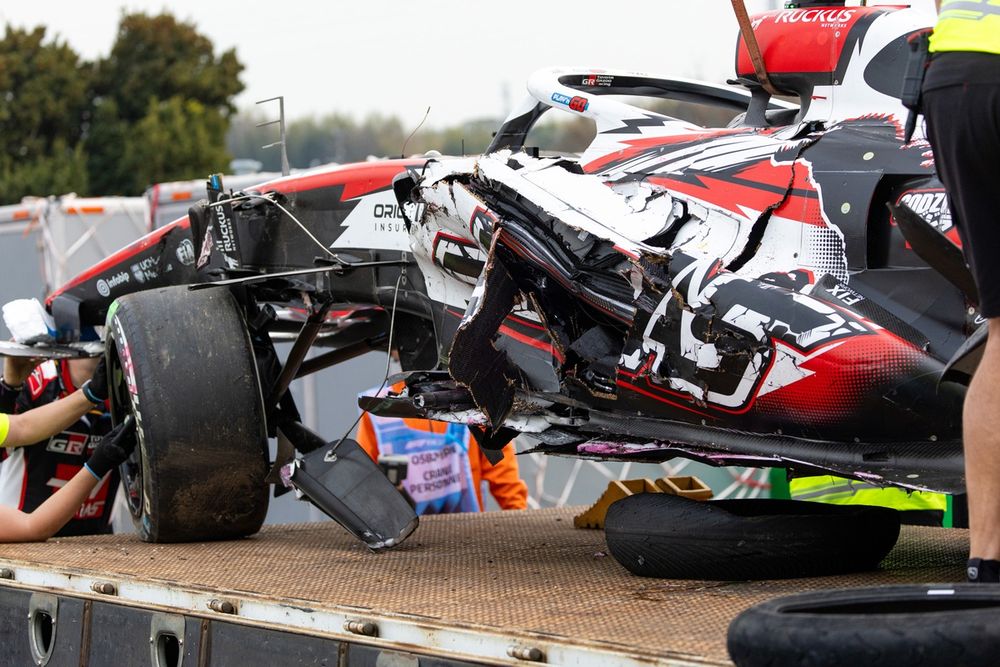
Oliver Bearman, Haas F1 Team car after his crash
Photo by: Kym Illman / Getty Images
We want your opinion!
What would you like to see on Motorsport.com?
– The Motorsport.com Team
Disclaimer : This story is auto aggregated by a computer programme and has not been created or edited by DOWNTHENEWS. Publisher: motorsport.com


