A version of this post first appeared on TKer.co
We’ve discussed how, if AI is all it’s cracked up to be, the winners in the stock market should extend far beyond the large-cap tech hyperscalers currently building the AI infrastructure.
It’s still early, but so far, it hasn’t been clear who’s demonstrably coming out on top in the AI race.
There have been numerous surveys and studies published about how AI is being used. But most fail to separate the ambiguous qualitative discussions from the more tangible quantified wins.
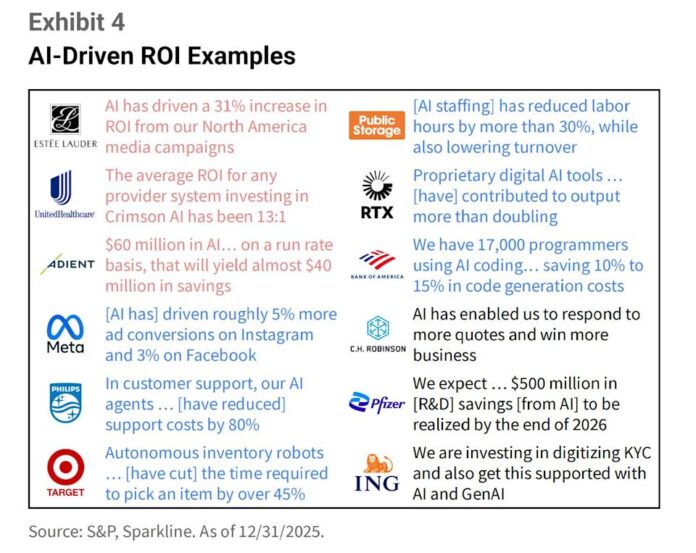
Sparkline Capital’s Kai Wu recently stepped up and tackled this problem. He dug into earnings calls and analyzed mentions of AI adoption. Specifically, he screened these mentions for references to AI-driven economic gains and returns on investment.
“Encouragingly, companies across a wide range of industries are deriving real economic value by applying AI to use cases such as consumer marketing, medical clinic optimization, auto plant automation, social media advertising, customer support, warehouse logistics, storage unit staffing, weapons manufacturing, software coding, supply chain logistics, pharmaceutical R&D, and insurance KYC,” Wu observed in a new note.
This is good news because we’re not talking about hypotheticals. We’re talking about real gains from deploying AI tools.
“Since 2017, the number of firms reporting AI-driven ROI or economic gains has surged from basically zero to 155 and 675, respectively,” Wu added. “While this still only represents 3% and 15% of our global stock universe, the trajectory is encouraging.”
Notably, he also found that the companies mentioning these gains have seen their shares outperform the market.
“Since 2017, firms merely discussing AI usage on earnings calls have outperformed the market by 3.2% per year,” Wu said. “More importantly, companies able to point to specific AI-driven economic gains or ROI have done even better, earning excess returns of 4.8% and 5.2%, respectively.”
Of course, any number of things can be driving those stock prices. And again, we’re still in the early innings of all this.
But at this point, it’s significant we’re getting tangible evidence of AI’s disruptive power.
Read Wu’s report here.
The emergence and embrace of AI technology is leading to both winners and, unfortunately, many losers.
One of the more talked-about losers has been the software business, where AI tools have disrupted the economics of the sector. Why pay licensing fees for third-party tools when you can cheaply develop customized apps in-house with the help of AI?
In recent weeks, software stocks and stocks in related industries have been hammered.
On Wednesday, Deutsche Bank’s Jim Reid circulated this chart of how far down many of these stocks are from their 52-week highs.
The big market-moving news last week was that Anthropic released an AI-powered tool automating tasks for lawyers. From Bloomberg:
“A new AI automation tool from Anthropic PBC sparked a $285 billion rout in stocks across the software, financial services and asset management sectors on Tuesday as investors raced to dump shares with even the slightest exposure. … Anthropic is part of a rash of AI startups developing tools for the legal industry. … Anthropic stands in contrast, however, in that it builds its own models that can be customized for an industry’s specific needs. Its position in the AI ecosystem as a major model developer gives it the unique advantage of disrupting both traditional legal news and data services as well as legal AI upstarts.”
It’s not the most surprising development. But investors and traders appear to have been caught on their heels with regard to the speed at which these AI tools are becoming available.
But why did private equity stocks get hit? From Bloomberg:
“Anthropic’s Claude Code and other ‘vibe-coding’ startups are disrupting traditional SaaS by allowing users with no coding experience to build software. … The sector has been a hugely popular target for buyout firms and their private credit cousins. From 2015 to 2025, more than 1,900 software companies were taken over by private equity buyers in transactions valued at more than $440 billion, according to data compiled by Bloomberg.”
So there’s quite a bit of turmoil in the markets. And it’s not difficult to see why some stocks are doing worse than others.
The AI revolution is sure to come with much more market volatility as we continue to learn about who’ll win and who’ll lose.
For now, the good news is that amid all the violent price moves, the S&P 500 continues to hover near record highs — a reminder that narratives will change, and yet the stock market will go up.
Disclaimer : This story is auto aggregated by a computer programme and has not been created or edited by DOWNTHENEWS. Publisher: finance.yahoo.com