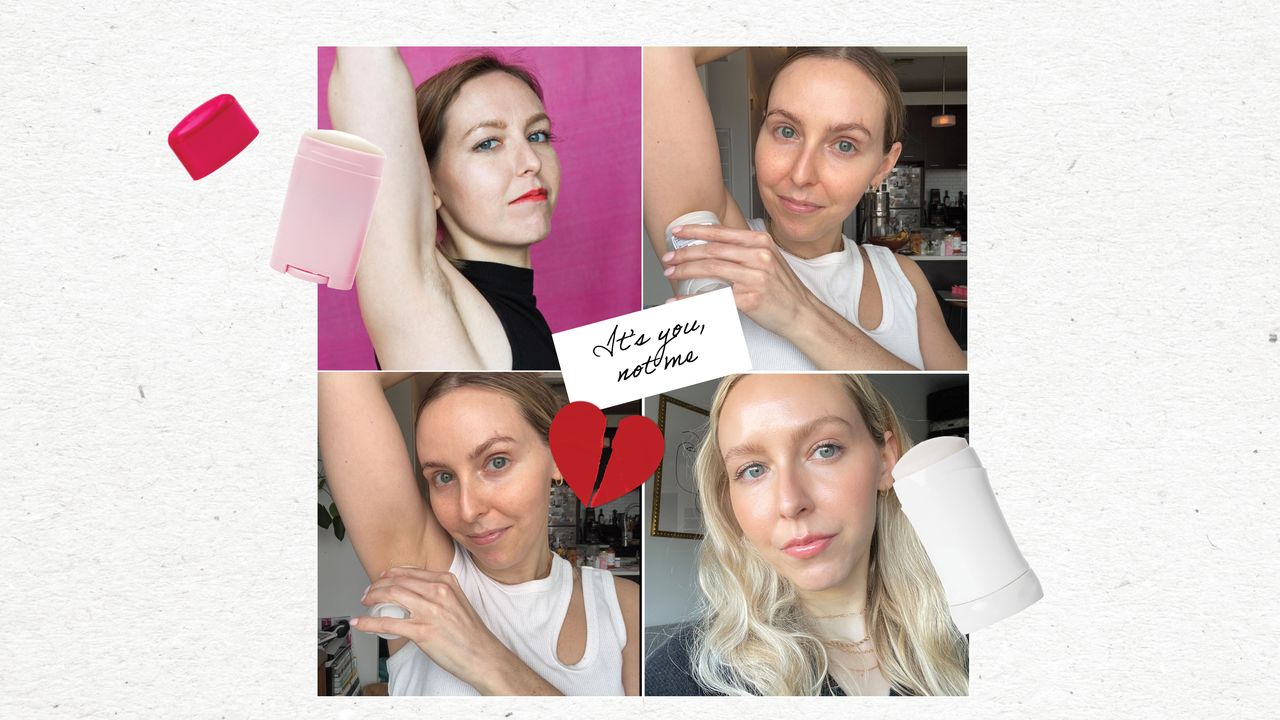
Natural deodorant, it’s you, not me. I just can’t do this anymore.
As a sweaty person, I need stability. I need to feel protected. I need something that puts as much work into the relationship as I do. Unfortunately, over the last decade, I haven’t gotten any of that from you. In fact, I’m walking away with 10 years’ worth of sweat stains, body-odor baggage, and that phantom feeling of underarm drippage. I’ve had enough.
TL;DR: I’m breaking up with my natural deodorant—and going back to antiperspirant.
First, what’s the difference between deodorant and antiperspirant?
Growing up, I didn’t know the difference between deodorant and antiperspirant. They were used interchangeably in my house (and still are today), even though they are completely different products. A refresher: “Deodorants help with odor, usually by reducing bacteria or masking scent,” says Joyce Park, MD, a board-certified dermatologist in California. “Antiperspirants actually reduce sweat, which, in turn, reduces odor because there’s less moisture for bacteria to break down.”
Unlike deodorants, antiperspirants are made with aluminum and undergo much more testing before hitting shelves. “They’re considered over-the-counter [drugs] and have stricter regulations and formulation guidelines than deodorants,” says cosmetic chemist Amanda Lam.
The aluminum salts in the formula (usually aluminum chlorohydrate or aluminum zirconium) reduce sweat by temporarily blocking the opening of the sweat duct, Lam explains: “When you apply it to slightly damp skin, the aluminum dissolves and interacts with proteins in your sweat to form a plug near the surface of the duct,” temporarily stopping the sweat.
“Traditional antiperspirants will typically include other adsorbents like silica, talc, and starch to boost sweat reduction and are anhydrous,” Lam says. “They may also include various silicones to improve feel and glide on the skin.”
Deodorants are also anhydrous (sans water), but they are made without aluminum. “They can also contain absorbents (typically plant-derived starches) and will usually contain something like zinc ricinoleate, which is an odor neutralizer,” Lam adds. “Deos typically feature a blend of natural waxes, butters, and oils rather than silicones. Kind of like one giant lip balm with some starch in it.”
A giant lip balm certainly sounds more fun, but I had used antiperspirant for most of my life. One of my first favorites was the now-discontinued Secret Scent Expressions Va-Va Vanilla, which, as you can imagine, was a sweet-smelling, solid stick, practically made for a 12-year-old girl. It was also incredibly effective at stopping the puberty-induced sweat and odor of said 12-year-old girl (hi, that’s me).
Why I decided to switch to using a natural deodorant:
Before I quit antiperspirant a decade ago, I was struggling with yearslong underarm irritation (itchy inflammation). It wasn’t chronic, but it was constant. “Aluminum salts can be irritating for some people, especially right after shaving,” says Dr. Park. “Fragrance is still a big trigger. More often, it’s a combination of friction, occlusion, shaving, and individual skin biology.”
Also, I worked out all the time, would shave frequently (much too frequently, compared to my current once-a-week razor date), and loved anything with added fragrance. (The sweeter, the better!) Little did I know that I was likely experiencing my now-diagnosed fragrance allergy. These days, too much of it (worn anywhere on my body), and I break out in hives. Fun! All this to say, there was a lot that went into my decision to give up antiperspirant.
In 2016, during the clean beauty boom, I finally kicked antiperspirant to the curb. I’d just joined the Allure team, and we were talking more about what our definition of “clean” was. (Based on our reporting, the topic was introduced around 2010, but didn’t pick up steam until a few years later. It wasn’t until 2019 that Allure recognized the market with its official Clean Best of Beauty seal, which is still prominent today.) During this time, many common, well-known ingredients became our enemies. So, sulfates were stripped from shampoo formulas, parabens were no longer primarily seen as product-extending preservatives (which they are), and conversations about aluminum salts being linked to breast cancer swirled and spiraled. (The breast-cancer link has since been debunked many times over, but more on that later.)
Disclaimer : This story is auto aggregated by a computer programme and has not been created or edited by DOWNTHENEWS. Publisher: www.allure.com