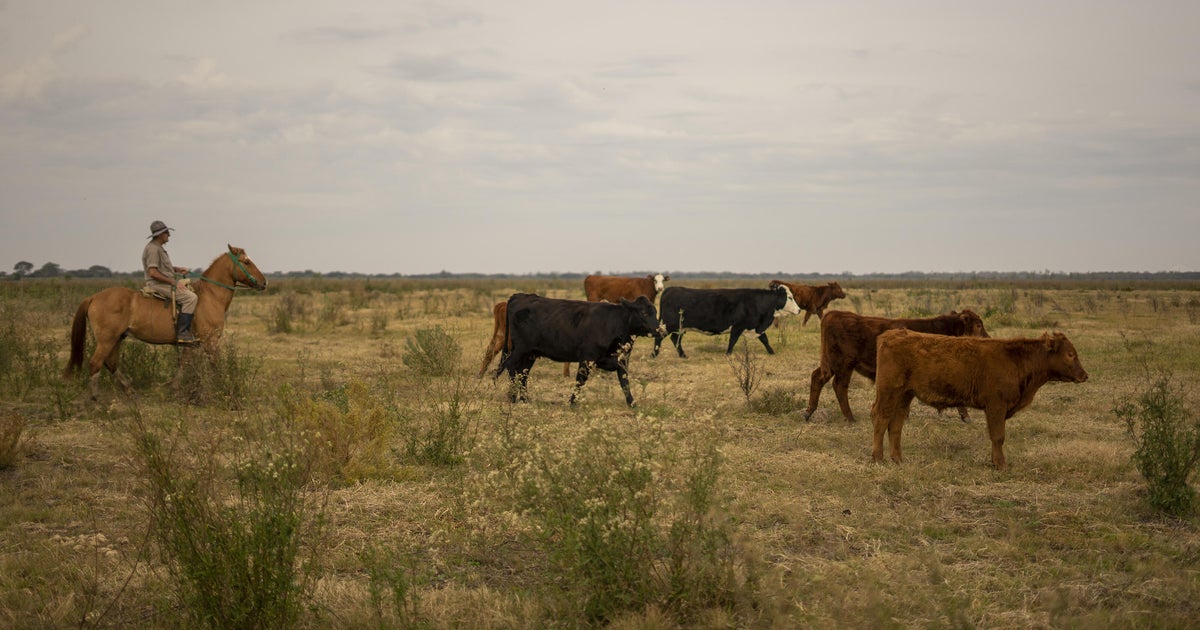
President Trump’s move to boost U.S. imports of beef from Argentina to help ease costs for consumers may have less impact than the White House is hoping for, experts said.
The executive order, which Mr. Trump signed on Friday amid a new trade deal between the two countries, allows Argentina to export an additional 80,000 metric tons of beef to the U.S. tariff-free this year, according to the Trump administration. The directive applies to imports of lean beef trimmings, which are used to produce ground beef.
“As President of the United States, I have a responsibility to ensure that hardworking Americans can afford to feed themselves and their families,” Mr. Trump said in the order.
But David Ortega, a food economist and professor at Michigan State University, told CBS News that 80,000 tons of beef represents only 0.6% of the overall U.S. beef supply — too little to move the needle on prices, he said.
“We’re talking about less than 1% of supply,” Ortega said. “And so I wouldn’t expect this to have much of an impact on these prices. Now, it doesn’t hurt, but we’re not talking about any major quantities that we are importing that would immediately suppress prices.”
The U.S. produced nearly 27 billion pounds of beef in 2024, according to data from the U.S. Department of Agriculture shared on Statista.
What drove up beef prices
Average ground beef prices around the U.S. reached $6.69 a pound in December, up 19% from a year ago, according to data from the Federal Reserve Bank of St. Louis. Five years ago, consumers could buy a pound of ground beef for $3.95.
The biggest factor behind the jump in beef prices: Extreme weather conditions that have shrunk the nation’s cattle supply. Droughts, including a recent bout of dry weather in 2022 that affected beef-producing states, have made it harder for farmers to grow crops needed for feedstock and forced many cattle ranchers to sell off their beef cows. Wildfires have also ravaged grasslands used to graze cattle, according to the White House.
By contrast, the cost of chicken and eggs, which spiked in 2022 amid an avian flu outbreak that required the destruction of millions of birds, has recently dipped, St. Louis Fed figures show.
“While prices for other proteins such as eggs, pork and chicken have declined in recent months, beef prices remain elevated,” a Department of Agriculture spokesperson said in an email. “This is due to the perfect storm of sustained increase in consumer demand for beef, coupled with a prolonged decrease in the supply of live cattle.”
The country’s beef cattle supply stood at 27.6 million on Jan. 1, down 1% from a year ago, according to USDA data. Overall, the total number of cattle in the U.S. is at a 75-year-low.
In a fact sheet last week, the White House acknowledged the supply challenges facing the U.S.
“President Trump is responding to market challenges and ensuring a plentiful ground beef supply for American families at affordable prices by taking action on multiple fronts.”
So what would lower costs?
Derrell Peel, a professor in the department of agricultural economics at Oklahoma State University, also expressed skepticism that the executive order will help ease costs for domestic consumers, saying there’s “nothing that the administration can do in the short run to make U.S. beef prices come down.”
That’s because the key to lowering prices will be to rebuild the cattle supply, a process that will likely take several years, Peel explained. Part of that effort will require saving female cows, known as heifers, for breeding, instead of killing them to meet consumer demand for beef, Peel noted.
“We have record-high cattle prices, and we’re going to continue to until we regrow,” he said.
Disclaimer : This story is auto aggregated by a computer programme and has not been created or edited by DOWNTHENEWS. Publisher: cbsnews.com