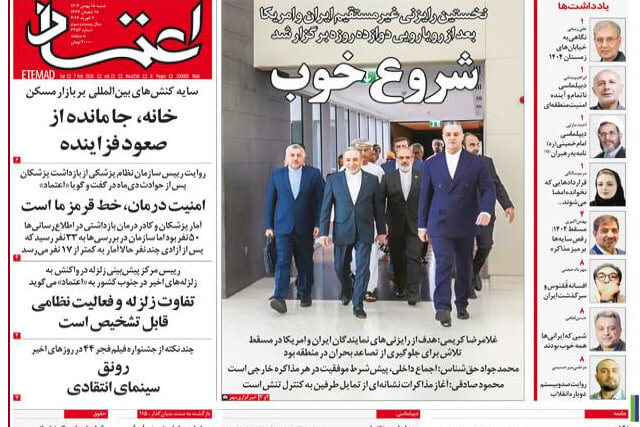
TEHRAN- In a reference to recent developments, reformist political activist Ali Bagheri told Etemad: The public atmosphere in the country and also international reactions show that the prevailing perception of a war atmosphere has given way to hope for diplomacy. A series of unofficial news reports from inside and outside the country indicate that the horizon of negotiations has become brighter than in comparison to the past, and this issue has noticeably changed the psychological atmosphere prevailing in the country and the region.
This change in atmosphere occurred in a situation where the country, along with internal tensions and crises, was under the most severe external threats, including the threat of war from the United States. At the height of the U.S. threats and while many countries are in strategic confusion in such circumstances, Iran was able to maintain its course with a combination of authority and prudence and not allow external threats to disrupt the country’s major decision-making. The main basis of the conditions that have made negotiations possible today has been this kind of authoritative and, at the same time, prudent confrontation by Iran.
Hamshahri: Battlefield-diplomacy harmony to defend Iran
The Hamshahri newspaper dealt with Iran’s foreign policy. It quoted Seyyed Reza Sadr al-Hosseini, an expert on regional issues, as saying: The Americans initially sent their aircraft carriers and warships towards Iran in a military action to put extreme pressure on the Iranians. The U.S. intended to instill fear and terror in its opponent by bringing the CENTCOM commander to the negotiating table, so that what was not achieved by the Marines could be achieved through diplomacy. But it must be said that, according to the firm stance of Iran’s chief negotiator, these talks were solely on the nuclear industry and the issue of enrichment. Iran entered the negotiations to remove unfair sanctions in exchange for reducing tensions related to the nuclear industry.
Also, the unveiling of the Khorramshahr-4 missile (on the eve of the negotiations in Muscat) sent a clear and transparent message to the Americans, and Dr. Araghchi’s words about the harmony between “battlefield and diplomacy” were proven. It should not be forgotten that the hands of Iranian military men are on the trigger to defend the country.
Arman-e-Emrooz: A sensitive negotiation
Arman-e-Emrooz analyzed the resumption of Iran-U.S. negotiations and the existing internal and external tensions. According to the newspaper, signs of obstacles being created by both internal and external fronts are visible as the negotiations resume. In the foreign arena, opponents of negotiations can be divided into three groups: first, saboteurs who fundamentally cannot tolerate any kind of interaction and openness; second, the Israeli regime, which is opposed to any agreement or reduction of tension between Iran and the U.S.; and third, extremists who, although not necessarily saboteurs or affiliated with Israel, oppose any tranquility in Iran and openness in foreign policy. The people defined under the third group are in different parts of the world, including lawmakers in the U.S. Congress. Domestically, we are also facing a group of extremists who reject negotiations and claim that any agreement will be detrimental to Iran. On the contrary, evidence shows that a significant percentage of the population supports dialogue and agreement. The success of any negotiation requires, above all, unity of opinion and coordination, which can serve as a key strategy in the service of national interests.
Jam-e-Jam: Public retreat; change of strategy or tactical maneuver?
In recent weeks, the U.S. government has slightly toned down its threatening language and spoken of its readiness for dialogue with Iran, especially in messages not made public. However, the synchronization of these messages with the continued deployment of military logistics toward Iran’s maritime borders and the advancement of maximalist demands further exposes the contradictions in the rhetoric of White House leaders. It appears that the United States has reached the conclusion that, for now, it cannot force Iran into a retreat through a ‘serious and decisive threat’—one that is both realistic and imminent, and capable of convincing Iran that resistance carries a heavier price than making concessions. The issue is not a lack of military capability, but rather the uncertainty of regional consequences, the risk of chain reactions, and the serious hesitance of U.S. allies to enter a new crisis. In such a climate, Washington seeks to utilize negotiations not to reach a balanced compromise, but to increase pressure, break resistance, and ‘condition’ the opposing side. This is why dialogue and threats proceed simultaneously and side-by-side. It is a form of negotiation viewed less as a path to agreement and more as a tool for political and psychological pressure.”
Disclaimer : This story is auto aggregated by a computer programme and has not been created or edited by DOWNTHENEWS. Publisher: tehrantimes.com