It’s a sinister form of sightseeing: visiting the sites of horrific crimes to soak in the macabre atmosphere – and perhaps even buy souvenirs.
Residents of the suddenly notorious South Gippsland town of Leongatha have been disturbed by morbid sightseers driving up to the former home of Erin Patterson, where “the mushroom murderer” fatally poisoned her ex-husband’s parents, Gail and Don Patterson, his aunt, Heather Wilkinson, and almost killed Heather’s husband, Ian. Towards the end of her trial, friends of Patterson put up plastic sheets around the building, to block the view of her house from the road.
But the historical tradition of “dark tourism” suggests Leongatha may have to deal with the impertinent interest of strangers for a long time to come. An Institute for Dark Tourism Research was founded at the University of Lancashire in the UK in 2012, partly to study “trauma-scapes” such as murder sites, which attract visitors lured by a lingering scent of death. “People think that it would be a modern, contemporary phenomenon,” says the institute’s executive director, Dr Philip Stone, “but it’s not.”
Dark tourists stalked the slums of London in the 19th century. “Go back to Jack the Ripper,” suggests Stone. In September 1888, “When one of the victims, Annie Chapman, was still lying in the yard, a landlord let out a room opposite the crime scene, so visitors of the day would pay a penny to come and have a look from the top window and see the body. That is early dark tourism.”
Fruit sellers set up around the yard, where Chapman’s disembowelled corpse lay on a dry autumn day. “It’s all driven by media exposure,” says Stone. ” ‘Jack’ was the name given to the murderer by the tabloid press, because horrible tales of salacious murder sell newspapers.” More than 130 years later, the dismal Jack the Ripper Museum in London runs twice-daily Jack the Ripper walking tours, and a business with the ill-chosen name of The Jack the Ripper Experience escorts holidaymakers through the East End every evening.
As a “true-crime” writer, I feel a certain unease about this.
Here in Australia, Dark Stories True Crime Tours, run by the marvellously monickered David Dark, offers walks in cities from Maitland to Perth. Dark says his “hosts” concentrate largely on historical crimes. Although his Melbourne tour passes sites related to the city’s recent gang wars, “It’s not history yet,” he says. “And who knows who’s still around and who may not appreciate certain things being talked about?”
Patterson’s trial was held in April to July last year, 58 kilometres north-east of Leongatha in Morwell, which experienced a much-publicised mini-economic boom when it was flooded with journalists and YouTubers, authors and influencers, fabulists and fools.
There was some small echo of the experience of Snowtown in South Australia, where the remains of eight butchered victims of former abattoir worker John Bunting and his associates were found in acid-filled barrels in the vault of a disused bank in 1999. The case inspired a critically admired movie, Snowtown, released in 2011, which prompted a new wave of dark tourists curious to see the bank building.
Before it closed, the Snowtown Crafts and Curios gift shop endeavoured to tempt visitors with an under-the-counter offer of locally crafted 15-centimetre plaster ornaments of barrels with heads and legs sticking out, as well as “Snowtown SA” fridge magnets promising “You’ll have a barrel of laughs”. The shop’s owner said, “I’m doing something that can bring money into Snowtown. You can’t tell me the people who made the Snowtown movie didn’t cash in on the town.”
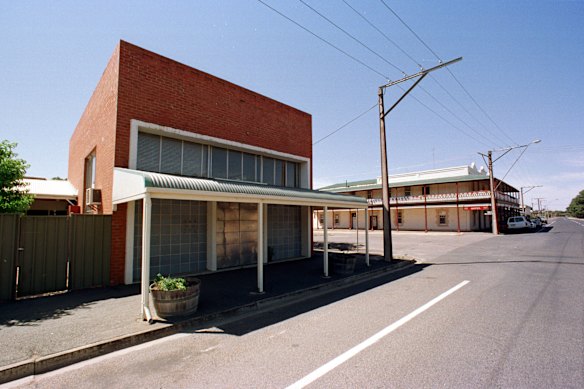
Two of the sadistically tortured victims had once been buried around Bunting’s housing-commission home in Salisbury North, which has apparently since been bulldozed.
The original serial-killer “House of Horrors”, as designated by the UK press, was demolished, too. Nothing remains of the Cromwell Street, Gloucester home of British serial killers Fred and Rosemary West, where nine of the couple’s 12 confirmed victims were buried.
Stone, who was then working as a hotel and casino manager, moved to Gloucester during the frenzy of public interest around the Wests’ case. “As I was picked up by a colleague from the train station, and before being taken to my hotel, he said, ‘Would you like to go see Cromwell Street?’ To them, it was a kind of local celebrity thing.”
The US geographer Kenneth E. Foote has suggested that the memorialisation of tragedy takes on different – sometimes shifting – forms: sanctification, designation, rectification and obliteration.
“Gloucestershire County Council decided on obliteration,” says Stone. They purposely obliterated that place from the collective memory, and even the bricks from 25 Cromwell Street were ground into dust, so you couldn’t have one as a morbid souvenir. “The last time I was there, there were weed bins,” says Stone. “It was just a cut-through to the town centre.”
He says he is unsure if the council made the right decision. “We need to shed a light back on that particular episode,” he says, “because it’s important in terms of criminology, in terms of victimhood, in terms of women’s rights … And it’s important how we remember these people.”
The biggest and most notorious murder site in Australia is Port Arthur in Tasmania, where a lone gunman, with a subnormal IQ and a fat portfolio of grudges against his neighbours, indulged himself in a murderous rampage that killed 35 people and injured 18 more in April 1996. In search of insights into dark tourism, I visit Port Arthur on a coach tour from Hobart run by Gray Line Tasmania. The focus of the trip is the former penal colony’s convict heritage. Only a single mention is made of the slaughter.
“It has deeply affected the community,” says our driver-guide. “Although it was 29 years ago, it still cuts pretty rough.”
‘Education of the dark past is being contested, manipulated.’Dr Philip Stone, Institute for Dark Tourism Research, University of Lancashire
He offers to direct interested passengers to the memorial garden at the former site of Port Arthur’s Broad Arrow Café, where most of the massacre took place. Only sections of the shell of the cafe remain, a study in grief and ruin, an emptied heart overlooking a shallow pool ringed by kind words. The on-site guides will not talk about the killings, says our driver. They do not even speak the murderer’s name.
There is poetry in this prohibition, as one of the Port Arthur shooter’s moronic motives was apparently to make a name for himself. But as Stone says, “Generations change, and you’ve got to keep re-educating. And education of the dark past is being contested, manipulated.”
If the killer is not identified, it’s left open to fools who “do their own research” to blame a government conspiracy to strip ordinary Australians of their right to carry guns and shoot each other. Conspiracy theorists say that one untrained gunman could not have caused such carnage alone. It seems vital to recall that he could and he did.
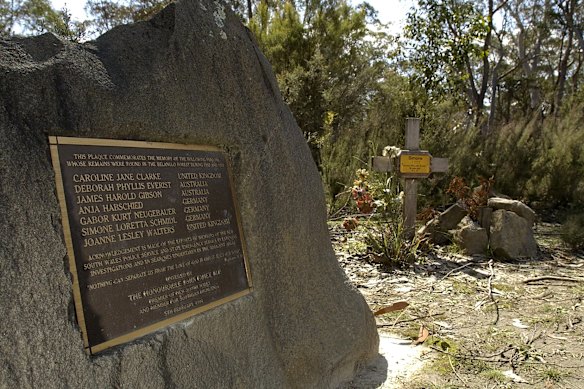
For two weeks in June 2015, a company called Goulburn Ghost Tours operated an “Extreme Terror Tour” of NSW’s Belanglo State Forest, where serial killer Ivan Milat had buried the mutilated corpses of the seven young backpackers he had murdered between 1989 and 1992. There is a small memorial to Milat’s victims near where their remains were discovered in the forest, and this seemed to be the centrepiece of the tours. The company was quick to respond to criticisms. “There is absolutely no one jumping out of the bushes,” said manager Louise Edwards at the time. “We don’t have recordings of people screaming. We don’t say any of the victims’ names and say, ‘Are you here?’ ”
Goulburn Ghost Tours’ website simply promised a visit to the death site accompanied by “trained and experienced Paranormal Investigators” and asked, “Who else is out here? Are we being followed … watched? Is there another victim waiting to be found?”
It further urged visitors to “use paranormal techniques to help solve the baffling murder of Angel, believed to be murdered AFTER Ivan Milat was jailed!”
Public outrage soon forced the company to abandon the tour. Stone calls this “milking the macabre … blurring that line between commodification and commemoration”. However, he says, “you could argue that it keeps the memory alive – in a very crass, trivialised way.”
On a road trip from Canberra, I ask my son to drive me to the backpackers’ memorial. It’s coming on dusk as we leave the highway and head into the forest, where the roadside guideposts come to resemble lines of grave markers and aloof pine trees mimic observers at a funeral procession. Kangaroos bound before us, grey-brown like pine bark. The car trembles on loose rocks and sharp stones. No road sign points travellers towards the memorial. All we have is the GPS coordinates, and they seem to suggest we should leave the car and trek into the trees.
About nine kilometres from the main road, on the far edge of a wide, dirt turning circle, desultorily segregated by a shin-high log barrier, sits what looks like a shrine. The memorial is in two parts. The larger is a rock bearing a plaque with the names of the victims, and a tribute to the search workers who combed the forest for their remains. The smaller is a cross erected by the parents of German backpacker Simone Schmidl.
Schmidl’s family did not attend her funeral at Sydney’s Northern Suburbs Crematorium. The name on the crucifix is simply “Simone”. The inscription in German translates as “You live on in our hearts. We love you.” The shrine does not look as if it is cared for, but my son is moved by the simple tributes left by strangers: silk flowers, a woollen blanket, a costume necklace. “So somebody saw this and thought, ‘I could make some money out of this?’ ” he asks, incredulously.
I bow my head and wonder if, as a true-crime writer, I am not doing that same thing myself.
Get the best of Good Weekend delivered to your inbox every Saturday morning. Sign up for our newsletter.
Disclaimer : This story is auto aggregated by a computer programme and has not been created or edited by DOWNTHENEWS. Publisher: www.smh.com.au