
Australians have felt this pain before – but it’s been a while.
In 1979, Ayatollah Khomeini ascended to power in Iran’s Islamic Revolution. As AMP economist Shane Oliver explains, the flare-up cut out about 5 per cent of global oil supply.
News clips from Sydney showed drivers queuing up at service stations with only enough petrol to serve cars with number plates starting with odd numbers. Even numbers were served the next day. On weekends, all stations were closed.
The revolution marked the last time Australia rationed fuel. Iran’s response to US-Israeli strikes and the assassination of Ayatollah Ali Khamenei might spawn a more severe crisis.
In 2026, about 20 per cent of the world’s oil travels through the Strait of Hormuz, which Iran has shut down to increase the costs for US President Donald Trump.
“At a high level, it’s four times as big,” Oliver says, while noting the world now has oil reserves and Russian supply that could help fill the gap.
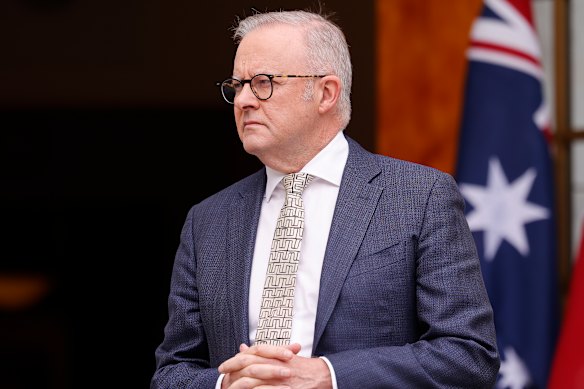
Prime Minister Anthony Albanese prefers a steady-as-she-goes approach over projecting urgency. In the face of what the International Energy Agency says is the biggest oil shock ever, he has tried to avoid doomsday talk as Australians rush to petrol stations – some near Albanese’s Canberra residence had run out of certain petrol types on Thursday.
He and his ministers are using past and present tense to skirt questions about future supply: “No ships that were scheduled to arrive, haven’t arrived. Our fuel supply is here,” Albanese said on Thursday.
All well and good. But that situation may change dramatically in a month when shipments that were not booked before the war start to slow down.
The prime minister will come under pressure as the weeks go on to play a central role in managing the crisis, use his position to urge calm, condition the public for what might come next and outline the broader national resilience plan beyond fuel.
Chief executives are worried about the prospect of shortages not just of petrol but of the plastics used in construction, and the petrochemicals – made even more scarce by the disastrous explosion at a crucial LNG plant in Qatar – used in fertiliser and drugs we rely on from China and India.
One leading business figure told this masthead that the public needed to know “how real this could get”.
Albanese convened the national cabinet, the forum for premiers and chief ministers, on Thursday. The body was created during the pandemic. The prime minister’s announcement on Thursday of a fuel supply tsar had a distinct COVID vibe about it, reminiscent of the war-like planning from that gloomy time.
The government’s judgment to refrain from using more acute language delays the point at which it attracts COVID-level scrutiny for its policy response.
Opposition Leader Angus Taylor has been preoccupied this week fighting One Nation in Farrer. Some of his colleagues are agitating internally to drop everything and shift focus to the oil crisis and Labor’s response, setting minimum standards for success and turning it into a topline political issue.
Labor tore strips off former prime minister Scott Morrison for elements of his pandemic response and his “I don’t hold a hose moment” during the 2019-20 bushfires.
In a blistering press club address, Albanese scolded Morrison on sovereign capability, saying, “Failing to plan is a plan to fail”. The government’s Future Made in Australia plan is its attempt to build resilience, but there’s little evidence that Australia’s just-in-time production model has changed since COVID.
COVID presented supply and demand problems – toilet paper was the most visible example in March 2020 – but the oil crisis presents a different challenge for Australia. In the pandemic, Morrison could look to like-minded nations like the US for lessons. This time, Australia is in a tougher position: more reliant on imports than many other nations, and geographically isolated – a positive during the pandemic but a problem now.
Albanese has not yet slipped up, and governments of both stripes failed to heed lessons on sovereign capability before the current reckoning.
But some state Labor governments are grumbling in private about the speed of the Albanese government’s response and their sense that the feds are not quite capturing the economy-wide supply blockages that could be in store. Credible economists are calling for work-from-home directives and more upfront official messaging.
The Bondi massacre showed the prime minister can come across as jittery at times when the nation requires a government with a hardened security profile. This Middle East crisis shows no signs of winding down, yet the prime minister is dipping in and out of speaking publicly on the oil situation, leaving most of the government’s management to ministers Chris Bowen and Julie Collins.
The prime minister expressed hope that Trump might call it a day in the Middle East. “The objectives of denying Iran the opportunity to have a development of a nuclear weapon have been secured,” he said. “I’m hopeful that you can see an endpoint.”
Hope alone won’t shield the nation from the worst of a crisis that is increasingly being felt in Australia’s suburbs.
Cut through the noise of federal politics with news, views and expert analysis. Subscribers can sign up to our weekly Inside Politics newsletter.
 Paul Sakkal is chief political correspondent. He previously covered Victorian politics and has won Walkley and Quill awards. Reach him securely on Signal @paulsakkal.14Connect via X or email.
From our partners
Disclaimer : This story is auto aggregated by a computer programme and has not been created or edited by DOWNTHENEWS. Publisher: www.smh.com.au