
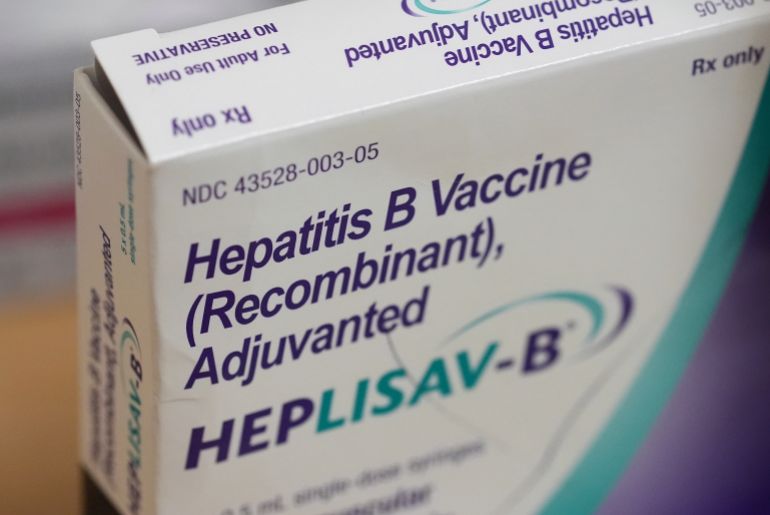
Danish researchers were set to begin a controversial United States-funded vaccine trial on newborns in the West African nation of Guinea-Bissau last month when public outrage derailed their plans.
The scientists wanted to assess the effects of administering hepatitis B vaccines at two separate times on 14,000 babies. Half of the sample group, chosen at random, would receive the vaccine at birth – as is recommended – while the other half would get it six weeks later. The researchers would then compare health outcomes over five years.
Recommended Stories
list of 4 itemsend of list
Soon after the trial was announced, anger erupted in the international health expert community over the ethical grounds of the experiment. It resulted in such widespread scrutiny that the Bissau-Guinean government suspended the research on January 22 pending a review.
“I was disappointed, to say the least, that my country could have approved a study of that kind,” Magda Robalo, a former Guinea-Bissau health minister, told Al Jazeera on a video call from the capital, Bissau.
While a small ethics committee within the health ministry knew about the study, the country’s national public health institute, which would approve such a monumental experiment, was not informed, she said.
“[The researchers] took advantage of the fact that Guinea-Bissau does not have a very strong research capacity … a very strong critical mass of public health professionals, very well vested in understanding what the politics that surround global health are,” she added with a pained expression.
Advertisement
Because of their weaker immune systems, babies are at the highest risk of being chronically infected with the hepatitis B virus (HBV), which spreads through body fluids, and can lead to long-term liver damage and cancer. In most cases, mothers carrying the virus pass it on to their infants during birth or through breastfeeding. HBV resulted in 1.1 million deaths globally in 2022, according to the World Health Organization (WHO).
There’s no cure for the disease, but the WHO advises that babies be given doses of approved hepatitis B vaccines at birth, and boosters weeks later. WHO-approved vaccines offer protection, possibly for life, according to multiple independent studies.
Guinea-Bissau, a small country of 2.2 million, has one of the highest numbers of people infected with HBV in the world – about one in every five people. Authorities typically vaccinate babies six weeks after birth because there aren’t enough doses to go around. However, from 2028, Guinea-Bissau is planning a budget that supports at-birth vaccines.
The Danish researchers who planned the vaccine trial argue that the study is timely, as it will take advantage of the time left before Guinea-Bissau switches to the new schedule to recruit participants. They also point out that half of the babies will receive at-birth shots for the first time in Guinea-Bissau.
But critics like Robalo say the trial is unethical because it withholds vaccines at a critical time for the other 7,000 babies, even if they’d still receive shots in six weeks, per the current schedule.
“You don’t run such research,” Robalo, who served as a senior WHO official for many years, insisted.
“It is unethical to deny children an intervention that we know works, that will contribute to improving their lives and save them from a disease that we know they will likely acquire,” she said.
Under scrutiny
Not only are the ethics of the experiment under scrutiny, but so are the researchers set to lead it.
Scientists at the Guinea-Bissau-based Bandim Health Project, part of the University of Southern Denmark, have conducted studies on thousands of Bissau-Guinean women and children since 1978. The project is chaired by Christine Stabell Benn, and founder, Peter Aaby, both prominent scientists in Denmark.
The pair, who are married, say their work aims to reveal the unintended impacts of vaccines, whether good or bad. One of their studies, for example, found that a vaccine against diphtheria, tetanus (lockjaw) and pertussis (DTP) was linked to higher child mortality, particularly among girls.
Advertisement
After reviewing the results in 2014, the WHO concluded that the study and others with similar findings were inconsistent but merited further review. The WHO recommended that countries continue vaccinating against DTP.
Danish scientists have repeatedly accused Benn and Aaby of claiming without proof that vaccines containing inactivated viruses, such as the DTP and HBV vaccines, can cause adverse reactions, including death.
Critics say the pair downplays important results from their own randomised controlled trials (RCTs). RCTs, like the proposed one in Guinea-Bissau, are the gold standard of experiments in medical research because they significantly reduce the risk of bias.
Last February, an investigation by Danish publication Weekendavisen revealed they did not publish the results of an RCT they conducted 14 years ago, looking into the effects of the DTP vaccine.
The outcome of the study, which hypothesised that the vaccine increased child mortality rates especially among girls, was null, meaning no significant effects were recorded. The pair, however, continued to conduct studies and pushed in public statements over the years that the vaccine needed to be tested, the newspaper alleged.
Months after the investigation, the study was published.
In a response to Al Jazeera, Benn pushed back against allegations that their trial results were hidden.
The “accusations raised in Danish newspapers in February 2025 were investigated by our institution’s committee for research integrity. That review did not find grounds for sanctions or other actions,” she said.
Still, critics say there’s a disconnect between the researchers’ claims and findings in general.
“They haven’t really been able to produce solid evidence to back these hypotheses up,” researcher Anders Peter Hviid of the Danish State Serum Institute, a research institute, told Al Jazeera, questioning why the researchers would be willing to administer a vaccine they think is harmful in the first place.
“They have a lot of null findings which they keep ignoring themselves, time and again … and they are overlooking these ethical issues and basically running trials that are negative again and again and again on African children,” he said.
Other critics point out that hepatitis B infections in newborns can manifest long after the five years the study is meant to run – meaning the full effects of not giving vaccines at birth may never be known. They also fault the researchers’ plans to conduct an “open-label” trial, where the organisers would know which participants received vaccines. Usually, such experiments are done “blind” to avoid bias. It is unclear why the Bandim Health Project chose to conduct an open-label trial.
Both Benn and Aaby have pushed back against the backlash to the Guinea-Bissau project and what they called “moral outrage” in a lengthy statement, faulting their critics for not having a “curious and humble” mindset.
The pair say they are not questioning the vaccine’s effectiveness, but that “the issue is whether the prevention comes at a prohibitive price,” such as death.
Advertisement
“The moral outrage from academic celebrities seems unnecessary,” the statement read.
“Contrary to what some of the critiques claim, we will not withhold the vaccination from any children who would other[wise] have received it … As a result of the trial, more children who would not otherwise have had it, are actually getting the vaccine.”

Funding from Trump’s White House
Despite facing controversy at home, the Bandim Health Project found an audience with the US Centers for Disease Control (CDC), led by Health Secretary Robert F Kennedy Jr (RFK), a known vaccine sceptic whose anti-vaccine advocacy group praised Aaby in a 2019 article.
The researchers secured $1.6m in funding in December without having to go through a competitive, rigorous process, as would be the norm in a study where humans are the subjects, and where close monitoring by the CDC would be required. Earlier, RFK Jr disbanded a team of scientists at the agency’s helm and appointed a non-scientist as its acting head.
RFK has long pushed the narrative that vaccines are linked to autism. Details earlier leaked online about the Guinea-Bissau study showed it specifically aimed to see if administering the HBV vaccine at birth could lead to skin disorders and neurodevelopmental conditions – like autism – by age five.
The WHO, in December, reaffirmed there is no link between vaccines and autism.
After news of the research attracted the attention of researchers in Denmark and the US in early January, Guinea-Bissau approached the Africa Centres for Disease Control and Prevention, which declared that the trial would need to be reviewed. Representatives from the US health department, however, repeatedly told reporters that the experiment would go ahead, causing commotion before the decisive suspension by the Guinea-Bissau government last week.
Al Jazeera reached out to the US CDC for comment. CDC officials told news agencies that the experiment was important to test “non-specific effects” of the hepatitis B vaccine.
A military coup in Guinea-Bissau in late November caused a total government change. In a media statement last week, the new health minister, Quinhin Nantote, confirmed that his government had not been involved in talks about the study.
Under RFK, the US has suspended funding to Gavi, the Vaccine Alliance, which helped deliver crucial doses to less-wealthy nations during the COVID-19 pandemic. In a statement justifying the cuts to Gavi, RFK cited Bandim Health Project’s work.
The US has also cut the number of vaccines it recommends for newborns to 11 from 17. In December, the health department scrapped a decades-long recommendation for infants to receive HBV vaccines at birth, and now says guardians and physicians should decide for themselves.

Painful history of trials gone wrong
For many, the controversial trial is reminiscent of Western-led health studies that have proven deadly for minority communities and poorer countries in the past.
During a severe outbreak of meningitis disease in Nigeria’s northern Kano State in 1996, Pfizer administered the experimental Trovan antibiotic drug to 200 children. The medication, which was not approved by the US Food and Drug Administration, caused a severe reaction in the children. At least 11 of them died, and others experienced varying injuries from paralysis to blindness.
Advertisement
The case contributes to still-high levels of vaccine mistrust in northern Nigeria. In 2003, many boycotted a national polio vaccination campaign, leading to an explosion in polio cases a year later that saw Nigeria carry about 80 percent of the global burden at the time. COVID-19 vaccine campaigns similarly suffered from high hesitancy in the region.
Much earlier, between 1932 and 1972, US health authorities studying the effects of untreated syphilis on about 400 Black men in Tuskegee, Alabama, observed them in death, even though efficient treatments such as penicillin were already available. More than 100 men died in the trial.
Back in Bissau, former health minister Robalo told Al Jazeera that the country’s priorities are not to retest the hepatitis B vaccine, but to provide sufficient supplies so that babies can immediately get the birth dose.
The Bandim Health Project, she said, had operated in Guinea-Bissau for many decades and ought to have known what agencies to approach, especially after the military coup. Over the years, the researchers should also have trained enough Bissau-Guineans in clinical research to help boost local capacity, she added.
“We are not second-level citizens,” Robalo said. “We are not a population to be used for anything that you cannot do in the Global North. We demand respect, despite the fact that we don’t have the capacity that we need. We don’t tolerate that.”
Disclaimer : This story is auto aggregated by a computer programme and has not been created or edited by DOWNTHENEWS. Publisher: aljazeera.com



