Having gained a strong command of the German language in his seventeen years in the country, columnist Tom Pugh suggests there are still words he struggles to pronounce and sounds he can’t differentiate between.
I spend a good portion of my life speaking, reading and listening to German, both at home and at work. I can hold my own in meetings, read official letters without breaking into a panic, and chat with friends and neighbours.
But even after nearly two decades in the country I still have blind spots when it comes to pronouncing certain words and hearing certain sounds, beyond simply speaking with an accent.
Until now, I’ve consoled myself with the theory that the human ear can’t learn to distinguish certain sounds if it isn’t exposed to them early in life.
Famously, for example, this is one reason often given for why Japanese speakers sometimes struggle with “L” and “R” in English. Not a lack of effort, in other words, but science.
On closer inspection, however, it seems this comforting theory rests on shaky foundations.
Struggles with pronunciation
One of the first casualties of my German-speaking life was Coca-Cola. In Germany, people don’t ask for “Coke”, they ask for a Cola. The problem here is the “o”.
Germans pronounce it with a pure and sustained sound that seems to come from a secret chamber hidden somewhere in their mouths. I simply cannot make this sound.
I did try for a while, but every attempt to shape this elusive vowel made me look and sound like a gurning lunatic. Waiters didn’t just fail to understand what I wanted — they often backed away in alarm.
READ ALSO: 10 German words with hilarious literal translations
In the end, I stopped drinking cola altogether – a victory for my health, perhaps, but a notable defeat for my dignity.
For similar reasons, I also swapped my standard coffee order from Milchkaffee (milky coffee) to cappuccino. The German word Milch (milk) combines a light, precise “l” with a soft, hissed “ch” – a sound which is beyond me.
I may not say cappuccino like an Italian but at least people understand what I want – and the barista doesn’t stare at me as if I’m malfunctioning.
Struggles with understanding
There are plenty of German words I still don’t know, which means I can lose the thread of a conversation when it strays into unfamiliar territory, but that’s simply a question of vocabulary acquisition. It requires work but it’s not actually an insurmountable problem.
READ ALSO: The seven stages of learning German every foreigner goes through
What I find more frustrating are the subtle sound-shifts in German that indicate differences in meaning yet remain, to my British ears, completely undetectable. I often cannot hear the difference between the German “ü” and the German “u”, for example.
While this isn’t usually a problem, there have been times when it’s led me to make a complete fool of myself. Once, quite soon after arriving in Germany, I thought I’d been invited to take part in an over-18s football match and arrived, as a 30+ year old man in full kit, to find a pitch full of teenagers.
The fact that I hadn’t got to grips with the meaning of the German word “doch” was part of the problem, but the main culprit was my inability to hear the difference between U achtzehn (‘under’ / unter‑18s) and Ü achtzehn (‘over’ / über‑18s).
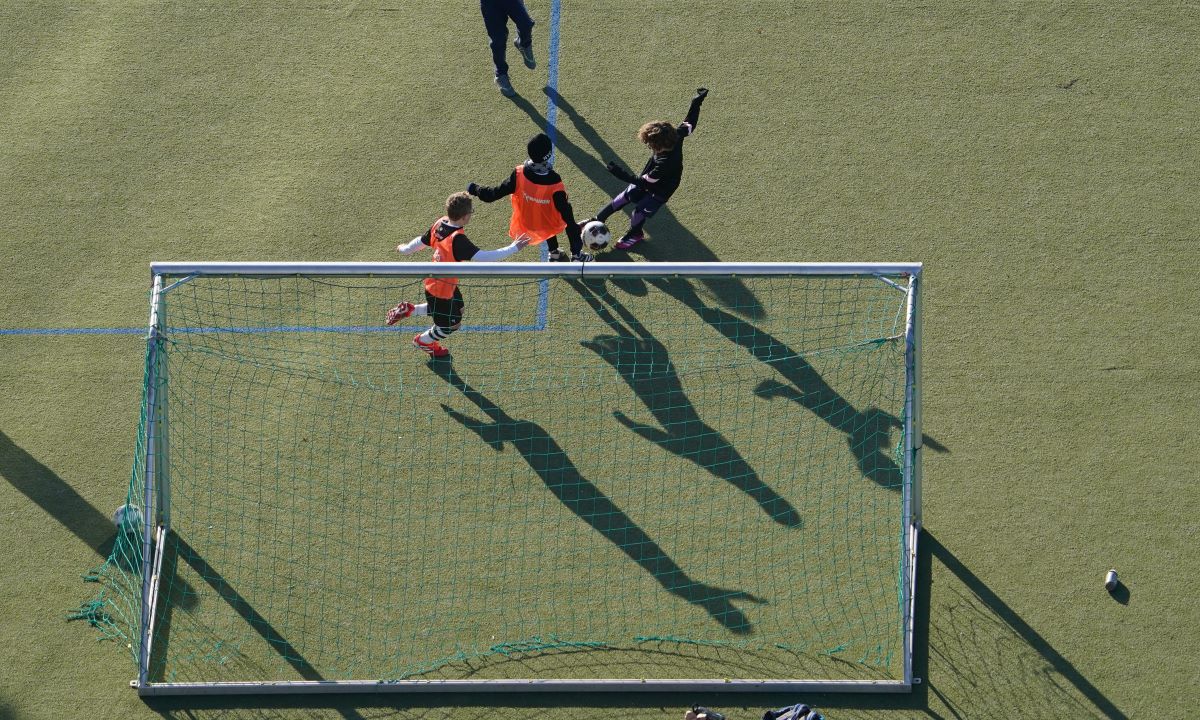
The author lacks the necessary ‘neural plasticity’ to understand that he’s far too old to play football. Photo: picture alliance/dpa | Marcus Brandt
READ ALSO: How drinking (a little) alcohol boosts your ability to speak a foreign language
I also have problems hearing the difference between the “e” sound and the “a” sound in German.
Which is fine most of the time, but problems arise around my wife’s niece, who is called Anna, and her wife, who is called Anne.
Everyone in the family pronounces these two names with a small but apparently unmistakable difference. Unmistakable for everyone, that is, except me. Invariably, whenever I try to address Anna or Anne, they either both look up or neither does.
What does the science say?
To be fair, this isn’t entirely a one‑way street, and I’m not above trying to take revenge by using words like “hat”, “head” and “hut” in quick succession.
It turns out that English vowel distinctions can be just as tricky when you didn’t grow up with them.
But generally the Germans I know don’t seem to struggle with English sounds as much as I do with German – a fact I try and excuse by claiming they must have encountered English‑language sounds earlier through music, films and television.
READ ALSO: The most popular youth slang words in Germany this year
So what does the science say? Well, while it’s true that scientists used to believe the adult brain couldn’t be retrained later in life to distinguish between sounds like “ü” and “u”, more recent research suggests it is possible for adults to retrain their ears.
Japanese adults, for example, improved their ability to distinguish “R” and “L” by nearly 20 percent after ten targeted listening sessions, according to a study reported by Dr Paul Iverson of the UCL Centre for Human Communication.
The process sounds quite involved, however, involving tasks designed to leverage “neural plasticity” in order to “change our perceptual warping”.
Weighing up the pros and cons, I think I’m more likely to settle for a coke-free future and a few misunderstandings.
Do you have similar problems saying or hearing certain words in German? Let us know which words you tend to mix up in the comments below.
Disclaimer : This story is auto aggregated by a computer programme and has not been created or edited by DOWNTHENEWS. Publisher: thelocal.de