Flights to and from Germany haven’t been severely impacted by jet fuel supply issues yet, but that could change quickly if the war in the Middle East continues. We asked airlines what passengers can expect.
Airlines in Europe are bracing for fuel supply shocks caused by the war in the Middle East.
The severity of the impacts on passengers will be determined in the coming days and weeks – depending on whether a recently announced ceasefire between the United States and Iran holds and if oil continues to move through the Strait of Hormuz going forward.
Some early impacts of related fuel price spikes and supply issues have already begun to be felt in parts of Europe, however, and some airlines have already resorted to drastic measures, including cancelling flights.
The Local contacted three major airlines operating in Germany to find out how airlines are preparing to deal with fuel shortages and price shocks, and what that means for travellers flying to or from the country.
Air travel restrictions begin in Europe
The Strait of Hormuz, through which roughly 20 percent of the world’s crude oil passes, has been effectively closed since shortly after the US and Israel attacked Iran on February 28th. Since then, jet fuel prices have increased by around 90 percent, according to figures from the International Air Transport Association (IATA).
An agreement reached between the US and Iran on Tuesday included that the Strait of Hormuz should be reopened, initially for at least two weeks while the ceasefire is in effect.
But the head of IATA warned Wednesday that even if the strait remains open from now on, it will take months for jet fuel supplies to recover around the world.
Related air travel disruptions have already become widespread in Asia and are expected to intensify in Europe soon.
The last jet fuel cargoes that had passed through the Strait of Hormuz were expected to arrive in Europe by around April 10th, with potential disruptions expected to become more severe from then on.
Already Scandinavian airline SAS announced that it planned to cancel a thousand flights in April due to surging fuel prices. Also, fuel rationing was recently reported at airports in Italy.
Germany is expected to see less severe impacts, because it has more domestic fuel refining capacity than other European countries.
That said, fuel prices for motorists initially rose much faster in Germany than in neighboring countries, and major airlines like Lufthansa have already drawn up contingency plans which include scrapping flights if shortages worsen.
READ ALSO: How to save money on fuel in Germany as prices hit all time high
How airlines in Germany are preparing
To get a sense of how travellers could be affected, The Local requested comment from Germany’s top three airlines by seat capacity; Lufthansa, Eurowings and Ryanair.
Asked what fuel-related disruptions were foreseeable, a spokesperson for Ryanair said, “We don’t expect any near-term fuel shortages, but the situation is fluid…”
“At present our fuel suppliers can guarantee supply to mid-end May,” the spokesperson said, adding that if supply chains are restored soon supply serious disruptions would be avoided, but that if the closure of the Hormuz Strait were to be extended into May or June, “then we cannot rule out risks to fuel supplies at some airports in Europe.”
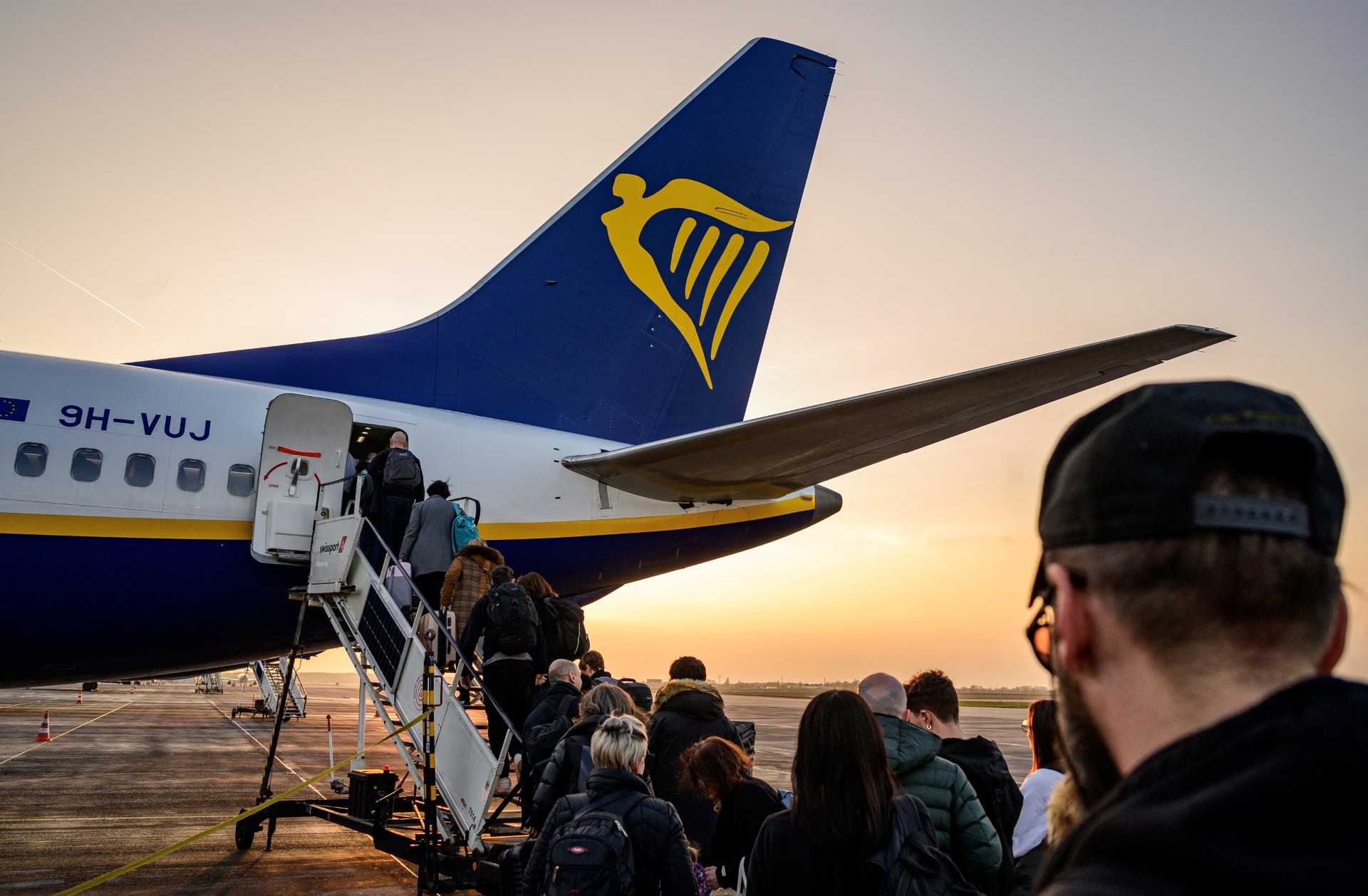
Passengers board a Ryanair flight in Spain. (Photo by John MACDOUGALL / AFP)
Asked if rising fuel prices were already being factored into ticket prices, the spokesperson told The Local, “With jet oil prices doubling during March, we expect all airlines will pass on these higher costs in the form of higher air fares post Easter and later this summer.”
Similarly, a spokesperson for Lufthansa Group told The Local that ticket prices can be expected to continue to rise, “Because the geopolitical environment remains highly volatile and is characterised by short-term changes and market fluctuations.”
They suggested that Lufthansa Group is “better protected against fluctuations” because its “kerosene requirements for 2026 are hedged at approximately 80 percent”.
Fuel hedging, which is practised to varying degrees by many airlines, is basically the practice of locking-in a portion of a company’s fuel supply for the coming term at a certain price to mitigate market fluctuations.
The Lufthansa spokesperson also noted that currently “demand for travel remains high, even though ticket prices have already increased.”
READ ALSO: The new direct flights you can catch from Munich in 2026
Asked if, and to what extent flight cancellations would be seen, the spokesperson said that Lufthansa Group airlines are developing and reviewing scenarios that “include the cancellation of unprofitable routes or the early retirement of older aircraft.”
One scenario would see flight capacity reduced 2.5 percent, and the grounding of around 20 aircraft. Another would see flight capacity decreased by five percent, and involve grounding 40 aircraft.
The affected aircraft would be “older, fuel-intensive aircraft models” – effectively bringing forward the planned retirement of planes nearing the end of their service life.
The spokesperson noted that the development of these scenarios is a precautionary measure.
Eurowings had not yet provided comment to The Local at the time of publication.
With possible disruptions looming, and the cost of air travel rising, travellers in Germany would be advised to book any absolutely necessary flights for the coming term as soon as possible, or to consider alternative travel (such as by car, train or bus) where possible.
The spokesperson for Ryanair said, “We urge all passengers to book their flights, and holidays, as soon as possible and then they will be insulated from inevitable air fare and accommodation cost increases…”
Of course booking early won’t protect travellers from potential flight cancellations, but in that case affected passengers would be entitled to alternative travel and/or compensation.
Disclaimer : This story is auto aggregated by a computer programme and has not been created or edited by DOWNTHENEWS. Publisher: thelocal.de