At the start of winter testing in Bahrain, most discussions in the Formula 1 paddock revolve around two words: compression ratio. Rivals are keeping a close eye on the Mercedes power unit, which complies with the 16:1 limit during static tests, but can achieve a higher ratio while running on track.
Audi, Ferrari and Honda immediately asked for clarification in a joint letter to the FIA, with Red Bull’s position understood to be more nuanced than initially thought. It is now up to the FIA to answer the question of whether it wants to adjust the measurement procedures or not — and if so, on what timeframe.
A first step in that process would be the required supermajority in the Power Unit Advisory Committee, with four of the five engine manufacturers as well as the FIA and FOM.
However, Vowles makes it clear that he would see such an intervention as completely against the DNA of F1.
“My harsh line on it is the PU that we have in the car is completely compliant with the regulations. It is not a month of work but several years of work to produce the PU to that level. We, as a sport, have to take care that this is not a BOP series. This is a meritocracy where the best engineering outcome effectively gets rewarded as a result, not punished as a result,” Vowles told media, including Motorsport.com.
“I’m sure other teams are pissed off. They weren’t able to achieve what Mercedes did, but we also need to take care. Right now, I don’t think there’s a person in the pitlane that can tell you what is the best PU, and we only focus on one detail of it.
Carlos Sainz, Williams
Photo by: Alastair Staley / LAT Images via Getty Images
“My hope is that sense prevails and that we, as a sport, recognise that we are here to be a meritocracy, and that the best engineering solution wins as a result of it. Therefore we are where we are right now, but I maintain that our PU is completely compliant with all regulations.”
Vowles emphasised that it is precisely for this reason — that Mercedes pushes the absolute limit — that he was determined to have a Mercedes power unit in the Williams cars.
“I’ve been with Mercedes for 23 years, pretty much from the start of my career that’s what I’ve always been a part of. The day I joined [this team], I re-signed the Mercedes arrangement here at Williams for pretty much that reason – which is that they are incredibly good at regulation changes, reading the rules exactly as the rules are, and making sure you push the boundaries of engineering. That is exactly what the PU represents right now for Mercedes.”
Changing the procedures is more complex than it seems
Vowles added that adjusting the measurement methods is easier said than done.
“First of all, they have to come up with a regulation, and good luck with them, where you’re testing power units in the conditions you’re trying to run on track. Anyone that knows anything about compression ratios, even if you’ve done your own cars, you kind of want to do it when it’s ambient.
“I’m sure they can determine a way of testing it, but the next element is that there are now two more steps. One: are we compliant even with any future regulation changes? No one knows that one particularly. And the second element of things is what do you do when you have effectively changed the rules? That now means that if we are not legal to it, that there are eight cars not participating on the grid. And that’s what I meant by we, as a sport, have to really think about what the implication of this change is.”
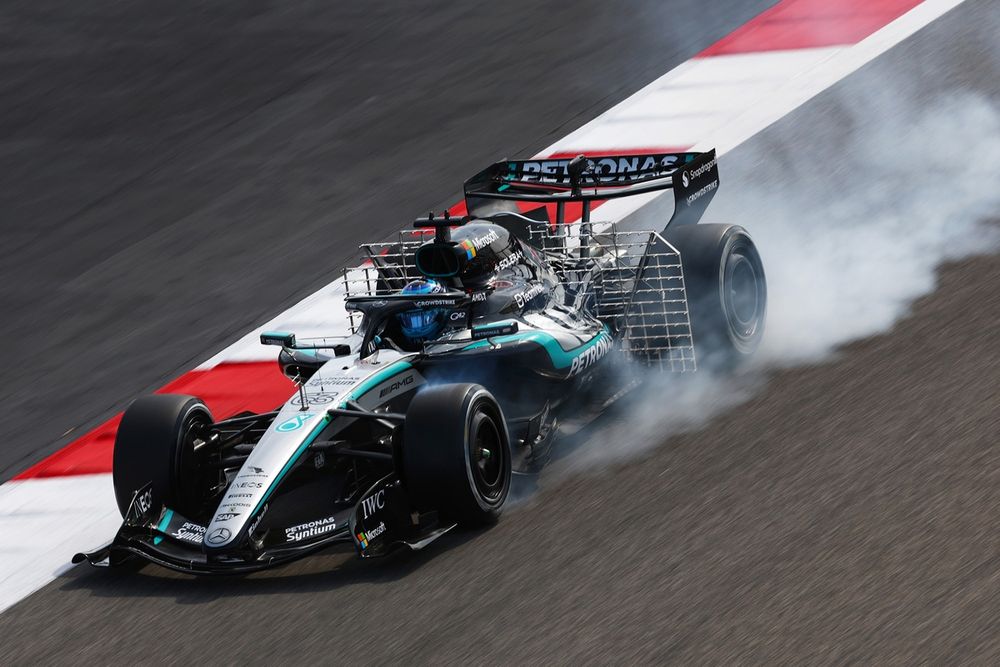
George Russell, Mercedes
Photo by: Joe Portlock / LAT Images via Getty Images
In defence of the FIA, the Williams team principal acknowledged that the governing body can never keep everyone in the paddock satisfied and that regulating F1 is an extremely difficult task, especially at the start of a new regulatory cycle.
“To defend the FIA, the FIA has a hard job. You have teams filled with a thousand individuals thinking about how we can interpret the rules in a clever way. Let’s be blunt about it, that’s what teams do, and that’s why we love the sport. It is difficult [for the FIA]. There’s 20-odd people trying to fight against 10,000 out there on the grid. It’s probably not that amount, but you get the idea behind it.
“The FIA do a really good job, generally speaking, of finding the boundary between clever interpretation and allowing it to go forward. What I’m stating here is that we need to take care that it’s not just politically driven by other teams that didn’t think of clever innovations now, and the FIA’s job is to take a correct line of action on all of this.”
We want your opinion!
What would you like to see on Motorsport.com?
– The Motorsport.com Team
Disclaimer : This story is auto aggregated by a computer programme and has not been created or edited by DOWNTHENEWS. Publisher: motorsport.com