By Anatoly Kurmanaev, Henrik Pryser Libell and Simon Romero
The decision by Maria Corina Machado, the Venezuelan opposition leader, to leave her homeland after more than a year in hiding has drastically raised the stakes in the unfolding stand-off over Venezuela’s future.
Machado said in an audio message published by the Nobel Peace Prize committee that she had left Venezuela for Oslo to participate in festivities surrounding the awarding of this year’s prize to her.
Nobel Peace Prize laureate Maria Corina Machado reacts to the crowd gathered in front of the Grand Hotel, in Oslo, Norway.Credit: AP
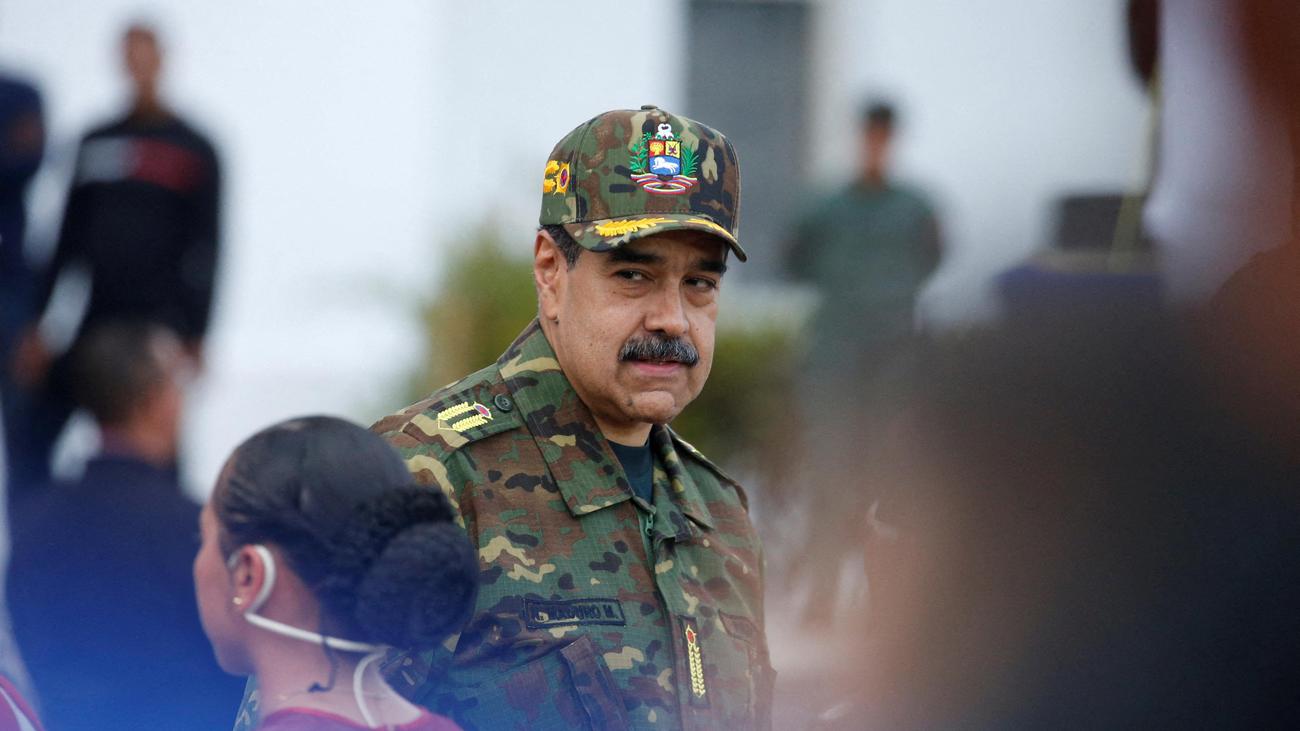
The news thrust Machado into the global spotlight, electrified her movement and re-established her as a major player in an escalating game of brinkmanship between President Donald Trump and the Venezuelan leader, Nicolas Maduro.
Machado, 58, received the Peace Prize for mounting a victorious election campaign last year against Maduro, who ignored the results, declared himself the winner and repressed those who challenged his claim to power.
She missed the award ceremony on Wednesday, eventually arriving in Oslo in the middle of the night. On Thursday morning, she appeared in public for the first time in 11 months, waving to supporters from a hotel balcony before leaving the hotel to shake their hands.
Her appearance has added a dramatic twist to a powerful political narrative: the courageous Venezuelan opposition leader, recognised with one of the world’s most prestigious awards for her struggle for democracy, reunited with supporters during a crucial moment in her country’s modern history.
Longer term, Machado’s decision carries major political risks for the Venezuelan opposition, whose previous leaders have withered into relative obscurity after going into exile.
Venezuela’s government, which has jailed hundreds of Machado’s supporters, has said the opposition leader would be considered a fugitive if she left the country. Analysts and Venezuelan government insiders say it is highly unlikely that Maduro would allow Machado to return to the country in the absence of a deal that would keep his government in power.
“This is a really vital moment for Maria Corina,” said Geoff Ramsey, a Washington-based Venezuela expert at Recorded Future, a global threat intelligence company. “The obstacle she faces now is to ensure that she can turn this moment into a trigger for change, rather than simply long-term exile.”
Machado’s re-emergence on the world stage comes as Trump faces a choice on how to proceed with his pressure campaign against Maduro, whom the Trump administration has labelled the head of a terror organisation seeking to flood the United States with drugs and criminals.
Trump has amassed the largest naval armada in the Caribbean since the 1962 Cuban missile crisis and has been making increasingly explicit threats against Maduro. On Wednesday, Trump said, without providing further details, that the United States had seized a tanker off the Venezuelan coast.
But the two leaders also spoke by phone last month, and the Venezuelan government this month restarted accepting deportation flights from the US, fuelling speculation that the two sides may settle the conflict diplomatically.
It is unclear how and when Machado left Venezuela. A Wall Street Journal report, citing US officials, claimed that she left Venezuela by boat on Tuesday.
Venezuelan officials in private claim that she had left days earlier with the knowledge of the government. The officials requested anonymity because they were not authorised to speak publicly.
Machado’s representatives have not commented on the date or manner of her departure.
She has long rejected any negotiations with Maduro’s government, arguing that he would leave power only by force.
Machado has been a steadfast supporter of Trump’s military pressure campaign against Maduro, and she has avoided criticising American airstrikes against suspected drug traffickers at sea, which many legal experts say amount to extrajudicial killings.
Now abroad, Machado will have an opportunity to more effectively lobby the US government and other international allies for her cause, analysts said.
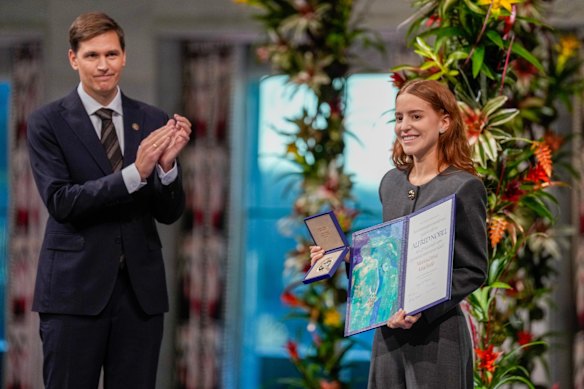
Machado’s daughter, Ana Corina Sosa Machado, accepted the award on her mother’s behalf on Wednesday.Credit: AP
“The US policy toward Venezuela is moving quickly, and this is an opportunity for Machado to try to steer Washington’s strategy more clearly toward regime change,” Ramsey said.
A higher public profile would also bring greater public scrutiny to her policies and statements, said Christopher Sabatini, a Latin America expert at Chatham House, a London-based international affairs research group.
Explicit support for violent actions without the application of due process risks exposing Machado to criticism of warmongering and reducing her international support, he said. At the same time, insufficient support for Trump’s policies risks drawing the ire of a notoriously thin-skinned president.
“She is a de facto spokeswoman for democracy in Venezuela, and how she is going to thread this needle, I don’t know,” Sabatini said.
Machado has already come under scrutiny for exaggerating Maduro’s ties to drug-trafficking as the Trump administration tries to make the case that Venezuela – a relatively minor player in the drug trade – is flooding the US with deadly drugs.
Machado has also waded into highly contentious political disputes in the US related to Trump’s false claims that he won the 2020 presidential election. In recent weeks, she has amplified debunked claims that Venezuela’s government rigged elections in the US.
Most Viewed in World
Disclaimer : This story is auto aggregated by a computer programme and has not been created or edited by DOWNTHENEWS. Publisher: www.smh.com.au