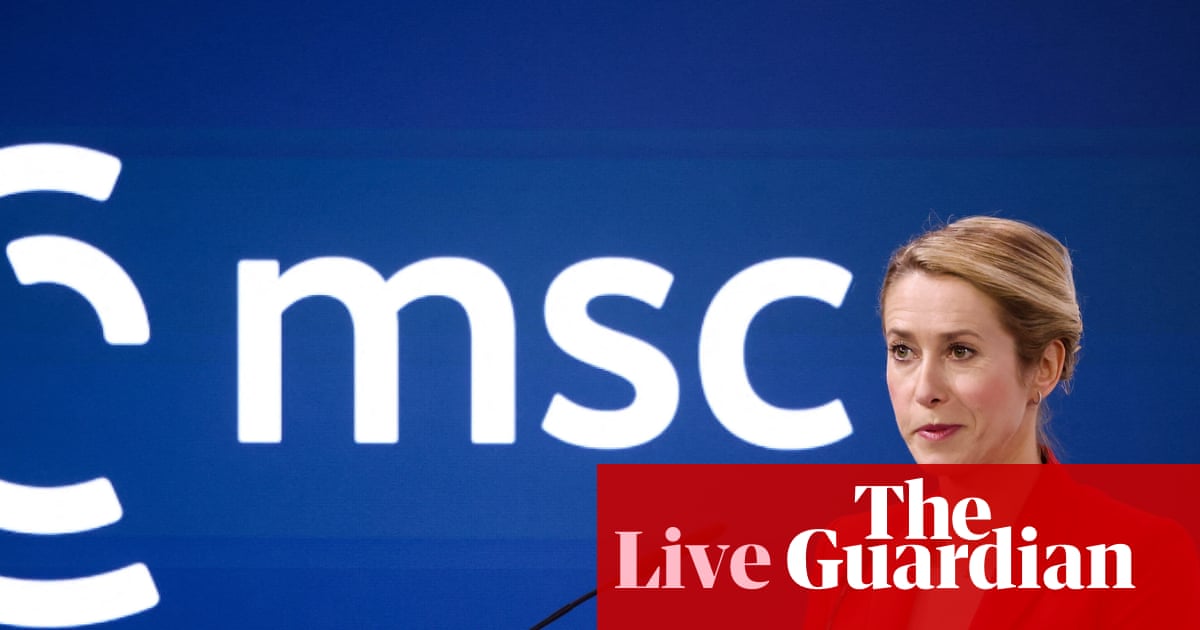
EU’s Kallas is speaking on the main stage now.
In her first response to Rubio’s speech yesterday, he somewhat snarkily says that “contrary to what some may say woke decadent Europe is not facing civilizational erasure,” and says that many countries still “want to join our club – and not just fellow Europeans,” pointing to Canada.
She says that Russia continues to pose a significant challenge.
“This starts in Ukraine, but we know that Russia’s endgame is not Donbas,” she says, pointing to continuing attempts to sabotage or undermine EU countries.
She continues:
“But let’s be clear-eyed about Russia: Russia is no superpower. After more than a decade of a conflict, including 4 years of full-scale war in Ukraine. Russia has barely advanced beyond the 2014 lines, and the cost? 1.2 million casualties.
Today, Russia is broken, its economy is in shreds. It is disconnected from the European energy markets and its own citizens are fleeing.
In fact, the greatest threat Russia presents right now is that it gains more at the negotiation table, then it has achieved on the battlefield.”
Nato’s deputy secretary general Radmila Šekerinska picks up Haddad’s point.
She says that the last Nato summit in The Hague agreed not just on increased defence spending, but also on ramping up own production.
She says:
“This will be repeated in Ankara now: we need to produce more, and we need to produce more everywhere.
We need more European production, we also need more production on the US side.
If you look at the numbers, and especially if you look at the numbers on key capabilities, which are urgent in Ukraine, like air defence, we don’t have enough, period.”
She adds:
“Unfortunately, most of our stockpiles are not up to the task. We went to industry, … and the only place where these capabilities were available was in the US stockpiles.
I was in Norway recently, I visited a company that does all of its exports to the US, and then the US has additional production and many of European countries buy it.
These are the links that defence companies have developed.If we try to dismantle them, we end up weaker and not stronger, so the call in the Ankara summit will be very much we need to produce more and for this, we need better regulation, we need speedier processes, and this is very much where Nato focuses on how do we make interoperability standards.”
France’s Haddad also pushes for “European preference” on defence purchases, arguing it’s just “common sense.”
He says when you’re increasing defence budgets – often by cutting other spejnding – you cannot then spend it abroad to “subsidise a factory in Kentucky” in the US.
“This makes no sense,” he says.
He says it’s also about the control of use, export, and technological knowhow that comes with it.
“We know that when you buy a weapon from another area, it comes with strings attached. It comes with [some] fine print on how and when you can use it. So all of this is absolutely critical.”
France’s Europe minister Benjamin Haddad has a slightly different take on the speech though, lamenting that four Europeans on a panel are expected to respond to Rubio’s speech a day later.
“We should not either be relieved or shocked by this or that speech. I think the worst lesson we could draw from this weekend is to say, well, I can cling to some love words that I heard in part of his speech and push the snooze button,” he says.
He says the EU should instead “focus on ourselves,” including on rearmament and improving its competitiveness.
“This is also the best way in the long run to reshape and maybe salvage the transatlantic relationship: to make it more balanced, more mature, with two pillars that are equal rather than looking for love or thinking about how the Americans are going to talk about us.”
Kallas, a former Estonian prime minister, also offers a bit more on Rubio’s speech, as she says “there were messages for us, and they were messages for the public in America.”
“For me, every time I hear this European bashing – it’s very in fashion right now – I’m thinking of what is the alternative and, and really, I mean, all the best or good things that we got from Europe, and all the good things that Europe actually represents.”
But she says she gets some reassurance from Rubio’s comments:
“The message that we heard from there is that America and Europe are intertwined; have been in the past and will be in the future. I think this is important. It is also clear that we don’t see eye to eye in all the issues and that this will remain the case as well, but I think we can work from there.”
EU’s Kallas is speaking on the main stage now.
In her first response to Rubio’s speech yesterday, he somewhat snarkily says that “contrary to what some may say woke decadent Europe is not facing civilizational erasure,” and says that many countries still “want to join our club – and not just fellow Europeans,” pointing to Canada.
She says that Russia continues to pose a significant challenge.
“This starts in Ukraine, but we know that Russia’s endgame is not Donbas,” she says, pointing to continuing attempts to sabotage or undermine EU countries.
She continues:
“But let’s be clear-eyed about Russia: Russia is no superpower. After more than a decade of a conflict, including 4 years of full-scale war in Ukraine. Russia has barely advanced beyond the 2014 lines, and the cost? 1.2 million casualties.
Today, Russia is broken, its economy is in shreds. It is disconnected from the European energy markets and its own citizens are fleeing.
In fact, the greatest threat Russia presents right now is that it gains more at the negotiation table, then it has achieved on the battlefield.”
in Munich
Guten Tag, as we open the third – and final – day of the Munich Security Conference.
We have a fairly short programme today, with Europeans reacting to US secretary of state Marco Rubio’s speech yesterday, and thinking about further reforms to the EU’s economy and competitiveness.
Can you think of a better Sunday morning?
We will hear from the EU foreign policy chief, Kaja Kallas, ECB president Christine Lagarde, and former Nato secretary general Jens Stoltenberg, among others.
It’s Sunday, 15 February 2026, it’s Jakub Krupa here, and this is Europe Live.
Good morning.
Disclaimer : This story is auto aggregated by a computer programme and has not been created or edited by DOWNTHENEWS. Publisher: theguardian.com