By Tom Ryan
FICTION
What’s with Baum?
Woody Allen
Swift Press, $39.99
Woody Allen has one of the most distinctive voices in popular culture. Not just the sound of it, but the way he talks and what he talks about. The nervy, hesitant phrasings, the anxious asides, the self-deprecatory gags, the delicious sprinkling of Yiddishisms, the preoccupation with his mortality, the awareness of the cruel absurdities forever waiting in ambush. To hear him speak, or to read his prose, is to find life being transformed into an ongoing stand-up routine, sometimes uncomfortably, often hilariously. His is an art that is both familiar and unique, that of a stricken Everyman whose only weapon against the darkness is his wit.
Whether the contexts in which we encounter the Allen voice belong to non-fiction (his memorable stand-up routines, his talk-show interviews, his numerous books, such as Getting Even and Without Feathers, filled with comic odds and ends) or fiction (his work for the theatre – most famously Play It Again, Sam – and the dozens of films he’s written and directed over almost six decades), we’ve come to know the schtick so well that when others mimic it, we recognise immediately what they’re doing.
Set his turns as Alvy in Annie Hall (1977) or as Isaac in Manhattan (1979) or as Joe in Radio Days (1987) alongside John Cusack’s stylised performance in Bullets Over Broadway (1994) or Kenneth Branagh’s in Celebrity (1998) and the impression becomes irrefutable. The Allen patter can also frequently be found in the way supporting actors deliver their lines. Like Julie Kavner, playing Alvy’s mother in Annie Hall, exclaiming to her adolescent son’s obsessive worrying about the end of the world: “What is that your business?”
It’s the way he thinks, who he is. He’s like a latter-day version of Shakespeare’s Fool, a jester winking wisely at the world, poking fun at himself at the same time as he critiques the foolishness all around. And, God knows, he has plenty of material to work with. We might mistake ourselves for his betters, but he knows best.

Woody Allen at the 2023 Venice Film Festival.Credit: Getty Images
Now 90, he’s been in the spotlight for more than seven decades, writing jokes for others as a teenager before establishing a stand-up career of his own. There have been attempts to silence him, following Mia Farrow’s accusation in 1992 that he’d sexually molested their adopted daughter, Dylan, when she was seven, a charge which she made soon after learning of his affair with her (and Andre Previn’s) adopted adult stepdaughter, Soon-Yi Previn, and which he’s repeatedly denied ever since.
He provides an extended rebuttal in his otherwise engaging 2020 autobiography, Apropos of Nothing, tellingly the only time the jester appears to lose his cool. He spends about a third of the book making his case about what really didn’t happen and how much evidence there is to indicate that a vengeful Farrow fabricated the whole affair.
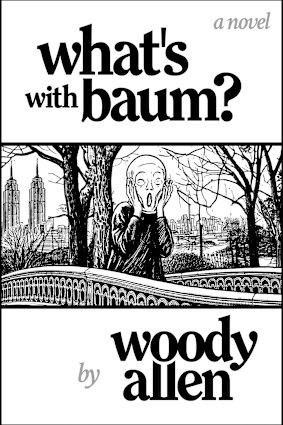
But, as the winning What’s with Baum? (dedicated to wife Soon-Yi) amply illustrates, his voice has lost none of its spark. And the answer to the title’s question will be apparent to anyone familiar with his career even before they delve beyond its eye-catching cover, which features Edvard Munch’s iconic figure from The Scream transplanted to Central Park. A perfect encapsulation of Asher Baum’s state of mind (as it was of Munch’s).
A recurring view of Allen’s work all along has been its autobiographical aspect. While he’s always denied this, he’s simultaneously seemed to be endorsing it. His 1997 film Deconstructing Harry, for example, has him playing a writer who comes to understand that the only way he can make sense of himself is through his art. What’s with Baum?, Allen’s first novel – you see, it’s never too late! – also reads as a series of meditations about his own life. Fictionally rearranged, but virtually unmistakable.
Baum is a writer who constantly converses with himself, the only person who really understands him; or at least that’s what he thinks. He’s seen by some to be past his prime, although it’s clear between the lines that he’s never really climbed any kind of peak. Which is the kind of observation that reflects much of the disavowal of Allen’s career since he fell foul of an unofficial blacklist, and especially of his more recent work, including Crisis in Six Scenes (2016), the harshly judged TV series he made for Amazon, the hugely undervalued Wonder Wheel (2017), with Kate Winslet, the engaging A Rainy Day in New York (2019), with Timothee Chalamet, and the flawed but likeable French-language Coup de chance (2023), a Paris-based pondering about the vagaries of fate.
Allen with Diane Keaton in Annie Hall. As in his films, his first novel feels partly autobiographical.Credit: Getty Images
Now middle-aged, Baum has reluctantly allowed himself to be uprooted from his beloved Manhattan for a life in the Massachusetts countryside with third wife Constance and her adult son, Thane (!). Thane’s also a writer and, to Baum’s jealous chagrin, his debut novel has just been released to great popular acclaim. Baum’s resentment is only exacerbated by the fact that his own publisher has lost interest in him, and to make matters worse – Allen again mischievously drawing on his own experiences with public disfavour – there’s even talk around that he’s guilty of an impropriety with a journalist who’d been interviewing him.
Baum’s brother, whom he suspects of having an affair with Constance, regards him as “a lost poet with pipe dreams and a siege mentality”. For his part, Baum has had doubts about his future ever since “it became clear to him that the tiny space he took up in the grudging universe, the universe would one day want back”. He’s since learned to see “the abyss in every mole, cough and hangnail” and himself as “a meaningless agglomeration of cells killing time between one abyss and another”.
The novel is pervaded by an almost overwhelming air of weltschmerz (melancholy) and the only time Baum perks up is when he meets Thane’s girlfriend, who is the spitting image of his second wife, the love of his life. Allen makes sure we understand his character’s subsequent yearnings for exactly what they are, his perspective again providing a compellingly comic study of a protagonist whose self-doubting verges on a self-loathing with paranoid tendencies. A subject that is very much his business.
The Booklist is a weekly newsletter for book lovers from Jason Steger. Get it delivered every Friday.
Most Viewed in Culture
Disclaimer : This story is auto aggregated by a computer programme and has not been created or edited by DOWNTHENEWS. Publisher: www.smh.com.au